








Greek mythology is a world of gods, monsters, and heroes, each story steeped in symbolism that reflects human nature, society, and the cosmos. Among these myths, the tale of the Minotaur and King Minos stands out as a powerful allegory of divine punishment, human hubris, and the consequences of unchecked pride.

The Birth of the Minotaur: Hubris and Divine Retribution
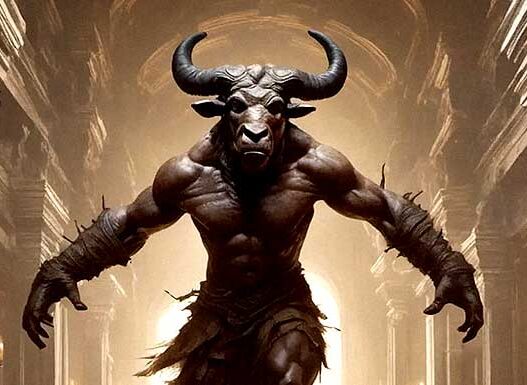
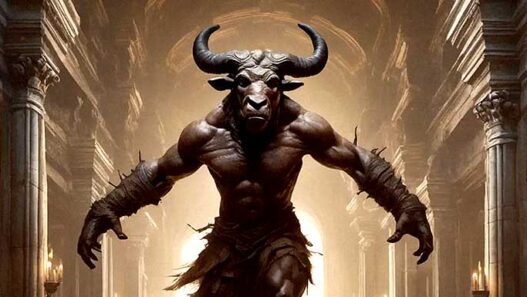
The Minotaur, a fearsome creature with the body of a man and the head of a bull, was not simply a monster born of chance, it was a direct consequence of human arrogance and divine intervention.
According to the myth, King Minos of Crete demanded a sign from the sea god Poseidon: a magnificent bull to sacrifice in tribute. When Poseidon granted him the bull, Minos, captivated by its beauty, refused to sacrifice it.
This act of disobedience angered the gods. In retaliation, Poseidon cursed Minos’ wife, Pasiphaë, causing her to fall in love with the bull. From this unnatural union, the Minotaur was born, a living symbol of Minos’ hubris and the divine punishment it invited.
For a full retelling of the hero’s daring journey, read my blog on the Story of Theseus and the Minotaur
The King Behind the Myth
King Minos was a ruler of Crete; he was a symbol of authority, justice, and divine mandate. According to myth, he was the son of Zeus and Europa, which made him semi-divine, a mortal king with a direct connection to the gods.
This lineage granted him both power and responsibility, but it also set him up for scrutiny by divine forces.
Minos is often depicted as a strong but authoritarian ruler, known for his strict justice. Some myths even suggest he became a judge of the dead in the Underworld after his death, reflecting his association with law and order.

Mythological Minos
Asterion, the king of Crete, raised the three sons of Zeus and Europa: Minos, Sarpedon, and Rhadamanthus. According to the Odyssey (Book XIX, l. 203) and Plato’s Laws (624), Minos would consult Zeus every nine years, receiving guidance to ensure his laws reflected divine will.
Tragedy struck when Minos’ son Androgeos won the Panathenaic Games in Athens. King Aegeus, jealous and fearful of his rising fame, sent Androgeos to Marathon to face a bull, where he was killed. Enraged by his son’s death, Minos set out for Athens to demand justice.
On his journey, he stopped at Megara, ruled by King Nisos. Learning that Nisos’ strength came from a magical lock of hair, Minos gained the love of Scylla, Nisos’ daughter.
With her help, he cut off her father’s hair, enabling him to conquer the city. Afterward, Minos punished Scylla for betraying her father, tying her to a boat and dragging her to her death in the sea.
When Minos finally reached Attica, he called upon Zeus to punish the city, and the god responded with plague and famine. Seeking relief, the Athenians consulted an oracle, which instructed them to comply with any demands from Minos. In retribution, Minos required Athens to send seven boys and seven girls every nine years to Crete as sacrifices to the Minotaur, the monstrous offspring of Minos’ wife, Pasiphaë, and the Cretan Bull, sent by Poseidon after Minos refused to sacrifice it.
To contain the Minotaur, Minos commissioned Daedalus, the master architect, to construct the labyrinth, an elaborate maze from which no one could escape. The beast was eventually slain by the hero Theseus, guided by Minos’ daughter Ariadne, who provided the thread that allowed him to navigate the labyrinth and defeat the monster.
The Symbolism of the Minotaur – Check out the mythological and psychological meaning of the Minotaur, from primal instincts to heroic confrontation.
Symbol of Fate and Confinement
To contain the Minotaur, Minos commissioned Daedalus, the master craftsman, to build the labyrinth, an intricate maze so complex that no one could escape. Beyond its function as a prison, the labyrinth symbolises the inescapable consequences of one’s actions, the complexity of fate, and the moral entanglement of humans and gods.
It is a physical manifestation of the idea that hubris leads to entrapment, both literal and figurative.
Theseus’ journey into the labyrinth further emphasises this point. By confronting the Minotaur, he navigates the web of fate, guided by intelligence and courage, ultimately restoring balance, but only temporarily, as the myth reminds us of the cyclical nature of human error and divine oversight.
The legend of King Minos is far more than a tale of gods and monsters, it’s a mythic exploration of power, pride, and the consequences of human choice under the watchful eyes of the divine. From his consultations with Zeus to the tragic fate of his son and the birth of the Minotaur, Minos’ story reveals how the ancient Greeks understood leadership, justice, and the weight of moral responsibility.
For hardcore readers eager who are looking for something serious, scholarly, and up-to-date check out this book on amazon Knossos: Myth, History and Archaeology, a rich resource that connects archaeological history with the Palace of Minos.