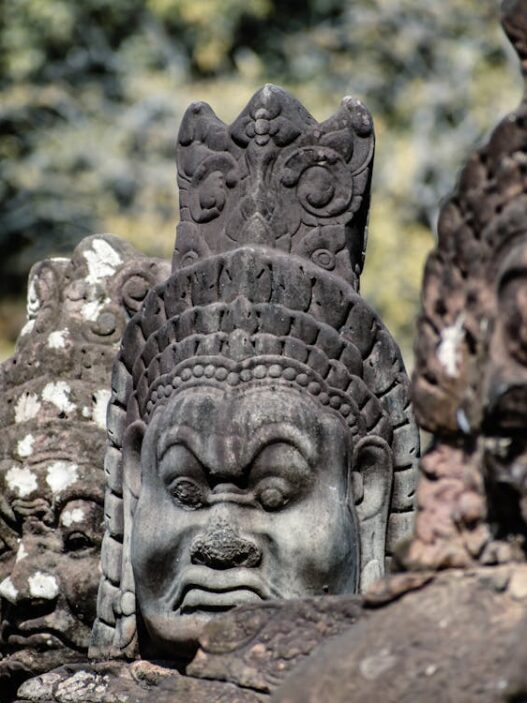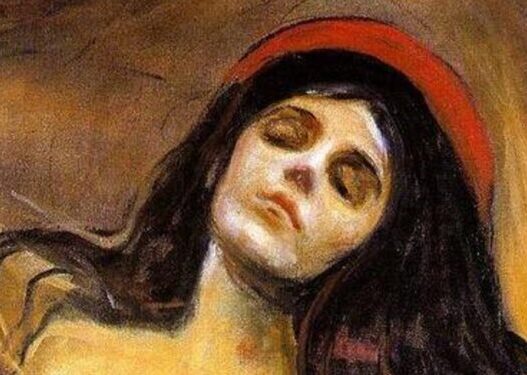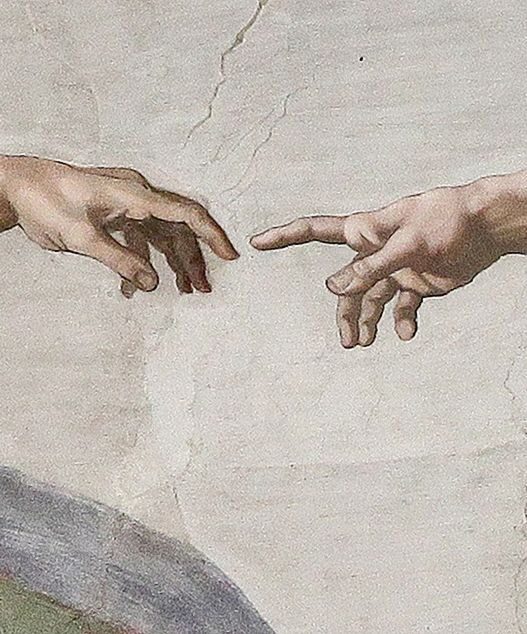








There is a painting you have stood in front of and felt something you could not explain. Not admiration. Not aesthetic appreciation. Something older than that. A recognition. As if the image already existed somewhere inside you before you ever saw it.
That feeling has a name. Carl Jung spent his entire life trying to understand it
Jung believed that the human psyche does not operate in isolation. Beneath our personal memories, our individual fears, our private obsessions, there is something deeper. A vast shared reservoir of images, patterns, and symbols that every human being carries regardless of where or when they were born. He called it the collective unconscious. And he believed that art, in all its forms, is the place where that unconscious speaks most clearly.
This is not a comfortable idea. It means that when you stand in front of a painting and feel that inexplicable pull, you are not simply responding to clever composition or historical context. You are recognising something that belongs to the deepest layer of what it means to be human.
The artist did not put it there deliberately. It came from somewhere older than intention.
Understanding Jung will change how you read yourself.
Who Was Carl Jung and Why Does He Matter to Artists?
Carl Gustav Jung was born in Switzerland in 1875 and died in 1961, having spent nearly nine decades trying to understand what happens in the parts of the human mind we cannot see. He began his career as a close collaborator of Sigmund Freud, the father of psychoanalysis, and for a time the two men were the most important relationship in each other’s professional lives. Then, in 1912, they broke irrevocably.
The reason for that break matters enormously for anyone interested in art and symbolism. Freud believed the unconscious was primarily a repository of repressed personal experiences, mostly sexual in nature. Jung thought this was far too small an idea. He had been studying mythology, folklore, alchemy, religious texts, and the dreams of his patients from around the world and he kept finding the same thing. The same images. The same patterns. The same symbolic structures appearing in cultures that had never had contact with each other.
A patient in Zurich dreaming of a solar phallus. The same image in a two-thousand-year-old Mithraic liturgy. A medieval alchemical text describing a king dissolving in a bath. A modern patient describing the same image in a nightmare. These could not be personal memories.
They had to come from somewhere else.
Jung concluded that the human psyche has layers. The outermost layer is consciousness, the part we think of as ourselves. Beneath that is the personal unconscious, where Freud was right, the repressed memories and unprocessed experiences. But beneath that is something neither Freud nor anyone before Jung had properly named.
The collective unconscious, which is often described as a layer of the psyche that is not personal at all. A layer we are born with, shared by all humans, structured by patterns that appear in every mythology, every religious tradition, every art form across history.
This is why Jung matters to artists and to anyone who studies art. Because if he is right, art is not merely self-expression. Art is the place where the collective unconscious surfaces. The artist reaches down into that shared depth and pulls something up. And the viewer, standing in front of the painting or the sculpture or the poem, recognises it. Not because they have seen it before. Because they carry it already.
His later work on symbols is explored fully in Jungian Symbolism: Man and His Symbols, which unpacks the framework he spent his final years developing.
My first experience of Jung was seeing one of his intricate mandalas. I remember the moment clearly. There was an immediate pull, the kind that bypasses thinking entirely and goes somewhere older. My first instinct was the one most people have: I read it as a spiritual object. Sacred geometry. A devotional image. Something made for prayer or meditation or ritual.
But then I sat with it longer. And once I removed that immediate and natural connection to spirituality, something else came into focus entirely. I began to see it not as a religious symbol but as a map. A map of the soul.
What struck me was how it worked as a total image. Nothing in it was arbitrary. Every ring, every quadrant, every axis existed in precise relationship to everything else. And the longer I looked, the more I recognised in it the same quality I had noticed in my own inner life without ever having a name for it. The way a dream from years ago connects without warning to something that happened yesterday. The way a fear you thought you had resolved resurfaces in a different form, wearing different clothes but carrying the same weight. The way joy and grief can exist in the same moment without cancelling each other out.
Jung was mapping that. All of it. The fragments, the contradictions, the moments of inexplicable recognition. He was showing that they were not random, not noise, but part of a pattern. Completely interlinked, in the most beautiful way I could imagine.
That was the moment I understood what he was actually doing. Not psychology in the clinical sense. Something closer to cartography. A map of what it feels like to be a conscious human being moving through a life, with all the chaos and repetition and mystery that involves.
I have never looked at a mandala the same way since.

The Collective Unconscious and Archetypes
If the collective unconscious is the lake, archetypes are the shapes carved into its bed. They are the structures that give form to the unconscious content that rises to the surface in dreams, myths, and art.
Jung identified archetypes as universal symbolic figures and patterns that appear across all human cultures. They are not learned. They are not inherited through cultural transmission. They are, in Jung’s view, part of the basic hardware of the human psyche. The Great Mother. The Hero. The Trickster. The Wise Old Man. The Shadow. The Self. These figures appear in the mythology of ancient Greece, in the folk tales of sub-Saharan Africa, in the religious texts of India, in the dream journals of twentieth century Europeans. They predate any individual culture because they belong to the psyche itself.
What makes this idea so powerful for understanding art is that it explains why certain images feel universal. Why the image of a hero descending into darkness and returning transformed resonates across every culture that has ever produced stories. Why the labyrinth, the monster at the centre, the thread that guides you out, keeps returning in art and mythology across thousands of years. The full range of these recurring figures is explored in Mythological Creatures as Symbols of the Human Psyche, which maps the archetypes directly onto their most enduring visual forms.
The mythologist Joseph Campbell arrived at the same conclusions from a completely different direction.
His work on the hero’s journey confirmed Jung’s framework across world mythology. Precisely because these patterns are so consistent, The Symbolism of the Labyrinth in Myth and Art is one of the richest single case studies in how a single archetypal image has accumulated meaning across every culture that has touched it.

These are not coincidences. They are the collective unconscious expressing itself through the available symbolic vocabulary of each culture. The forms change. The archetype beneath them does not.
What is striking, furthermore, is that you do not need to know anything about Jungian theory to respond to these archetypes. The response is pre-intellectual. When you watch a film in which the hero descends into the underworld and returns changed, something in you responds to that before your critical mind has a chance to analyse it. When you stand in front of a painting of a labyrinth, something in you already knows what it means. That is the archetype speaking directly to the collective unconscious you carry.
Jung and God: “I Don’t Need to Believe — I Know
Of all the interviews Jung gave throughout his lifetime, one moment has never stopped making people stop and think. In a 1959 BBC interview that perfectly sums up the complex themes Jung articulates time and time again about religion and the human psyche, the interviewer asked him directly — “Do you believe in God?”
His answer was without hesitation.
“I don’t need to believe. I know.”
What Jung meant was actually far more humble than it sounds.
He wasn’t claiming a direct line to the divine. He wasn’t saying he had all the answers. What he was describing was something deeply personal. A force he had felt throughout his life that seemed to operate beyond his own will. Something that pushed back when he pushed forward. Something that redirected him when he was certain he knew best. Something that, more than once, completely upended his plans, only for things to turn out in a way he never could have engineered himself.
Here’s the thing about Jung and religion — he didn’t fit neatly into any camp.
He wasn’t a churchgoing Christian in the traditional sense. He wasn’t an atheist. He wasn’t a mystic chasing enlightenment. He was something harder to label.
A man who had looked so deeply into the human psyche that he had come face to face with something he couldn’t explain away, but had courage to admit this.
And that search wasn’t easy. Jung wrestled with these questions his entire life. Not from a place of doubt, but from a place of someone who had felt something real and was determined to understand it honestly, even when the answers were uncomfortable and didn’t fit neatly into the world’s existing frameworks.
Throughout his life and work, Jung observed that every culture, every civilisation, every human being across history had produced images of God. The human mind seemed to reach for the divine naturally. He called this the God-image, and he saw it as one of the most powerful and universal forces in the unconscious.
For Jung, that wasn’t proof that God was a human invention. If anything, it made him more convinced that the experience of God was real.
Why This Matters for How We See Art
So what does any of this have to do with art and symbolism?
Everything, actually.
Jung believed that the same unconscious forces driving his personal experience of God were the very forces that artists had been tapping into for centuries, often without realising it.
The symbols that appear again and again across cultures, across time, across mediums.
The light, the shadow, the serpent, the mother, the destroyer — these were the unconscious speaking and reaching out like tendrils into the sky.
And that’s exactly why, once you understand Jung, you can never look at a symbol the same way again.
The Shadow Self — The Dark Side We Refuse to See
Of all Jung’s concepts, the shadow is the one that most directly explains why we are drawn to darkness in art. Why we cannot look away from the monster. Why the villain in a story is often more compelling than the hero. Why certain paintings disturb us in ways we find difficult to articulate.
The shadow is the part of the psyche we refuse to acknowledge. It is formed in childhood as we learn which parts of ourselves are acceptable and which are not. The rage that was punished. The selfishness that was shamed. The darkness that was told to go away. It does not go away. It goes underground. It becomes the shadow.
And here is the thing Jung understood that most people resist: the shadow is not simply the bad parts of us. It is the parts we have decided are bad, which is a very different thing. The shadow contains not only our destructive impulses but also our unlived potential, our creativity, our power, the aspects of ourselves we were told were too much.
For many people, ambition is in the shadow. Sexuality is in the shadow. Anger, which is often the most honest emotion, is in the shadow.
When the shadow is ignored, it does not disappear. It grows stronger. It begins to operate from outside our conscious awareness, manifesting in what Jung called projection. We see in other people exactly the qualities we cannot accept in ourselves. The person who is most vehemently opposed to dishonesty is often the person most afraid of their own capacity for it. The person who is most certain of their own goodness is often the one with the darkest shadow.
Art has always known this. Long before Jung gave it a name, artists were depicting the shadow in the monsters, the villains, the dark doubles, and the creatures that live at the edges of the known world. The monster is never simply an external threat. It is the externalised inner one.
The shadow is a moral problem that challenges the whole ego-personality, for no one can become conscious of the shadow without considerable moral effort. To become conscious of it involves recognising the dark aspects of the personality as present and real. This act is the essential condition for any kind of self-knowledge. — Carl Jung
Precisely because of this, the mythological creatures that have endured longest in art are the ones that function as shadow figures. They are not simply scary. They are recognisable. They carry something of us.

What all of these share is that confronting them directly proves fatal or paralysing.
Perseus cannot look at Medusa.
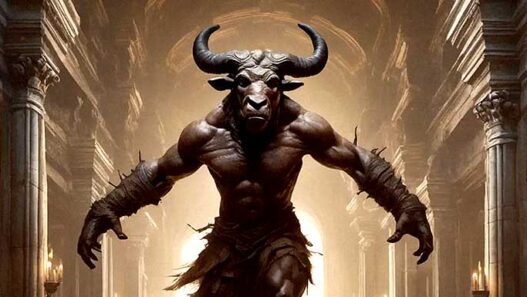
Theseus cannot face the Minotaur without a thread to find his way back.
Munch’s figure cannot look at the landscape.
The shadow, Jung argued, can only be approached indirectly. Through art. Through symbol. Through the very act of making something that allows the unacknowledged to become visible at one remove.
This is one of the deepest reasons art exists.
The Anima and Animus — The Hidden Opposite Within
Beyond the shadow, Jung identified another layer of the unconscious that has shaped art and mythology perhaps more than any other. The anima, which he described as the feminine principle within the male psyche, and the animus, the masculine principle within the female psyche.
To understand this, it helps to think about what Jung meant by masculine and feminine not as gender roles but as psychological orientations. The feminine principle in Jung’s framework is associated with receptivity, relatedness, feeling, imagination, the inner world. The masculine principle with action, rationality, structure, the outer world. Every human psyche, regardless of gender, contains both. The one that is suppressed, the one that is not given conscious expression, becomes the anima or the animus.
Download Collected Papers on Analytical Psychology by C. G. Jung
The anima in the male psyche is not simply an image of women. It is the man’s relationship with his own inner life. With feeling. With imagination. With the things that cannot be measured or achieved. When a man falls in love, Jung argued, he is not simply falling in love with the person in front of him. He is projecting his anima onto them. He is falling in love with his own inner feminine, which he has finally found somewhere to rest.
This sounds abstract until you look at how often art returns to it. The mysterious woman. The unknowable feminine. The muse. The goddess. The witch. The siren. These are not simply images of women. They are images of the anima. And their power comes from the fact that they represent something the artist is carrying inside themselves that they cannot otherwise access.
Moreover, the anima does not only appear as a positive figure. An unintegrated anima becomes volatile, destructive, irrational in the projection it generates. The femme fatale. The temptress. The figure whose beauty destroys. These are not images of actual women. They are images of what happens when the inner feminine is feared rather than engaged.
The animus operates differently in the female psyche. It manifests as inner conviction, as the voice of authority, as the tendency to be more certain than the evidence warrants. Unintegrated, the animus becomes the inner critic, the voice that says your work is not good enough, that you are not enough. The women in mythology who are defined by their relationship to a powerful or destructive male figure are often carrying an unintegrated animus, an inner masculine that has not yet been made conscious.
In both cases, the work of integration is the same. To recognise the projection. To withdraw it from the person or image onto whom you have cast it. To own the quality as yours. That is not a comfortable process. But it is, Jung argued, one of the most transformative things a human being can do.
When I think of the anima and animus, my mind begins to search for the multiple historical examples of a being containing both sides of the human psyche. And it always comes back to an exhibition I visited last year at the British Museum. Ancient India: Living Traditions.
There was a deity I stood in front of for a long time. Ardhanarishvara. A composite form of Shiva and his consort Parvati, the figure split precisely down the centre. The right half unmistakably masculine. The left half unmistakably feminine. Not blended, not ambiguous, but both. Fully. Simultaneously.
What moved me was how deliberate that division was. This was not a symbol of confusion or in-between-ness. It was a symbol of wholeness. The idea that to be complete, a being must contain its opposite. That the masculine is not whole without the feminine inside it, and the feminine is not whole without the masculine inside it.
Jung arrived at the same conclusion from a completely different direction, through dreamwork and clinical psychology and the study of alchemy. But here it was, carved in stone, centuries before Jung was born. The anima and animus were not a twentieth century psychological theory. They were an ancient human understanding that certain traditions never forgot.
Standing in front of that figure, I felt the same thing I feel when a piece of theory suddenly stops being abstract. It becomes true in your body before your mind has finished processing it.
The Persona — The Mask We Show the World
If the shadow is what we hide from ourselves, the persona is what we show to others. Jung took the word from the Latin for the masks worn by actors in classical theatre. The persona is the social face. The role we play. The version of ourselves we have constructed to function in the world.
This is not inherently dishonest. We all need a persona. It is the interface between the self and society. The professional persona, the parental persona, the public persona. Without them, every interaction would require exposing the full complexity of the inner life, which is neither practical nor appropriate.
The problem arises when we confuse the persona with the self. When we forget that the mask is a mask. When the role becomes more real to us than the person wearing it. This is what Jung called identification with the persona, and it is one of the most common sources of psychological suffering in the modern world.
The person who has spent thirty years being excellent at their job and has no idea who they are outside it. The person whose social image is so carefully maintained that their inner life has been almost entirely suppressed.
Art has been exploring this tension for as long as art has existed. The mask. The hidden face. The gap between appearance and reality. Between the surface of the painting and what lies beneath it.
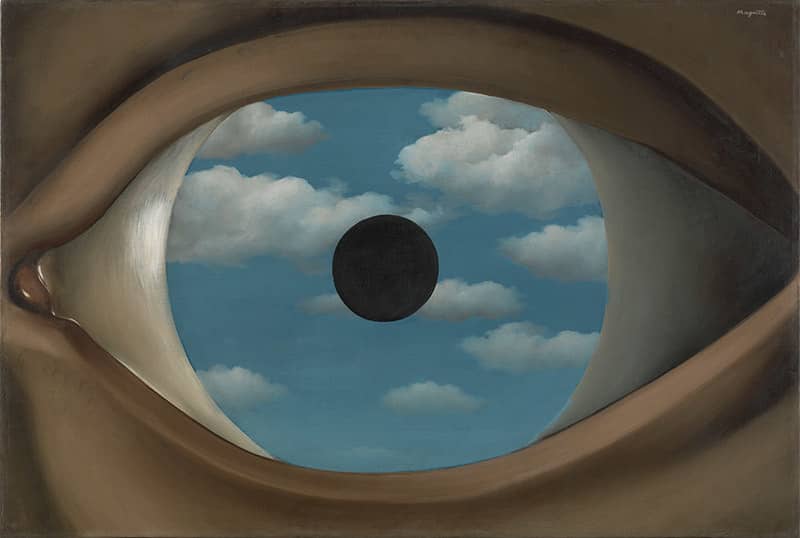
Magritte made the persona his entire subject, painting figures whose faces are perpetually obscured, replaced, or hidden from themselves and from us and the veil operates as both anima symbol and persona symbol simultaneously, concealing while simultaneously inviting us to consider what concealment means.

What is particularly interesting, furthermore, is how contemporary culture has amplified the persona problem in ways Jung could not have anticipated. Social media is essentially a persona construction machine. The carefully curated image. The life presented for consumption. The gap between the presented self and the actual self has never been wider or more constantly reinforced. Jung would have had a great deal to say about this.
Understanding the persona does not mean dismantling it. It means holding it lightly. Knowing where it ends and you begin. The healthiest relationship with a persona is one of conscious use, wearing it when it serves, setting it aside when it does not, and never making the mistake of believing it is the whole truth of who you are.
Individuation — The Journey Toward Wholeness
Everything Jung described, the shadow, the anima, the animus, the persona, points toward a single destination. He called it individuation. The process of becoming a whole person. Not a perfect person. Not a person without darkness or contradiction. A person who has integrated all of their parts, who knows their shadow and has stopped projecting it, who has withdrawn their anima or animus from the objects they have been cast upon, who wears their persona lightly and knowingly.
This is, Jung believed, the deepest goal of the human psyche. And it is a lifelong process, not an achievement. You do not become individuated and then stop. You continue. The unconscious continues to offer material. Life continues to present opportunities for integration. The work does not end, but the relationship with it changes. Instead of being driven by forces you cannot see, you begin to engage with them consciously.
What makes individuation so relevant to art is that the great symbolic traditions of human culture are essentially maps of this journey. Alchemy, one of the richest symbolic systems Jung studied, describes the individuation process through the stages of transformation from lead to gold, from the raw and undifferentiated to the refined and integrated. Every stage has its symbolic form. Every symbol encodes a psychological truth.
Alchemy was Jung’s favourite symbolic map of the individuation process, and understanding its stages transforms how you read its imagery in art.
The Ouroboros, the serpent eating its own tail, is the most ancient symbol of this completed cycle of self-knowledge, a wholeness that contains its own destruction and renewal
What is remarkable, in addition, is that you find this same journey structure in the mythological heroes whose stories have endured longest. The hero who descends into darkness, confronts what lives there, and returns transformed. This is not simply a narrative formula. It is the individuation process rendered as story. The hero is always us. The darkness is always the unconscious. The return is always integration.
This is why these stories have never stopped being told. Not because they are exciting, though they are. Because they describe something that the psyche recognises as its own deepest need.
Princeton University Press publishes Jung’s Psychology and Alchemy for anyone who wants to go directly to the primary source text.


The Collective Unconscious in Modern and Contemporary Culture
Jung died in 1961 but his framework did not. If anything, it has become more urgently relevant as culture has accelerated. Because the collective unconscious does not only express itself through ancient myths and classical paintings. It expresses itself through whatever symbolic vocabulary a culture currently has available. And that vocabulary, in our time, is enormous.
Consider what it means for the collective unconscious to operate in a world saturated with images, with social media, with advertising, with political messaging designed to trigger unconscious responses. Every brand is an archetype. Every political figure projects a persona and activates a shadow in their opponents. Every viral image that spreads faster than anyone can explain is doing so because it has touched something archetypal.
Understanding Jung in this context is not simply an academic exercise. It is a form of psychological literacy. It is the difference between being moved by symbols and knowing why you are being moved by them.
What each of these examples reveals is that the collective unconscious is not a historical phenomenon. It is not something that belonged to a more symbolic age and has since been replaced by rationalism. It continues to operate. It continues to shape what we make, what we consume, what we fear, what we desire, what we cannot look away from.
Romance as a cultural ritual is one of the clearest examples. Valentine’s Day Symbolises the Quiet Propaganda of Romance reads the annual ritual as a collective anima projection, the way society manufactures and sells an archetypal feeling back to us as a consumer event.
On another note, AI art is perhaps the most extraordinary development of all from a Jungian perspective, a machine trained on everything humanity has ever made, producing images from the collective unconscious more literally than any individual artist could
Dreams, the Unconscious, and the Art That Came From Them
Dreams were, for Jung, the primary language of the unconscious. Not coded messages to be deciphered, as Freud sometimes seemed to suggest, but genuine attempts by the psyche to communicate, to balance, to compensate for what consciousness has been avoiding. The dream does not lie. It simply speaks in a language we have forgotten how to read.
This is the language that certain artists have always worked in. Long before Jung published a word, artists were making work from the same depths that dreams come from. They were not illustrating psychological theories. They were simply going as far down into themselves as they could go and making visible what they found there.
The Surrealists, when they arrived in the early twentieth century, were doing this with explicit theoretical intent. Automatism, the technique of bypassing conscious control to allow the unconscious to direct the hand, was a deliberate method for accessing the same material that Jung was studying in his patients’ dreams.
The images that emerged, the melting clocks, the burning giraffes, the figures whose faces have been replaced by objects, are not arbitrary. They follow the logic of the unconscious with extraordinary precision. Dreams as Portals: How Surrealism Reimagines Myth and Memory explores this tradition in full, tracing the line from ancient dream symbolism through to twentieth century Surrealism.
What these works share is that they cannot be fully explained. You can describe their technical qualities. You can contextualise them historically. But the response they generate in the viewer exceeds any explanation. That excess, that remainder after all the analysis has been done, is the collective unconscious responding to itself. The unconscious in the painting meeting the unconscious in the viewer.
This is not mysticism. It is simply a more complete account of what art does than the purely formal or historical one.
The Tate documents the psychological underpinnings of Surrealism clearly. Their account of the movement is a useful companion for understanding how the movement connected to the unconscious tradition Jung was mapping simultaneously.
How to Start Reading Art Through a Jungian Lens
By this point you have the full framework. But knowing the theory and applying it are two different things. The good news is that reading art through a Jungian lens is not a technique that requires expertise. It requires a different kind of attention.
Start with your response rather than the object. Before you read the label, before you look up the artist, before you apply any context at all, notice what you feel. Not what you think you are supposed to feel. What you actually feel. What is the quality of the feeling? Where in your body does it sit? Is it recognition? Unease? A pull you cannot explain? That response is data. It is the unconscious registering something before the conscious mind has had a chance to intervene.
Then ask what the dominant image is doing. Not what it represents symbolically in an art historical sense, though that matters too, but what it is doing emotionally. Is it concealing something? Devouring something? Transforming? Descending? Rising? Fragmenting? These are verbs the unconscious understands. They correspond to psychological processes. The image of descent in art almost always corresponds to an encounter with the shadow. The image of transformation almost always corresponds to individuation. The image of the double almost always corresponds to the meeting of conscious and unconscious.
Finally, ask what the image does not show. The shadow, in Jung, is defined by absence. By what has been pushed out of the frame. The most revealing question you can ask of a painting is not what is in it but what is conspicuously absent. Who is missing? Whose perspective has been excluded? What darkness is the composition carefully avoiding? The answer will often tell you more than anything that is actually depicted.
These three questions, what do I feel, what is the dominant image doing, and what is absent, will open almost any work of art in ways that purely formal or historical analysis cannot reach. They will also, over time, open something in you. That is not a side effect of the Jungian approach to art. It is the point.

Further Reading
If this post has opened up questions about mythology, psychology, and the monsters we project onto the world, these posts go deeper:
The Symbolism of the Minotaur: Myth, Psychology and the Inner Beast, the companion piece to this post, exploring the same Jungian shadow dynamic through the figure of the Minotaur
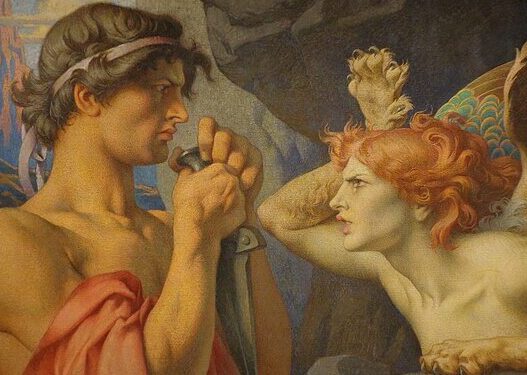
The Sphinx in Greek Mythology: Power and the Unanswerable Riddle, another powerful female mythological figure whose symbolic weight far outlasts the hero who bested her
Mythological Creatures as Symbols of the Human Psyche, the broader framework for understanding how mythology externalises internal psychological states
Carl Jung and the Hidden Language of Symbols, a foundation in Jungian psychology for readers who want to go deeper on the shadow, the Anima, and the concept of integration
The Symbolism of the Labyrinth in Myth and Art, on the symbolic logic of containment, power, and the structures we build to imprison what frightens us
8 Symbols Every Artist Should Know, including the severed head as a recurring symbol of transformation rather than violence