




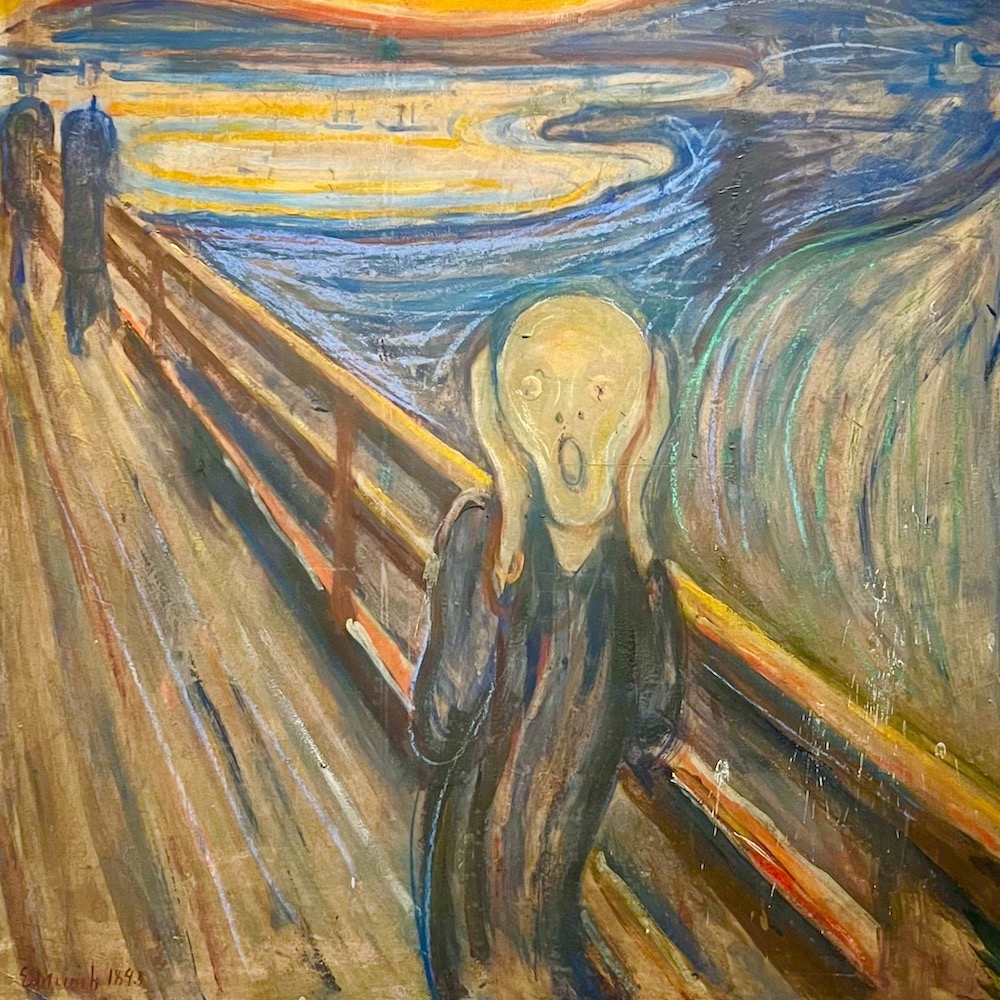
On a quiet evening in 1893, as the sun bled across the Norwegian sky, Edvard Munch walked along a fjord and felt something stir deep within him, a strange, trembling panic that seemed to echo through the air itself. The world around him pulsed with colour and sound, and in that moment, he sensed what he would later call “the scream of nature.”
From that haunting experience, Munch poured his emotions onto the canvas. Through swirling lines, fiery skies, and a figure frozen in terror, he created The Scream. If you want to understand the full breadth of his life and obsessions, Edvard Munch: Behind the Scream by Sue Prideaux is the most complete account written.
The Symbolism of The Scream Painting
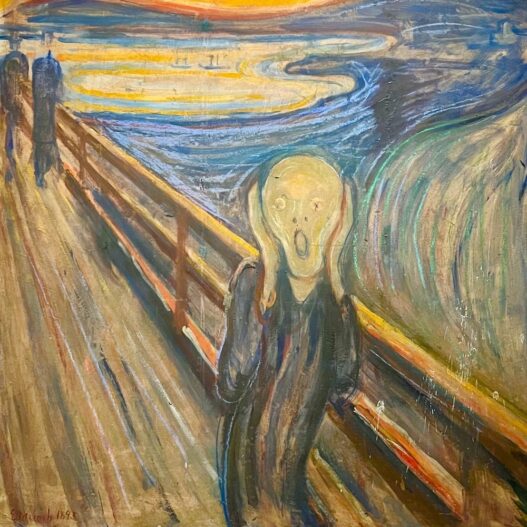
Edvard Munch once described the inspiration for The Scream: he was walking along a bridge at sunset when he felt “a vast endless scream passing through nature.” This statement reveals much about the work’s emotional essence. The distorted figure, mouth open in terror, embodies an inner cry of existential fear, a reaction not to a single event, but to the overwhelming pressures of modern life.
The fiery sky reflects not just a sunset but Munch’s inner turmoil. The contrasting curves and lines suggest a world that is unstable, echoing the fragile state of the human psyche. Through these visual elements, artist Munch turned invisible emotion into visible form.
If you look closely at the upper left corner of The Scream, you’ll see faint pencil handwriting that reads in Norwegian:
“Kan kun være malet af en gal Mand.”
(“Could only have been painted by a madman.”)
For years, art historians thought a vandal had scribbled it on the painting, but in 2021, scientists at Norway’s National Museum confirmed the handwriting matches Munch’s own.
The Symbols Hidden Inside The Scream
Most people see The Scream as a single image. That open mouth, that hollow face frozen in horror. But Munch built this painting layer by layer, and every element carries deliberate symbolic meaning.
We know this because he told us. Munch kept diaries, and in them he documented not just the moment that inspired The Scream but the obsessive way he returned to it. He painted four versions across seventeen years. He made a lithograph so the image could be reproduced and spread. He wrote the words “could only have been painted by a madman” onto the canvas itself. This was not a painter capturing a passing emotion. This was a man who understood exactly what he had made and refused to let anyone miss it.
Edvard Munch: The Modern Life of the Soul is the most thorough academic exploration of this obsession — essential reading if you want to go deeper.
This was a man who understood exactly what he had made and refused to let anyone miss it.
The Figure
The central figure is deliberately faceless and androgynous. Munch did not paint a specific person in a specific moment of fear- this was an attempt to place a mirror directly in front of us.
The elongated skull, the hands pressed to the cheeks, the body that seems to be dissolving into the landscape around it, swirling perpetually through the boundary between self and world. In psychological terms, it is the ego collapsing under the weight of anxiety. I find it almost unbearable to look at directly for that reason.
The Sky
The blood-red sky is not simply dramatic weather. Munch’s diary entry from 1892 describes looking out over Oslo fjord and watching the sky turn “red as blood.” Historians have since suggested this may have been the atmospheric afterglow of the 1883 Krakatoa eruption, whose ash cloud caused vivid red sunsets across Europe for years.
Whether Munch knew this or not, he transformed a natural phenomenon into the perfect visual metaphor for apocalyptic dread, the colours of the sky bleeds across the canvas.
The Bridge
The straight, rigid lines of the bridge cut directly against the swirling chaos of the landscape. The bridge represents the rational, ordered world.
Society, structure and normality stands on it, between two worlds, unable to belong fully to either. The two dark figures walking calmly in the background make this even more unsettling. They feel nothing. Only our central figure is breaking apart.
The Swirling Landscape
The undulating lines of the fjord, the hills, the sky create an uncanny perepective that curves and pulses as if the world itself is vibrating with anxiety. This was a radical departure from how landscapes were painted at the time. Munch was depicting how nature feels when the mind is unravelling.
The recognisable, everyday setting we discover on a daily basis, can be distorted into an alien realm where we can feel detached from simple creature comforts.
This technique would go on to define Expressionism as a movement. It was the same instinct that drove Van Gogh to paint the Starry Night.
The Colours
The warm tones of the sky clash violently with the cold blues and blacks of the fjord below. In colour psychology, this combination creates a sense of alarm and unease without the viewer quite knowing why.
Munch understood this instinctively. The painting manufactures a common fear does our eyes will notice before our mind settles into the dark context. Our body responds to colour instinctually.
What is the meaning of The Scream by Edvard Munch?
At its core, The Scream painting represents existential dread and the anxiety that accompanies self-awareness. E. Munch captures the universal experience of feeling powerless against overwhelming emotions. The central figure, stripped of identity, becomes a symbol for humanity itself, caught between fear and despair.
Does The Scream symbolise mental health?
Yes. Many art historians interpret the painting of scream as an expression of Edvard Munch’s own struggles with mental health. Munch’s diaries reveal that he suffered from anxiety and depression, and this painting visualises that internal struggle. In modern interpretations, The Scream has become a powerful symbol of mental health awareness and emotional vulnerability.
What was Munch trying to convey?
Munch artist sought to convey not just a moment of fear but a universal emotional experience, the “scream of nature.” He believed that art should express inner feelings rather than depict external reality. Through this approach, Munch pioneered a psychological form of art that deeply influenced Expressionism.
What are the four versions of The Scream?
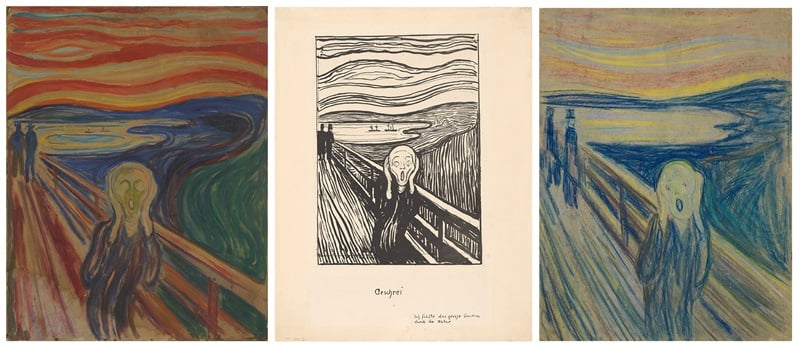
Edvard Munch created four main versions of The Scream between 1893 and 1910:
The 1893 tempera on cardboard (National Gallery, Oslo)
The 1893 crayon on cardboard (Munch Museum, Oslo)
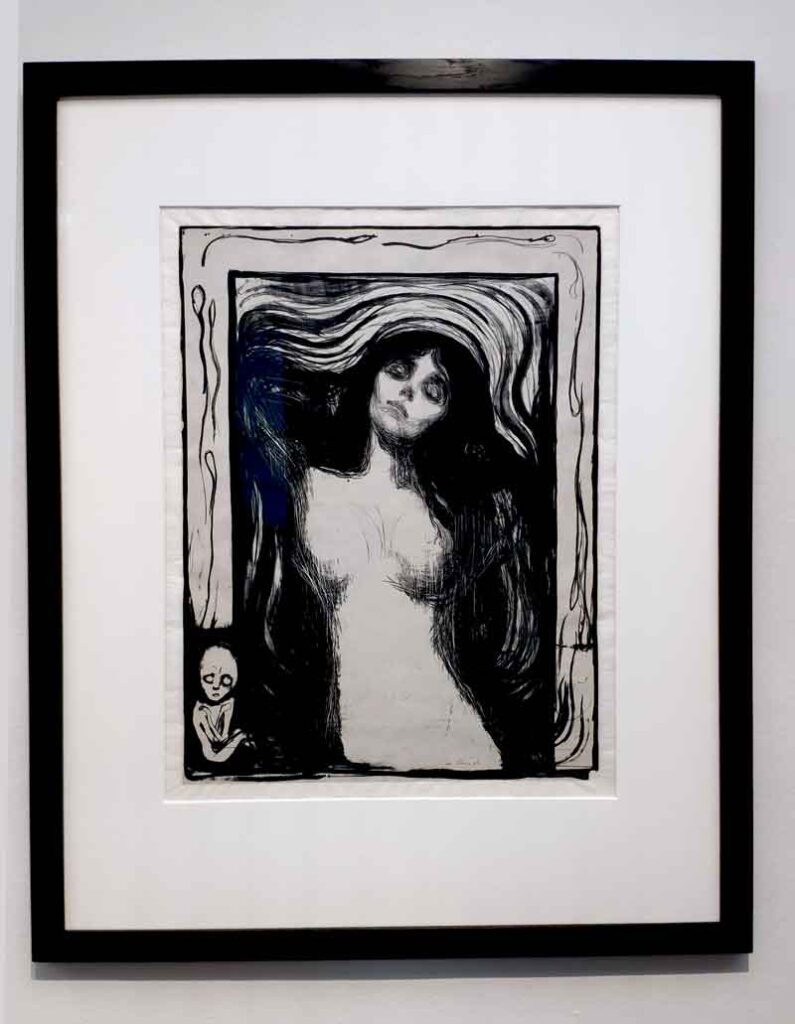
The 1895 lithograph print (various collections worldwide)
The 1910 tempera on board (Munch Museum, Oslo
Each version maintains the same haunting imagery but varies in colour and intensity, offering insight into Munch’s evolving emotions and techniques.
What is The Scream worth today?
In 2012, one version of The Scream painting sold at auction for nearly $120 million, making it one of the most expensive artworks ever sold. Its cultural impact and rarity continue to elevate its worth in both emotional and financial terms.
Why is The Scream so popular?
The Scream resonates across generations because it captures a feeling everyone can relate to, anxiety, fear, or existential panic. Its bold simplicity, universal theme, and iconic composition have allowed it to transcend time and culture, appearing in countless adaptations and references in popular media.
How does The Scream encourage critical thinking?
By depicting raw emotion rather than objective reality, Munch invites viewers to reflect on their own feelings and interpretations. The ambiguity of The Scream painting forces us to confront questions about our inner world, society’s pressures, and the fragility of human emotion.
Munch, Anxiety and the Art of Making Feeling Visible
Edvard Munch grew up surrounded by death. His mother died of tuberculosis when he was five. His sister Sophie died of the same illness when he was fourteen. His father, a devout and deeply melancholic man, suffered what Munch described as “religious madness.” Another sister was committed to a psychiatric institution. Death and mental illness were not abstract fears for Munch, they were the furniture of his childhood.
By his twenties, Munch was struggling with his own anxiety and what he described as “the demons that followed him.” He drank heavily. He cycled through intense, destructive relationships. In 1908, he suffered a complete nervous breakdown and checked himself into a clinic in Copenhagen, where he stayed for eight months.
His breakdown and recovery are documented in extraordinary detail in Edvard Munch: Behind the Scream and you will find the passages about his time in Copenhagen are unlike anything else written about an artist’s mental collapse.
The Scream was painted fifteen years before that breakdown, but it reads like a premonition.
What I find remarkable about Munch is that he did not try to hide any of this. At a time when artists were expected to depict beauty, mythology, or the natural world, Munch turned the camera on his own psychological interior and refused to look away. The Scream is not a painting about something that happened to him. It is a painting about what it felt like to be him, and that is precisely why it has outlasted almost everything else painted in the nineteenth century.
There is a reason it still appears on mugs, t-shirts, emojis and memes over a century later. It is because the feeling it depicts has not gone anywhere. If anything, it has intensified.
The Cultural Legacy of The Scream
Few paintings have escaped the gallery walls and entered everyday life the way The Scream has.
Since the 1990s, the image has been reproduced so many times that it risks becoming decoration, something you see on a novelty phone case and barely register. But strip away the familiarity and look at it again properly, and it still stops you cold. That is genuinely rare. Most art loses its power when overexposed. The Scream seems to absorb it.
In film and popular culture
Wes Craven borrowed the image almost directly for the Ghostface mask in the Scream horror franchise , an acknowledgment that Munch had already created the definitive visual language of terror. The painting has appeared in Home Alone, Bean, and dozens of other films, always deployed in the same way: as a shorthand for pure, wordless panic.
As a symbol of mental health
In recent decades, The Scream has been adopted widely as a symbol for anxiety and mental health awareness. There is something both appropriate and slightly uncomfortable about this. Munch suffered genuinely and seriously. His pain was real and often debilitating.
That his most raw expression of that pain has become a universally recognised symbol of the mental health conversation feels like a form of justice. His suffering made visible and meaningful for millions of people who recognised themselves in it.
The theft
In 1994, the most famous version of The Scream was stolen from the National Gallery in Oslo in a brazen daytime raid that took less than a minute. The thieves left a note that read: “Thanks for the poor security.” It was recovered three months later. In 2004, a second version was stolen at gunpoint from the Munch Museum. That one was missing for two years before being recovered in 2006, damaged but intact.
The fact that people were willing to steal it, twice, says something about how singular the painting is. You cannot replace it with another work. There is nothing else that does what it does.
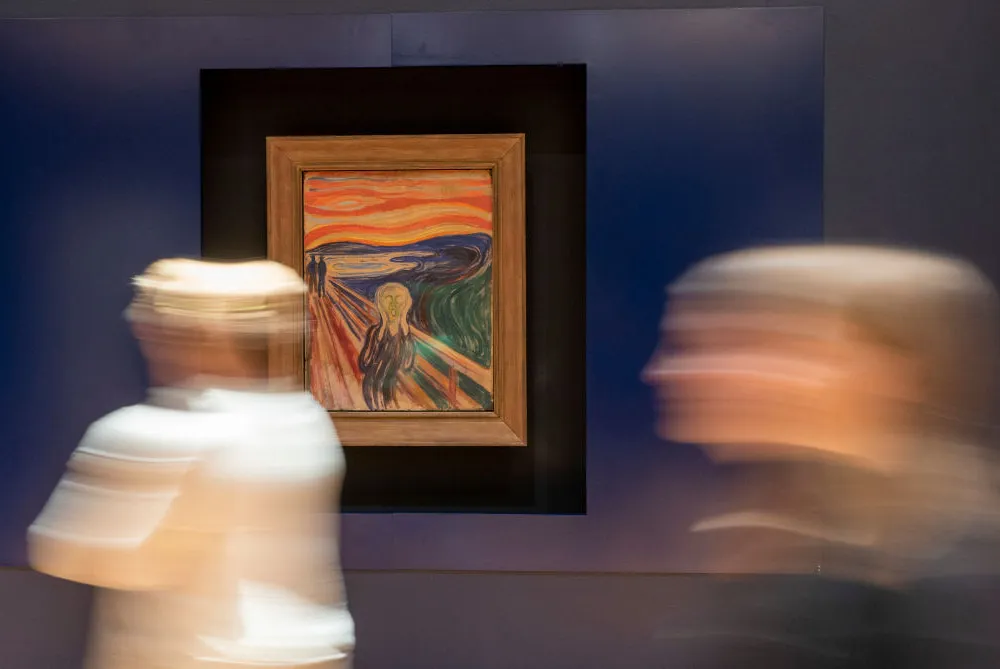
If you have never stood in front of the original, I would encourage you to make the trip to Oslo. No reproduction, including the ones in this post, prepares you for the experience of seeing it in person.
It is smaller than you expect, and far more devastating.
Other Noteable Works by Munch