The Kiss and the Terror of Complete Surrender

There is a reason The Kiss ends up on the walls of more bedrooms than almost any other painting in history. Not museums. Bedrooms. It isn’t there because it’s technically brilliant, though it is. It’s there because it shows us something we desperately want to believe is possible, and something we are, in the same breath, terrified of.
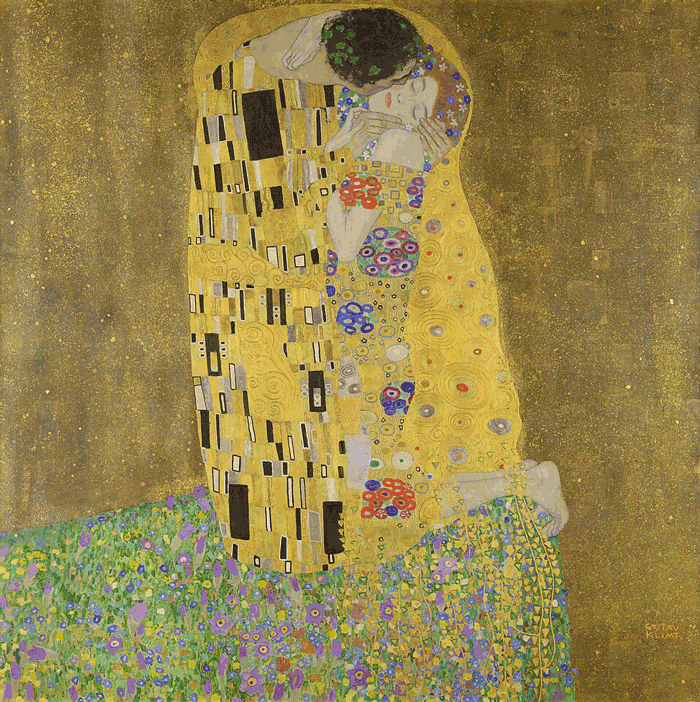
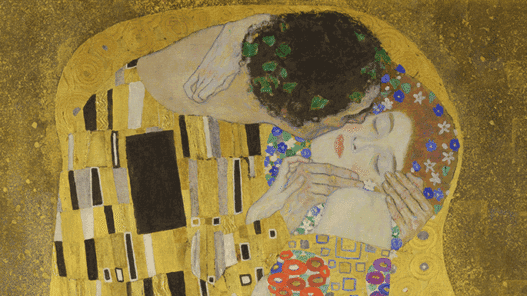
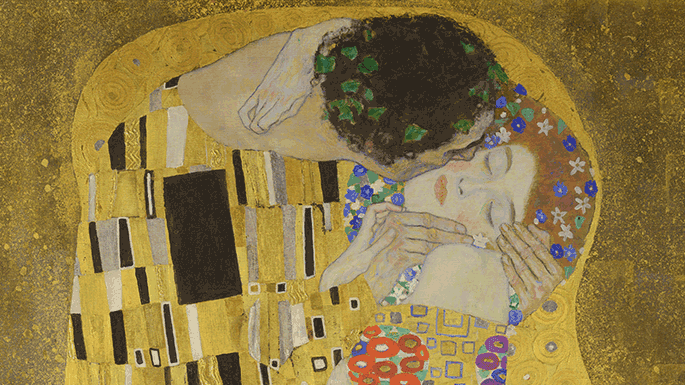
Gustav Klimt The Kiss 1907-08 oil and gold leaf on canvas Belvedere Museum Vienna Gustav Klimt The Kiss 1907-08 oil and gold leaf on canvas Belvedere Museum Vienna
Gustav Klimt, The Kiss, 1907-08. Oil and gold leaf on canvas, 180 x 180 cm. Österreichische Galerie Belvedere, Vienna. Public domain.

There is a reason The Kiss ends up on the walls of more bedrooms than almost any other painting in history. Not museums. Bedrooms. The walls of people who have just fallen in love, or who are trying to remember what it felt like.

It isn’t there because it’s technically brilliant, though it is. It’s there because it shows us something we desperately want to believe is possible, and something we are, in the same breath, terrified of.

Most people have never noticed that she is kneeling at the edge of a cliff. That beneath her feet, the flowers end and the world drops away into nothing. That she knows this, and her eyes are closed anyway.

Once you see it, you can’t unsee it.

What You’re Actually Looking At
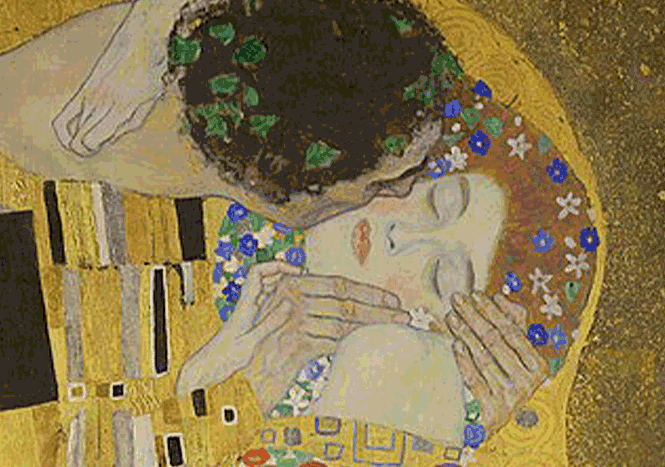
Detail of woman's face and hands in Gustav Klimt The Kiss showing closed eyes and expression of surrender
Detail of The Kiss, 1907-08. She carries the emotion of the entire painting alone.

At first glance, The Kiss (1907-08) appears to be a straightforward celebration of romantic love. Two figures wrapped in golden robes, locked in an embrace at the edge of a flower-covered cliff. The man bends to kiss the woman’s cheek. Her eyes are closed. Her hands rest gently over his.

It looks like safety. It looks like arrival.

But look again.

The woman is kneeling on a ledge of flowers that drops off into nothing, no ground beneath her feet, no horizon, no world beyond the gold. She is suspended at the very edge of something, and she is not looking down. The gold marks the boundary of the sacred here, the cocoon of love, the place where ordinary gravity no longer applies, and Klimt has placed her right at its limit.

When we turn to the man for his response, it is nowhere to be found. His face is completely hidden from us, and where we might expect to find eyes, expression, some confirmation that he feels what she is feeling, there is only the curve of a jaw, the line of a neck, a presence without an interior. He is defined entirely by what he is doing, not by what he feels. She carries the emotion of the entire painting alone.

The Gold Is Symbolic

Klimt’s use of gold leaf is the most immediately striking thing about the painting, and almost certainly the most misunderstood.

Vienna in 1907 was one of the wealthiest, most materialistic cities in Europe. The Ringstrasse, the grand boulevard the Emperor had built, was lined with palaces designed to display the power of money. The new bourgeoisie were obsessed with gold as a symbol of status and accumulation. Real gold. Heavy gold. Gold that announced exactly how much it cost.

Which makes something hidden in the material facts of this painting almost absurd. All that gold, the gold that fills the entire canvas, that removes the figures from time, that makes the painting feel heavy with the eternal, amounts to roughly 2.41 grams of actual gold leaf. Less than the weight of a paperclip. Worth almost nothing at the time Klimt applied it.

The most overwhelming visual surface in Western art is, materially, almost nothing at all.

And this is exactly how the experience of love works. The feeling that fills every available space in your life, that makes ordinary Tuesday afternoons feel consecrated, that transforms a specific person’s face into something you would describe, if pressed, as sacred, is made of no substance you can weigh or measure. It is 2.41 grams of something, applied with extraordinary care, that creates the sensation of an infinite and eternal world.

Klimt did not do this accidentally. It is commonly explained as an influence from Byzantine religious art, and that explanation is historically accurate as far as it goes. Klimt visited Ravenna in 1903 and was transfixed by the gold mosaics of the San Vitale basilica. 

He went twice that year, which is not the behaviour of a man taking notes. It is the behaviour of a man who found something he had been looking for without knowing it. And he was not alone in this. Turner returned to Venice so many times that the city’s light became inseparable from his late style, the water and the atmosphere doing something to his eye that no studio in London could replicate. 

Matisse went to Morocco in 1912 and came back with colour relationships that simply did not exist in his work before he stood in that light. These were not vacations. They were the moments where an artist’s whole visual language broke open and reformed around something they could only have encountered in person.

When I stand in front of Turner’s pieces at the National Gallery, the light belongs somewhere else entirely. You can feel that it was carried from another place, absorbed in a city that London could never have produced. That is what Ravenna did to Klimt. Not influenced him. Marked him permanently.

For Klimt, Ravenna was that moment. And the timing matters. He arrived there in the middle of a professional crisis, the Viennese establishment having publicly rejected his University ceiling paintings as pornographic and nihilistic, the state refusing to hang them. He was a man whose visual language had just been declared unacceptable by the very institutions he had been trained to serve. What he found in the gold mosaics of San Vitale was not decoration. It was a way out, a new visual language rooted not in the academies of Vienna but in something far older and far less interested in the approval of the bourgeoisie whose drawing rooms he had been painting for.

What he found was this: in Byzantine iconography, gold does not represent wealth. It represents the absence of the physical world entirely. When you painted a figure in gold, you were not decorating them. You were removing them from existence as we know it and placing them somewhere that has no address.

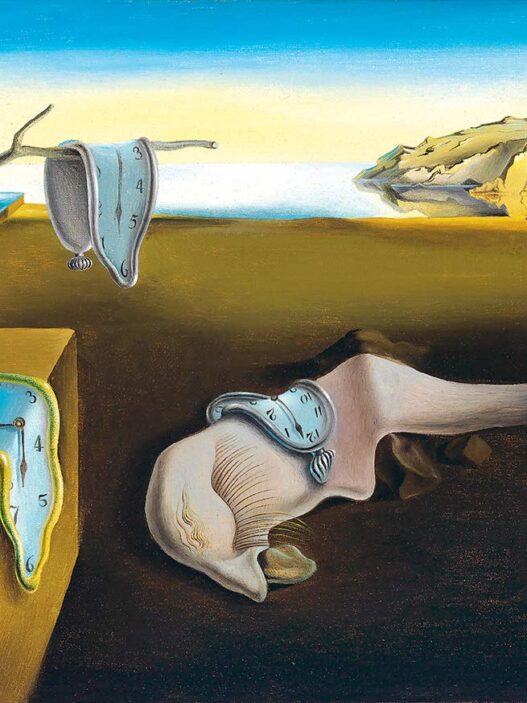
The couple in The Kiss exist in no recognisable place. No garden, no room, no riverside at dusk. Just gold, which is to say, just eternity. The moment of total absorption in another person, the moment where the clocks drip like a Dalí painting and the rest of your life recedes to the edge of perception, is what Klimt made visible here. An interior experience that, while it lasts, genuinely feels like it will never end.

That is the promise the gold makes. What the rest of the painting asks is whether you are willing to pay for it.

➤ The painting is housed permanently at the Österreichische Galerie Belvedere in Vienna. If you ever stand in front of it in person, the gold does something that no reproduction has ever managed to capture.

The Geometry of Two Selves

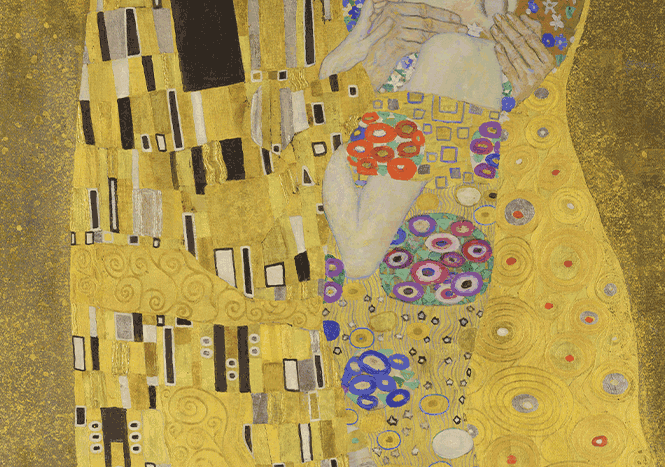
Detail of robes in Gustav Klimt The Kiss showing geometric masculine pattern and floral feminine pattern merging
Detail of The Kiss, 1907-08. The rectangular geometric forms.

Look closely at the robes and you will find something most viewers walk straight past.

The man’s robe is covered in rectangular geometric shapes, stark black and white blocks, angular and contained. The woman’s robe is covered in soft circular forms, roses and spirals, organic and open. Klimt was painting in a city saturated with symbolic language, and he knew exactly what he was encoding into the fabric.

The rectangle as a masculine symbol and the circle as a feminine one traces back to Pythagoras in the sixth century BC, who assigned gender to numbers and forms. Odd numbers masculine, even feminine. Angular forms active and structuring, curved forms receptive and generative. The rectangle as bounded and finite, the circle as infinite and without end. This was not fringe thinking. It ran through Neoplatonism, through Renaissance sacred geometry, through the alchemical tradition where the square represented the fixed earthly principle and the circle represented the celestial, the eternal, the soul.

By the time it reached Vienna in the early twentieth century this symbolic language was alive in exactly the intellectual circles Klimt moved through. Theosophy, which had a significant presence in Vienna’s avant-garde culture, was explicit about it. The straight line and the angle as the masculine, active, structuring force. The curve and the spiral as the feminine, receptive, generative one. Klimt’s audience in 1908 would not all have been able to name the tradition. But many of them would have felt its logic in their bones, the way we recognise a visual language we have absorbed without realising it.

Then look at what happens where the two robes meet.

The geometries overlap and dissolve into each other. The rectangles do not overpower the florals. The circles do not absorb the angles. They coexist in a single shape that contains both, neither dominating, neither disappearing. If this doesn’t represent the two sides of human consciousness becoming one, what does.

This is the image Klimt chose to place at the physical centre of the painting. Not the faces. Not the kiss itself. The merging of two geometric principles in the fabric that wraps around them both.

The flowers on the woman’s robe are worth a moment of specific attention. Klimt uses roses and circular spiral forms, and this is not arbitrary. The flower is the circle that also grows. It carries the geometric perfection of the closed form alongside the living, organic quality of the spiral, the shape of growth itself, the nautilus shell, the unfurling fern, the pattern that appears wherever living things develop. In Celtic tradition, in Hindu yantra, in Minoan art, the spiral is the shape of generation. Klimt reached for the oldest available symbol of the feminine principle, one that operated simultaneously as geometry, as nature, and as sacred form.

What this means for the painting as a whole is that the two figures are not simply a man and a woman in an embrace. They are two fundamental principles of existence, each with their own internal logic, their own symbolic history stretching back thousands of years, choosing to let their boundaries become permeable.

This is the visual argument Klimt makes before he asks you to look at their faces or notice the edge beneath her feet. The painting’s deepest claim is encoded in the fabric: that two things with entirely different natures can merge without either one being destroyed.

Carl Jung spent his career trying to say the same thing in words.

The Sacred Marriage Jung Couldn’t Stop Writing About

Here is something most articles about this painting won’t tell you: Klimt never read Jung.

His world was Freud’s Vienna, not Jung’s Zurich. Freud was the psychological force in the city Klimt worked in, and the two men inhabited overlapping intellectual circles, the same salons, the same Secession-adjacent conversations about the unconscious, repression, and sexuality as the hidden engine of human behaviour. Whether they ever spoke directly is unconfirmed, but Klimt was painting Judith, Danae, and The Kiss at exactly the moment Freud was publishing his most explosive ideas about desire and the unconscious.

These were the concepts filling every salon, every argument, every late evening in Vienna at the turn of the century. You did not need to sit across from Freud to be shaped by what he was thinking. You just had to be alive in that city, at that moment, making art about the human interior.

The Kiss was completed just before Jung and Freud’s famous split in 1912-13. The full Jungian framework, the archetypes, the collective unconscious, the hieros gamos as a psychological concept, came into its mature form after the painting already existed.

Which means Klimt didn’t paint the hieros gamos because he’d read Jung. The sacred marriage wasn’t an invention of modern psychology. It was one of the oldest rituals in human civilisation, enacted in ancient Greece long before anyone tried to explain it in clinical language.

Jung developed the concept partly because images like this one already existed, showing visually what he was struggling to articulate in words. The painting preceded the theory. The image knew something before the language caught up to it.

Jung spent decades arguing that this wasn’t mythology. It was psychology.

His central claim was that every human psyche contains both a masculine and a feminine principle, what he called the animus and the anima. Not in the crude biological sense, but in the deeper sense that Klimt’s robes already showed us: the structuring, bounded, angular force alongside the receptive, cyclical, generative one. Jung believed that most people spend their lives identified with one and in flight from the other. The masculine psyche represses the anima, the feeling, the intuition, the capacity for surrender. The feminine psyche represses the animus, the agency, the boundary, the capacity for direction.

And the repressed principle doesn’t disappear. It gets projected outward onto other people. Freud identified projection first, the mind’s tendency to locate in others what it refuses to acknowledge in itself. Jung took that insight and pushed it somewhere Freud never quite went: into love. What we find irresistible in another person, Jung argued, is rarely just them.

It is the shape of our own missing half, finally made visible in a face outside our own.

When I think of the canvases I have painted, aren’t they all mirrors in some form? Every mark a recognition of something already living inside you, finally made visible on a surface outside yourself. Jung would have understood that instinctively. The artist and the lover are doing the same thing, reaching outward to find what they couldn’t locate within.

This is why love feels like recognition. Why people say I feel like I’ve known you before. Why this painting stops people in a way that a technically superior work might not. You have been carrying the outline of this person inside you your entire life, not them specifically, but the principle they embody, the half of yourself you haven’t been able to access directly.

The sacred marriage is what happens when those two principles stop being projected outward and begin to integrate internally. When you stop needing another person to carry your missing half, and begin the slower, harder work of holding both within yourself. Jung considered it the central task of psychological maturity. He also considered it the most terrifying thing available to the human psyche, because it requires the partial death of the self you have spent your whole life constructing.

Look at The Kiss again with this in mind.

Two figures with opposing geometries, one structured and bounded, one organic and open, merging at the place where their bodies meet. Neither dissolving into the other. Neither dominating. The rectangles and the roses coexisting in a single shape that contains both.

Klimt painted the hieros gamos. Not as an ancient ritual. Not as a theological concept. As a Tuesday evening in Vienna, two people at the edge of a cliff, one of them with her eyes closed, choosing to let the boundary between self and other become permeable.

Jung would have said that moment, that specific act of surrender, is the closest most people ever get to what he called individuation. The becoming of a whole self. The integration of the opposing principles into something that no longer needs to be at war.

Which means The Kiss is not, in the end, a painting about two people.

It is a painting about one, and the terrifying, necessary work of becoming complete.

The Face We Cannot See

The woman’s face is the emotional centre of the painting. Her expression is remarkable, closed eyes, slightly parted lips, a quality of yielding that is neither passive nor weak. It is the face of someone who has made a choice. Who has decided, fully and consciously, to let go.

The man’s face, by contrast, is entirely hidden.

Klimt was the painter of Judith, of Salome, of Danae, a man who painted female subjects with extraordinary psychological complexity across his entire career. That he chose to conceal the male figure’s face completely is not an oversight.

One reading is autobiographical. How much do we truly know about Klimt? We have the studio photographs, the evidence of a man who took his craft with absolute seriousness, and almost nothing else. Klimt kept his own identity deliberately obscured throughout his life, no self-portraits, almost no public statements about his work. In hiding the man’s face, he may have hidden himself.

But the more interesting reading is psychological. The hidden face makes the male figure into something archetypal rather than individual. He is not a specific man. He is the one who comes, the force that arrives in a person’s life and asks them to surrender with softness. He has no face because he does not need one, because this is not a painting about him. It is a painting about her. About the interior experience of the one who chooses to yield.

She is the experience of letting go. He is the reason she has chosen to.

The Edge They’re Kneeling On

This is the detail most people don’t notice, and the one that changes the entire painting.

They are not standing in the sunlit meadows of a Renaissance idyll, that familiar European convention of love as pastoral ease. They are kneeling at the edge of a cliff. The flowers beneath them fall away sharply into the golden void. There is nothing below her feet except the edge of the world.

There is no fear in her expression. Her eyes are closed. She has chosen this.

This is the terror the title names. The deeper terror: the terror of complete surrender while it is happening. Of choosing, fully conscious, to kneel at an edge with no visible bottom, and to close your eyes anyway.

If you have ever stood at the edge of a cliff or a bridge, you will know the particular feeling that arrives uninvited. The body and the mind briefly lose their agreement. Something in you registers the drop before your rational self has caught up. That involuntary lurch is what Klimt has painted here, not as a physical experience, but as an emotional one. The moment where the self recognises what complete surrender actually costs.

Surrender requires trust in something you cannot verify. It requires releasing your grip on the self you have maintained, the defended, boundaried, geometric self, and allowing another person to hold you at a precipice.

Klimt does not pretend this is easy. He shows us the edge. He shows us the void. And he shows us a woman who has looked at both, and chosen to close her eyes.

That is not weakness. In Jungian terms, it is the most difficult act available to the psyche, the conscious willingness to dissolve, to allow the self to be transformed by contact with another, to undergo the small death that genuine intimacy requires.
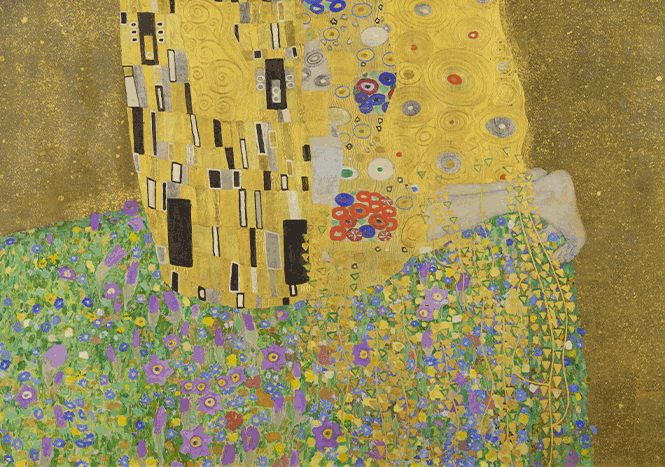
Detail of bottom edge of Klimt The Kiss showing flowers ending at golden void beneath figures feet
The bottom edge of The Kiss, 1907-08. The flowers end and the world drops away. Most reproductions never show you this.

Why You Keep Coming Back to This Image

The Kiss was purchased by the Austrian government before it was even finished, a rare honour that tells you everything about the impact it had on its first viewers.

But that was 1908. Why does it still work? Why is it on the mugs and the tote bags and the bedroom walls more than a century later?

Because what it depicts has not changed.

The particular terror of complete surrender is not a historical feeling. It is not something that belonged to fin-de-siècle Vienna. It is the terror that arrives every time you allow yourself to love someone fully, the terrifying mathematics of opening yourself to a loss you cannot control, in exchange for a connection you cannot manufacture any other way.

Every person who hangs this painting on their wall is making a small private statement. I believe this is possible. I believe it is worth the edge.

Some of them have experienced it. Some of them are still waiting. Some of them are grieving it.

I return to this painting because it represents something that feels increasingly rare, the lost act of love. Modern romance is saturated with imagery, curated and filtered and performed for an audience, until the genuine article becomes difficult to recognise. We have been shown so many versions of love that we have stopped believing in the one that costs something. Klimt’s version costs everything. Two people, the edge of the world, her eyes closed. No audience. No performance. Just gold, and the decision to kneel there anyway.

That is what love seekers are really looking for when they hang this on their wall. Not decoration. Evidence.

How to Look at It Differently

Gustav Klimt The Kiss 1907-08 full painting oil and gold leaf on canvas Belvedere Vienna
The Kiss, 1907-08. Look at it differently now.

Next time you see The Kiss, try this.

Don’t look at the gold first. Look at the edge. Find the place where the flowers end and the void begins, and notice that she is kneeling right there.

Then look at her hands. Her fingers are rigid over his, the only place in her entire body where the tension she is holding shows itself. Her face has surrendered completely. Her hands have not, not entirely. That small detail is the most honest thing in the painting. Surrender, even chosen surrender, is never total. The body keeps its last grip even as the mind lets go.

Then look at her face more carefully. Her shoulder arches toward her rose-flushed cheek, her whole upper body creating a kind of stillness that is almost architectural, as if she has arranged herself around the act of yielding. The surrender that is also a choice. The yielding that requires more courage than resistance.

Then look at where the two robes merge, and ask yourself where exactly one person ends and the other begins. The circular forms, organic and open, full of the shapes of a life or the shapes of a single moment, it is impossible to tell which. The earth becomes one with the figures, suspended in a speckled golden hour that belongs to no particular time or place.

The entire piece is flat, it could be anywhere in the world. But what we feel looking at it is completely grounded. Rooted in something that has not changed in the centuries since Klimt applied those 2.41 grams of gold to the canvas.

Did this moment last forever?

That’s the point.

If you want to go deeper on the Jungian ideas behind this post, read: Carl Jung and Symbolism in Art: A Complete Guide

And if the idea of the sacred marriage intrigues you, the myth of Persephone carries the same psychological architecture: Persephone: The Goddess Who Went to Hell and Came Back Ruling It

Further Reading

If this post has opened up questions about mythology, psychology, and the monsters we project onto the world, these posts go deeper:

Previous Post
Gustav Klimt, Pallas Athena, 1898, oil on canvas, Wien Museum, Vienna

Athena Symbolism: The Goddess Who Chose Strategy Over Chaos