




What does it mean to stand between the living and the dead? Carlos Schwabe Death and the Grave Digger demonstrates why art can turn the uncomfortable truth into something relatable.
We have all felt the presence of a graveyard or cemetery at one time or another and understood the fragility of human life and time. Flowers withering away, replenished annually to restore the memory of loved ones.
Carlos Schwabe explores this subject with an almost unbearable tenderness, and that’s precisely what makes Death and the Grave Digger one of the most arresting canvases of the Symbolist era.
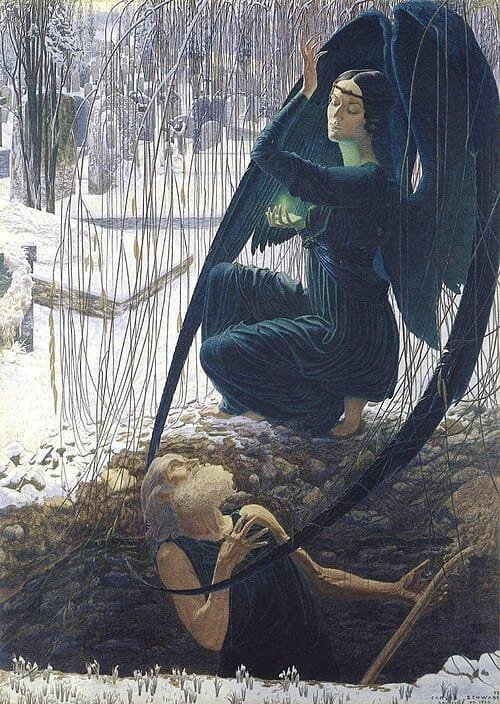
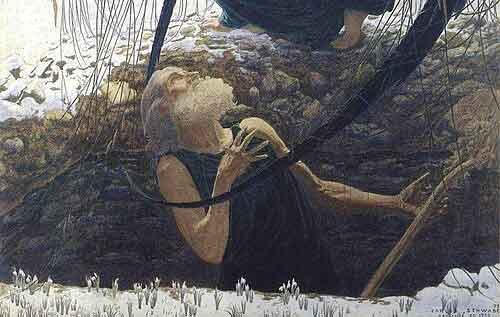
Painted around 1895, La Mort et le Fossoyeur is, on the surface, a quiet scene. A tired man arching backwards in a snow-covered grave witnessing an angelic figure descending. But the longer you sit with it, the more it opens up, like a poem that reveals a new line every time you return to it. So let’s break it down, layer by layer, and talk about what Schwabe was really doing here.
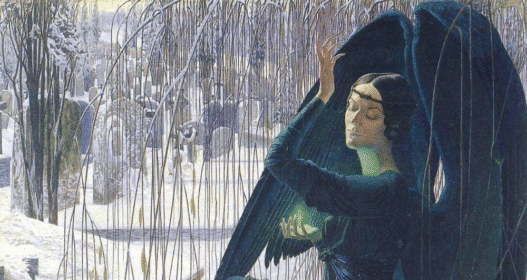
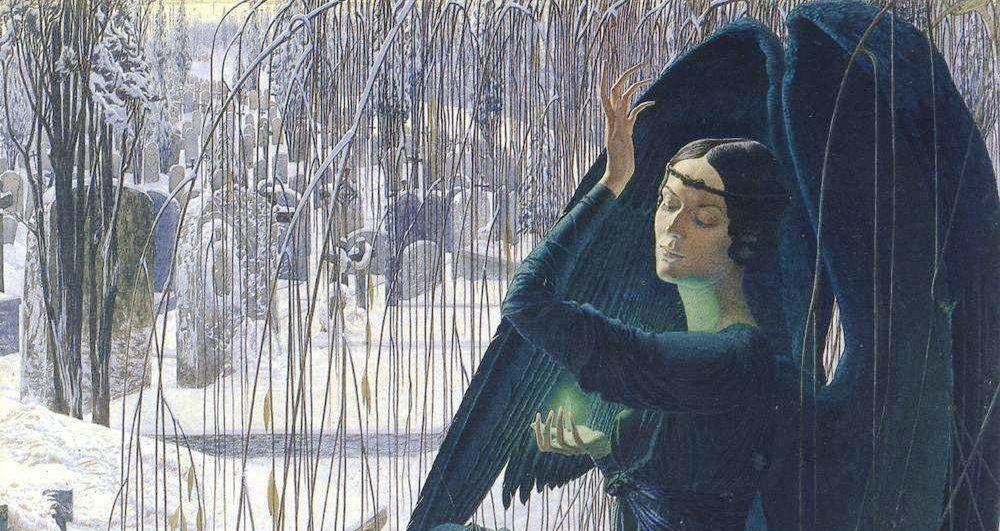
The Symbolism of Snow in Death and the Grave Digger
What first pulled me in was the snow. There’s something deeply peaceful about it, the kind of quiet that makes you feel like the world has paused just for a moment.
First and foremost, let’s talk about the setting. In Symbolist painting, winter and snow consistently signal suspension: a world paused between states, neither fully alive nor fully gone. Schwabe understood this, and he leaned into it hard. Snow has a very distinct characteristic, it feels cold to touch and melts under the heat of our skin. It can feel refreshing for a moment, but saps our body heat. Do you remember how the snow feels?
What’s particularly effective here is how the snow erases the boundary between earth and sky. Everything merges into a single, hushed whiteness, which is is point. The grave digger works at the threshold of two worlds, what is often an invisible line, becomes the point of no return, the living is returned to the earth.
Beyond that, there’s a temperature to the image that goes beyond weather. It’s emotionally cold in the best possible way. The day looks bright, overcast and subdued. The only warmth we can sense is from the earthy tones of the soil, that mimic the flesh tones of the old man, perhaps Schwabe is suggesting something more primal here.
For me, it feels like a dream where everything slows down and you finally have space to breathe.
This kind of layered symbolic thinking is central to the Symbolist movement Schwabe was part of. The use of threshold imagery, the space between two states made visually legible, runs through the tradition explored in depth at The Symbolism of The Minotaur.
Carlos Schwabe’s Depiction of Death as a Feminine Figure
Here’s where Schwabe really separates himself from the tradition he inherited.
In 1895, the conventional iconography of Death was skeletal terror or mournful allegory draped in black. Schwabe threw all of that out.
His Death is a woman. Graceful. Winged. Almost maternal in her composure. She doesn’t lunge or threaten.
She arrives, patient and inevitable. Look at her posture: slightly leaning back, hands extended in a gesture that feels less like seizure and more like invitation. She isn’t taking something. She’s offering something.
That reframing is radical for the period, and it’s worth sitting with. Instead of something to be feared, death becomes something close to mercy, a release offered to those who have carried enough and have waited long enough for it to arrive.
To say: I see what you carry. I know how long you’ve carried it. That emotional nuance is what elevates this from illustration to genuine art. The figure of the feminine as a guide between worlds, merciful rather than monstrous, appears across mythology and art history.
It connects directly to the way mythological creatures have long been used as symbols of the human psyche: figures that seem terrifying on the surface but reveal something far more complex about what we fear and what we secretly hope for.
The Grave Digger: Class, Labour, and the Act of Living
Now look at the other figure. Because the grave digger is just as important as Death herself, and he’s the one most analysis of this painting underreads. His shoulders are collapsed inward. His knees are partially bent and his whole body is clearly shaped by decades of repetitive, thankless labour.
The thing many people don’t know, is that, Carlos Schwabe (1866–1926) had a life characterised by intense, dedicated labor, transitioning from commercial design work to becoming a highly prolific Symbolist artist, illustrator, and painter.
He basically painted his own experiences, which in my opinion is one of the most purest ways of connecting with the audience as an artist.
Another thing to note, is he painted it physically, anatomically. You feel the heaviness of the shovel even when it’s out of frame. But notice his expression. It isn’t fear. It isn’t the face of a man confronting punishment for his sins. It’s something closer to recognition, even relief.
As if he had always suspected death might be a monster arriving to settle a score, and here she is instead: tender, almost angelic, and entirely without judgment. That surprise is part of the painting’s argument. Schwabe is making a claim about who deserves a peaceful death.
The contrast with Death sharpens this further.
She is vertical; he is folded. She radiates stillness; he radiates accumulated strain. And yet she hasn’t come for him with violence. She’s come as relief. As if dying, for this man, might finally mean rest. This is a deeply humanist statement, and a surprisingly modern one.
In 1895, art about death was largely concerned with the spiritual transcendence of exceptional individuals. Schwabe took that tradition and handed it to a working man. This symbolism connects to something that runs through the myth of Medusa and countless other figures across Western art: the idea that those who carry the heaviest burdens are the ones most in need of grace, and the least likely to receive it.
A Death Nobody Painted Before
There is significance to shining the light on the old labourer here, and it goes deeper than it first appears.
Courbet shocked Paris in 1849 by putting working men at the centre of a canvas with The Stone Breakers. Millet did the same with peasant women in The Gleaners in 1857. By the 1890s, the Realist movement had established that labourers deserved to be seen. What it never did was give them a beautiful death.
Deathbed scenes in Western art were reserved for the exceptional: poets, martyrs, noblemen, revolutionary journalists. The people who dug the graves and laid the bodies were present at everyone else’s ending and absent from their own.
Schwabe changed that. And he did it from within Symbolism, a movement that could hardly have seemed less interested in the working class. The Salon de la Rose+Croix, where Schwabe had made his name in 1892, was devoted to spiritual elevation and esoteric idealism. Its subject matter was saints, angels, and mythological figures. Not grave diggers.
Which makes his choice here all the more deliberate. He took the visual language of transcendence: the winged feminine Death, the snow-white threshold, the descending light, and handed it to a labourer. Someone whose whole life had been other people’s endings, given one of the most dignified deaths in the history of the canvas.
This is where the performance ends and the truth begins.
What Jung Would See in This Painting
Carl Jung believed that what we exile from our conscious mind doesn’t disappear. It waits.
The grave digger has spent a lifetime beside death without ever truly facing it. In Jungian terms, he has lived in the shadow of the thing he most fears, keeping it at arm’s length through the ritual of labour. And here, finally, it arrives, not as punishment, but as the face he was never allowed to see.
That’s what makes the tenderness of Schwabe’s Death so psychologically precise. To understand why, it helps to have a grounding in how Jung mapped the shadow onto visual art — because what Schwabe is painting here is not death. The shadow, finally faced, doesn’t destroy.
It releases.
Why It Stayed With Me
At this point, you might be wondering: what does a painting from 1895 have to say to us now?
Quite a lot, it turns out. We live in a cultural moment that is deeply uncomfortable with death. We medicate it, hide it, euphemise it. We talk about ‘passing’ and ‘losing’ people as if death were a misplacement rather than a transformation.
We’re closer than ever to the concept of death with information being so readily available, yet we brush past it without taking a moment of silence.
Schwabe painted something braver: a direct encounter, rendered without flinching, that treats death as a presence worthy of looking at. Moreover, the painting speaks to anyone who has felt the exhaustion of simply continuing.
The truth is, the grave digger isn’t dying in this image. At least, not yet. But he’s been close to it his whole working life, his face tells a story of time and continuity. And Schwabe asks us to contemplate that: for the people whose labor puts them at the edge of the human experience, day after day, without recognition.
Ultimately, Death and the Grave Digger is a painting about honest dignitys, and stillness in a world that rarely stops moving long enough to acknowledge either.
Frequently Asked Questions:
What is the meaning of Death and the Grave Digger by Carlos Schwabe?Item #1
Death and the Grave Digger depicts a labourer at the moment of death’s arrival, represented not as a terrifying reaper but as a graceful, winged feminine figure. The painting’s central meaning is dignity: Schwabe argues that a merciful death belongs not only to the spiritually elevated, but to ordinary working people. The symbolism of the snow, the threshold between earth and sky, and the contrast between the two figures all reinforce this reading.
What movement does Carlos Schwabe belong to?
Carlos Schwabe was a central figure in the Symbolist movement, a late 19th-century art and literary movement that emphasised the spiritual, psychological, and emotional over literal representation. He exhibited at the first Salon de la Rose+Croix in Paris in 1892. His work sits at the intersection of Symbolism and Art Nouveau.
Where is Death and the Grave Digger currently held?
The painting is held in the permanent collection of the Musee d’Orsay in Paris, which houses one of the world’s most important collections of Symbolist and Impressionist art.
Why does Death appear as a woman in Schwabe's painting?
By depicting Death as a graceful, winged feminine figure rather than a skeletal reaper, Schwabe transforms the encounter from terror to tenderness. She arrives not to punish, but to acknowledge and release.
What does the snow symbolise in the painting?
In Symbolist painting, snow consistently represents suspension: a world paused between states, neither fully alive nor fully gone. In Death and the Grave Digger, the snow erases the visual boundary between earth and sky, making visible the threshold the grave digger is about to cross. It creates an emotional coldness: stripped of distraction, a space where the encounter between life and death can happen without interruption.