




There is a symbol so deeply embedded in the human imagination that cultures on opposite sides of the world, with no contact between them, arrived at exactly the same image.
We walk past this symbol every day and recognise it as a provider of life on this earth. With roots reaching into the earth and branches stretching toward the sky — the light seeker, connecting everything.
No other symbol has been independently conceived by this many unconnected civilisations and carried this consistently into the present day.
The question worth asking is not simply what the Tree of Life means. It is why the human mind keeps returning to this image, across every era and every continent, as the most natural way to express something it struggles to say in any other form.
What the Tree of Life Actually Symbolises
Before going culture by culture, it helps to understand what the image is actually doing structurally.
Every Tree of Life depiction shares the same architecture. Roots buried deep in the earth or the underworld. A trunk occupying the present, material world. Branches reaching toward the sky, the heavens, the divine. In the language of myth and symbol, this is called the axis mundi, the cosmic axis, the centre point around which existence is organised.
This is literally a map of reality.
It says: there are realms below you, a world you stand in now, and realms above. All three depend on each other. And what connects them is not a wall or a road but something living, a breathing organic thing that responds to seasons, sheds its leaves, and always returns. We recognise this because we live it. The transience of one season giving way to the next is not a metaphor. It is our actual experience of being alive.
The universe is alive, and you are inside it, somewhere between the roots and the branches.
From that central idea, layers of meaning accumulate: interconnectedness, immortality, growth, the cycle of death and renewal, wisdom, ancestry, and the possibility of transcendence.
The Tree of Life in Jungian Psychology
Jung identified the Tree of Life as one of the most powerful archetypal symbols in the collective unconscious, the shared psychological inheritance that all humans carry beneath their individual minds. For Jung, the fact that this image emerged independently across unconnected civilisations was not a mystery to be explained away. It was evidence of the archetype at work.
Worth noting is that Jung made a careful distinction between the Tree of Life and the Tree of Knowledge. Two trees. One represents integration, wholeness, and the fullness of being. The other represents the dangerous pull of pure intellect divorced from wisdom. That both trees grow in the same garden tells you something about the complexity of what is on offer.
In Jungian terms, the tree’s vertical axis mirrors the structure of the psyche itself. The roots correspond to the unconscious, the deep, dark, hidden material below the surface of awareness. The trunk is the conscious self, the ego, living in ordinary reality. The branches reaching skyward represent the Self in Jung’s specific sense, the integrated whole, the fullest possible expression of the human being, the thing we are always growing toward but rarely reach completely.
The Tree of Life, in this reading, is a diagram of psychological development. The goal is not to live only in the trunk, cut off from both the roots and the branches. Integration means knowing your depths without being consumed by them, and reaching upward without losing your grounding.
This is why the symbol appears so persistently in dreams, in art, in spiritual practice. It is the psyche mapping its own territory, using the most natural image available. If this resonates, my Carl Jung and Symbolism in Art: A Complete Guide goes deeper into how the archetype operates across centuries of painting.
The Tree of Life Around the World: From Yggdrasil to the Bodhi Tree
What makes the Tree of Life unlike almost any other symbol in human history is that nobody invented it and passed it on. It arrived separately, in cultures that had never met, speaking languages that shared no common root, worshipping gods that had nothing to do with each other. In my experience, it is the one thing in nature that time cannot erase. Rooted below in what we cannot see, reaching above toward what we aspire to, connecting everything in between.
Ancient Mesopotamia: Where It Begins
The earliest known artistic depictions of the Tree of Life date to around 900 BCE, found carved in the palace reliefs of Assyrian kings including Ashurnasirpal II and Sargon II. These intricate stone carvings show a highly stylised, symmetrical tree flanked by winged deities or guardian figures. Mesopotamia is widely regarded as one of the most ritualistic and deeply religious cultures in history. The Sacred Tree represented fertility, divine blessings, and the cosmic order. It is often linked to the date palm, a crucial provider of food, stylised in art with knots, intersecting lines, and rosettes.
Although different from Jung’s psychological view of the axis mundi as a map of the internal psyche, the Assyrian Tree of Life served as a literal centre of the world, anchoring the king’s political authority in both the physical and divine landscape. To be associated with the tree was to claim a position at the junction of heaven and earth.
Something about that image still works on you, even stripped of its original religious context, even three thousand years later.
Norse Mythology: Yggdrasil
Perhaps the most elaborate Tree of Life in any mythology belongs to the Norse. I like to think of this as the universe’s anatomy, the entire cosmos held in a single image.
To the Norse mind, Yggdrasil is not just a symbol. It is the anatomy of existence. The Vikings looked at the tree to see our true nature: small, interconnected parts of a massive, suffering organism. It was a profound awareness that all life is bound by a single, pulsing fate.
Deep beneath the surface lies the Well of Urðr, the spiritual reservoir that feeds the tree’s roots. This is the domain of the Norns, the three weavers of fate, who daily pour sacred silt and water over the trunk to heal the rot caused by the dragon Níðhöggr. The tree is not a static object. It is a living organism in a constant state of decay and miraculous repair.
Its branches span the nine realms of Norse cosmology, from Asgard where the gods reside to Niflheim, the realm of the dead. At its roots sit three wells, including the Well of Wisdom, from which Odin drank after sacrificing one of his eyes to gain knowledge.
That detail matters. The tree does not offer its gifts freely. Wisdom, in Norse mythology, requires sacrifice. Odin also hung himself from Yggdrasil for nine days to receive the runes, the sacred alphabet of power and meaning. The tree is the site of transformation, but like most things worthwhile in life, the cost is real.
What I love most about Yggdrasil in art is how alive with struggle it feels. Under constant threat of Níðhöggr gnawing at its roots, always carrying the tension between the worlds it holds together. It captures something true about growth that softer depictions miss: the tree endures, but endurance is not passive.
While the Assyrian Tree of Life and Yggdrasil are both expressions of the axis mundi, they function in fundamentally different ways. One was a political tool anchoring a king’s authority. The other was the physical structure of the universe itself.
Celtic Tradition: Crann Bethadh
For the Celts, trees were not symbols of life. They were life, in the most direct sense. Sacred groves were places of worship and ceremony. The druids performed rituals beneath them and believed specific trees to be gateways to the Otherworld. The oak in particular was considered the axis mundi of the Celtic world, the precise point where human and divine made contact.
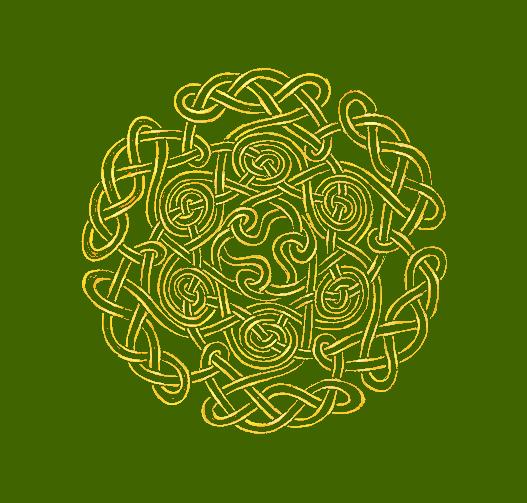
The Celtic Tree of Life, known in Irish as Crann Bethadh, appears in its most recognisable form as a circular design, the branches mirroring the roots below, the whole contained within a ring of interlacing knotwork.
That circular containment is significant. Unlike Yggdrasil, which reaches outward indefinitely, the Celtic tree is complete, enclosed, whole. For me it represents a closed, self-sustaining loop of energy and existence.
Jung used the Greek word temenos to describe a bounded, protected space where the work of the soul happens. The Celtic circle is a literal temenos. It says that the tree, the individual, does not need to reach indefinitely for external validation. It is already complete within itself.
The Celts also believed that cutting down a sacred tree was one of the gravest possible offences. To destroy the tree was to destroy the axis of the world, to sever the connection between realms. Some early Irish accounts describe enemy tribes felling each other’s sacred trees as an act of ultimate desecration.
The tree was not metaphorical. It was the actual centre of a people’s world.
Ancient Egypt: The Sycamore and the Acacia
The earliest known depictions of the Tree of Life in Egypt date to around 3100 BCE, where two trees held particular sacred significance: the sycamore and the acacia.
The sycamore was associated with the goddesses Nut, Isis, and Hathor, who were sometimes depicted living within the tree itself, offering food and water to the souls of the dead as they passed into the afterlife. The tree stood at the boundary between life and death, nourishing the soul through the transition.
The acacia was associated with Osiris, the god of death and resurrection, and with the concept of immortality. It was the tree beneath which Osiris was said to be buried and reborn. In Egyptian funerary art, the Tree of Life appears repeatedly as a threshold symbol, not a symbol of this life, but of what continues after it.
Hindu and Buddhist Traditions
In Hinduism, the Banyan tree is held in great reverence as the Tree of Life. Its extraordinary biology, sending down aerial roots that become new trunks and expanding outward indefinitely, makes it a natural symbol of both immortality and interconnectedness. A single Banyan tree can become an entire forest. They are sometimes called strangler figs because they begin growing on another tree entirely, slowly self-networking outward until they become their own vast structure. There is something worth sitting with in that detail. The thing that appears to be one tree is quietly becoming many.
In Hindu tradition, the Banyan represents the Trimurti: Brahma the Creator, Vishnu the Protector, and Shiva the Destroyer. The full cycle of existence held within one organism.
In Buddhism, the equivalent is the Bodhi tree, the specific fig tree in Bodh Gaya, India, beneath which Siddhartha Gautama sat in meditation and attained enlightenment. Vowing not to rise until he was enlightened, he sat beneath it for many days, not moving, not eating, just meditating, until he arose as a fully enlightened being. That tree, or a direct descendant of it, still stands today and remains a place of pilgrimage. The tree in this tradition is not a cosmic map. It is the precise location where the most important transformation in Buddhist history occurred.
Kabbalah: The Tree as Spiritual Map
Perhaps the most intellectually intricate version of the Tree of Life belongs to Kabbalistic Jewish mysticism. The Kabbalistic Tree of Life is not a physical tree. It is a spiritual map of the structure of divinity and the human soul simultaneously.
It comprises ten Sephirot, spheres or emanations, arranged in a specific pattern and connected by twenty-two paths. Those twenty-two paths represent the active principles of the cosmos and form an internal spiral staircase a person must climb to return to the divine source. Each Sephirot represents an aspect of God and a corresponding dimension of human experience: wisdom, understanding, kindness, judgment, beauty, and so on.
To study the Kabbalistic tree is to study the architecture of consciousness itself. It is a remarkably sophisticated psychological model developed centuries before the concept of psychology existed, using the tree as the only adequate structure to hold the complexity of what it was trying to map.
The Tree of Life in Art
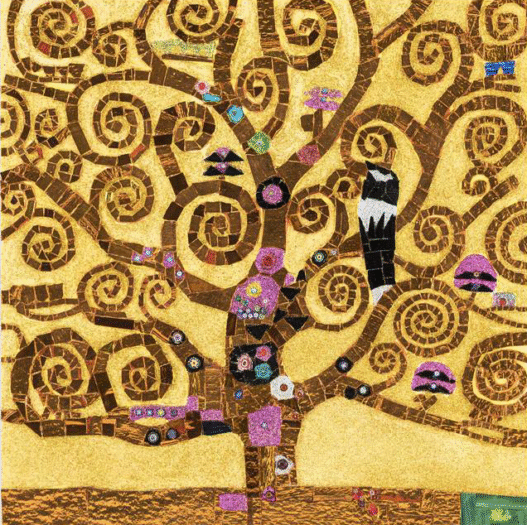
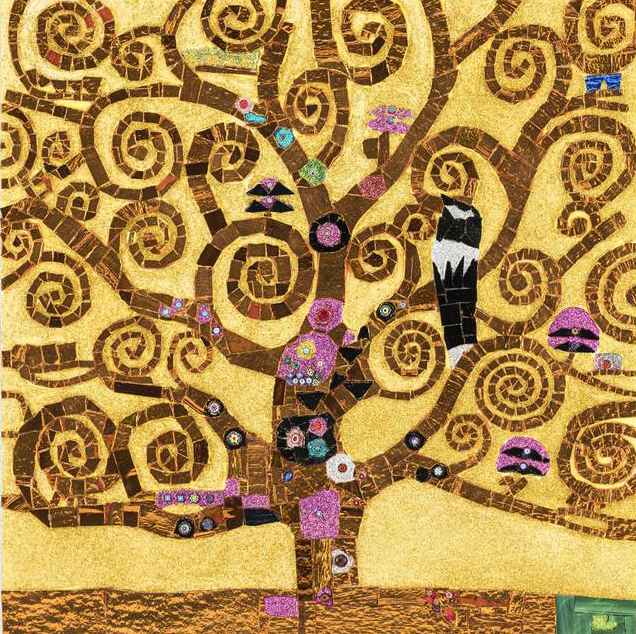
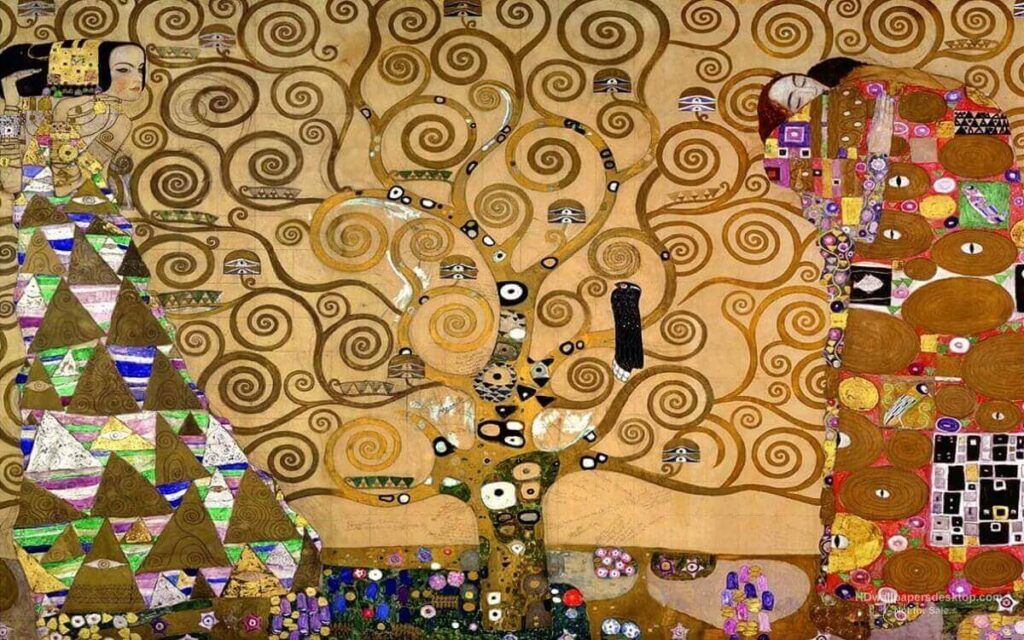
The most iconic Western representation is undoubtedly Gustav Klimt’s Tree of Life from the Stoclet Frieze, painted between 1905 and 1909. This painting is in many ways the pinnacle of Art Nouveau, if we overlook The Kiss.
The swirling golden branches spiral and curl across the surface in a kind of cosmic bliss. The roots and branches blur into each other. The boundary between the organic and the ornamental dissolves. The repeated swirls remind me of the fractals we see in nature, the piece feels chaotic and yet completely held together, like the thoughts we carry with us throughout the day.
What Klimt understood, and what makes the painting so enduring, is that the Tree of Life is an image of motion. Not a static symbol bound by its roots, but two sides of the same world, reaching, spreading, returning. His spiralling branches capture that better than any naturalistic rendering could.
Other artists have approached the image very differently. William Blake’s tree imagery throughout his illuminated books carries the shadow side, which is deeply Jungian. Trees as prisons, as nets, as the entangling structures of false religion and material limitation. As a child of around eight or nine, Blake claimed to see a tree filled with angels. For him the tree could be liberation or confinement depending entirely on whose hands had planted it.
In medieval Christian art, the Tree of Life appears in stained glass windows, illuminated manuscripts, and church architecture, often merged with the image of the Cross. The instrument of Christ’s death becoming the tree of eternal life. The wood that destroys and the wood that saves occupying the same image simultaneously.
In contemporary art, the symbol continues to evolve. Artists working in ecological themes have returned to the tree as a way of speaking about what is being lost, a symbol of life weaponised as a symbol of grief. The Tree of Life, in that usage, becomes urgent in a way it has not been since the ancient Assyrians carved their reliefs. For another symbol that carries the perfect balance between beauty and destruction, check out my Medusa Symbolism post that explores how mythology and Jungian psychology intersect in art.
Tree of Life FAQ
It Appears in Cultures All Over the World
The Tree of Life is a universal symbol found in ancient Mesopotamia, Egypt, India, Mesoamerica, and Norse mythology. Despite cultural differences, it often represents connection between heaven, earth, and the underworld, as well as life, growth, and immortality.
Found in the Bible — From Genesis to Revelation
In the Bible, the Tree of Life appears in the Garden of Eden (Genesis) as a source of eternal life, and again in the Book of Revelation, where it symbolizes restoration and healing in the New Jerusalem (Rev. 22:2).
Spiritual Growth and Wholeness
The tree’s roots, trunk, and branches represent the journey of the soul, from being grounded in the physical world, growing through life experiences, and reaching toward higher wisdom or divine understanding.
It's a Popular Theme in Art and Sacred Design
From Gustav Klimt’s iconic “Tree of Life” to stained glass in medieval cathedrals, the symbol continues to inspire artists as a visual metaphor for unity, renewal, and divine order. It’s also common in folk art, mandalas, and tattoo designs.