




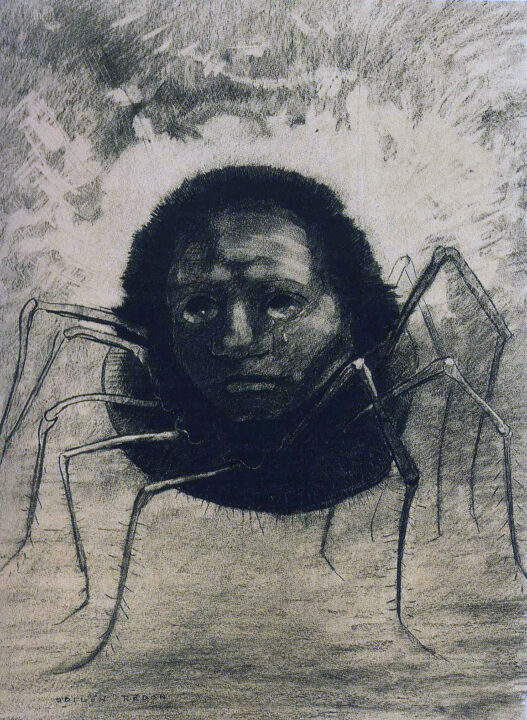
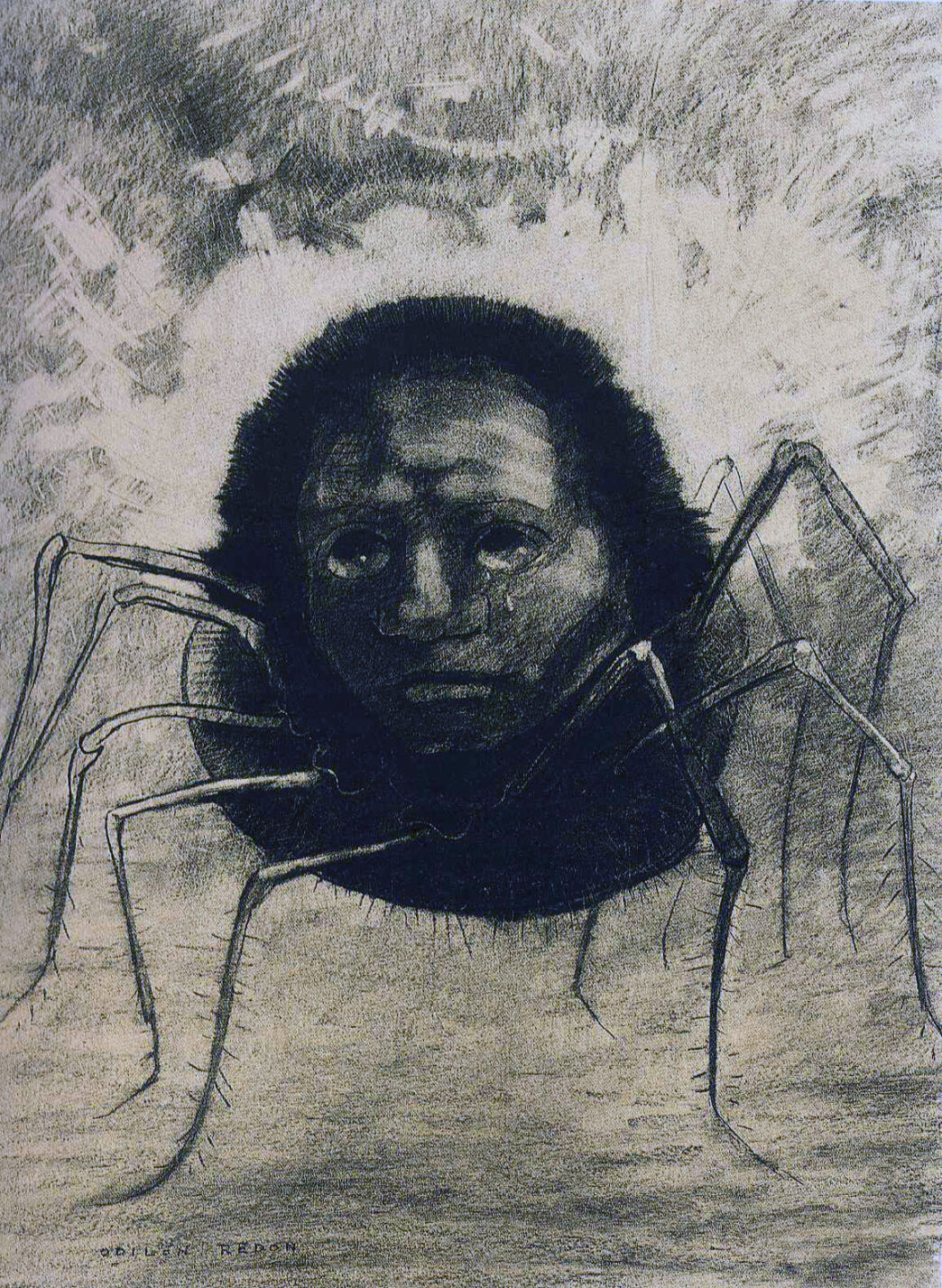
Few artworks capture loneliness and existential melancholy quite as tenderly as Odilon Redon’s The Crying Spider.
Looking at this drawing, you get a real sense of how detached the subconscious can be from reality, creating a world that feels both familiar and entirely foreign.
First created around 1881, this charcoal drawing is one of Redon’s haunting noirs, a series of black-and-white works that explore the murky intersection of dream and reality.
Who Was Odilon Redon?
Here’s the thing about Odilon Redon. His life reads almost like one of his own drawings.
Born in Bordeaux, France, in 1840, Redon was sent to live with relatives in the countryside as an infant, separated from his parents, spending much of his early childhood in quiet isolation. That solitude never really left him. In fact, it shaped everything he made.
He was a slow bloomer by the standards of the art world. While his contemporaries were making names for themselves in the salons of Paris, Redon spent years quietly studying, drawing, and developing a vision that didn’t fit anywhere neatly. He studied botany, music, and the natural sciences alongside art, and that unusual combination shows up directly in his work. The hybrid creatures, the floating organisms, the figures that are part human and part something else entirely. These came from a man who looked at the natural world and saw something stranger and more poetic than surface appearances suggested.
So by the time he created The Crying Spider in 1881, he was in his early forties and fully committed to his noirs, a body of work that set him apart from every other artist of his time.
The Noirs: Dreams Made Visible
Now, to really appreciate The Crying Spider, you need to understand the series it belongs to.
The noirs are the charcoal and lithograph works Redon produced primarily between the 1870s and 1890s. Dark, atmospheric, and deeply strange, they are unlike almost anything else being made in 19th century France.
Where the Impressionists were stepping outside to capture light, Redon was going inward. His noirs don’t depict the visible world. They depict the world behind closed eyes. Floating heads. Enormous eyes hovering in darkness. Figures emerging from shadows with no clear origin or destination. Basically, the faces we see in our dreams, pulled out of the subconscious and pressed onto paper.
The Crying Spider sits comfortably within this world. It shares the same void-like background, the same gritty charcoal texture, the same quality of a figure that exists in psychological space rather than physical space. And within the noirs series, it stands out for one particular reason. It is one of the few figures that provokes genuine sympathy rather than pure unease. That tension between revulsion and empathy is precisely what makes it so enduring.
Other key works from this period include Les Origines, a series of lithographs exploring prehistoric and evolutionary imagery, and various floating eye compositions that feel like dispatches from a dream you almost remember. Each of them shares the same quality. The sense that what you are looking at came from somewhere deeper than conscious thought.
Dreams, Myths and Psychology
To understand The Crying Spider fully, it helps to understand the Symbolist art movement Redon was part of. Emerging in the late 19th century, Symbolism rejected realism and naturalism, favouring inner emotions, dreams, myths, and psychological states. Artists like Redon weren’t interested in painting what they could see. They wanted to make visible what is invisible.
He was deliberately moving away from traditional academic painting toward something more internal, poetic, and psychological. And the faces we encounter in our dreams, distorted, hybrid, emotionally raw, are precisely what Redon spent his career putting onto paper.
The Crying Spider is widely seen as a projection of suppressed human emotion and the subconscious. When we look deeply at the significance of a spider personified, we see a mirror of our hidden anxieties, tangled emotions, and unspoken desires. Given what we know about Redon’s solitary childhood and his years of quiet isolation, it’s hard not to read this image as something genuinely personal. A real manifestation of an inner emotional world he had been carrying for a long time.
Another thing we can explore is how the spider’s body with a human head (possibly a child’s) invites sympathy and a quiet sense of connection with the creature’s sorrow.
There’s an uncanny sense of perspective, as if the spider is emerging from a shadowed cave, or perhaps we’re gazing at the creature’s underbelly, where fine strands of hair catch the light.
Its expression is turned upward rather than meeting the viewer’s gaze, suggesting a quiet withdrawal, as though lost in its own sorrow.
The rough, gritty texture of the charcoal intensifies the moody atmosphere, wrapping the entire scene in a feeling of unease and emotional weight.
Reading the Image: Symbol by Symbol
So what exactly are we looking at? Let’s slow down and move through it carefully.
One of the most striking features of The Crying Spider is the fusion of a spider’s body with a human face, possibly a child’s. In Symbolist art, such hybrids often reflect the complexity of human psychology. The creature is neither fully animal nor fully human, and that ambiguity is entirely the point. It sits in the uncomfortable space between the two, which is exactly where our most difficult emotions tend to live.
There’s also an uncanny sense of perspective, as if the spider is emerging from a shadowed cave, or perhaps we’re gazing at the creature’s underbelly, where fine strands of hair catch the light. Its expression is turned upward rather than meeting the viewer’s gaze, suggesting a quiet withdrawal, as though lost in its own sorrow.
Now, the tears. The tears are the most human feature in the drawing. Against the body of an insect, a creature many of us instinctively fear, those tears completely transform the nature of the figure from aggressive to passive. They suggest a universal emotional experience. The kind we often try to hide.
On top of that, spiders have long carried symbolic meaning. Associated with weaving, creation, patience, and the interconnectedness of life, Redon may be drawing on these deeper associations. The spider’s form becomes a metaphor for the fragile, tangled structure of human experience, where emotions, memories, and fate quietly weave together beneath the surface.
One more detail worth noticing is how the spider’s body half-emerges from a circular shape in the composition. Circles often represent wholeness, cycles, and continuity. By having the spider only partially emerge, Redon may be suggesting that our emotions and subconscious impulses are part of a larger web of life, continuously forming and reforming, never fully visible, never fully hidden.
And running through all of this is the rough, gritty texture of the charcoal itself. It wraps the entire scene in a feeling of unease and emotional weight that a cleaner medium simply couldn’t achieve.
The Void: A Space for Your Own Projection
Here’s where it gets really interesting.
The last thing to consider when studying The Crying Spider is the absence of background. In many of Redon’s noir drawings, there is little to no elaborated background. The figure simply floats in a void. That lack of real world context reinforces Symbolism’s central aim. The work isn’t about where it is. It’s about what it feels like.
The spider isn’t situated in a garden or a web. Instead it exists in a psychological space, an emotional vacuum that quietly invites you to project your own internal experience onto it. Whatever you bring to it, it will hold.
A Jungian Glimpse: The Shadow Made Visible
At this point, it’s impossible to look at The Crying Spider without noticing how naturally it connects to Jungian ideas.
Jung described the shadow as the part of the psyche we refuse to acknowledge. The emotions we push underground. The parts of ourselves we were taught were too much, too sad, too needy, too dark. They don’t disappear. They go somewhere else.
The Crying Spider feels like a portrait of exactly that. A creature that carries sorrow it cannot explain. Emotions that exist outside of the rational, visible world. The spider weeps not because something has happened, but simply because it feels. And that feeling has nowhere else to go.
Redon made this image in 1881, long before Jung had named any of this. But then again, great art has always known what psychology eventually catches up to.
If this resonates, my deep dive into Carl Jung and the hidden language of symbols explores the shadow self and the collective unconscious in full.
Spiders as Mirrors of Human Emotion
Redon had a knack for turning creatures that normally make us squirm into emotional mirrors.
What I always notice first, is in The Crying Spider, the tiny tears and mournful posture create a mix of revulsion and empathy. We shudder, yes, but we also feel a strange sympathy. That tension, that odd emotional cocktail, is precisely what makes Redon’s work resonate: he turns the uncanny into something profoundly human.
A closer look at this artwork reveals that Redon’s goal was not to provoke disgust, but to evoke sympathy, highlighting the human-like emotions and inner life of the insect. Scholars note that Redon often used animals and fantastical creatures to explore subconscious feelings and universal human experiences.
Redon wasn’t alone in using creatures this way. Across mythology and art history, animals and hybrid figures have always carried this kind of psychological weight, something I explore in depth in Mythological Creatures as Symbols of the Human Psyche.
For more context on the Symbolist aim of expressing inner emotional states rather than literal reality, see this overview of the Symbolist movement
Beyond Spider and Human
One of the most striking features of The Crying Spider is the fusion of a spider’s body with a human face.
In Symbolist art, such hybrids often reflect the complexity of human psychology.
The second symbol to focus on is the tears. The tears streaming from the spider’s eyes are the most human feature in the drawing. Against the body of an insect a creature many of us instinctively fear.
These tears make the figure unexpectedly poignant. They completely transform the nature of the insect from aggressive to passive, suggesting a universal emotional experience, even if we try to hide it.
As our eyes move across the artwork, we begin to notice the spider’s elusive body. Spiders have long carried symbolic meaning and are known for weaving intricate webs, they are often associated with creation, patience, and the interconnectedness of life. Redon may be drawing on these deeper meanings: the spider’s form can be read as a metaphor for the fragile, tangled structure of human experience, where emotions, memories, and fate quietly weave together beneath the surface.
One striking detail is how the spider’s body half-appears from a circular shape in the composition. Circles often represent wholeness, cycles, and continuity. By having the spider partially emerge, Redon may be suggesting that emotions and subconscious impulses are part of a larger web of life, continuously forming and reforming.
Why Redon Still Matters
So why does any of this matter today?
Redon occupies a unique position in art history. He doesn’t belong neatly to Impressionism, Post-Impressionism, or Surrealism, though all three movements owe something to him. The Surrealists in particular looked to Redon as a forerunner, recognising in his noirs the same commitment to the unconscious that they would later pursue with explicit theoretical intent.
What makes him important is precisely what made him unusual in his own time. He refused to paint the visible world. At a moment when French art was consumed with light, colour, and the surface of things, Redon went inward. He took seriously the idea that the inner life, dreams, fears, hybrid creatures, floating eyes, was as real and as worthy of depiction as anything you could see through a window.
As a result, his influence quietly runs through a century of art that followed. And The Crying Spider is perhaps the purest expression of that commitment. A creature that has no business making us feel sympathy. And yet it does.
Where to Find Redon’s Work
Odilon Redon’s art has been collected by some of the world’s most respected galleries, giving audiences across continents the chance to experience his range, from haunting charcoal noirs to vivid pastels and oils.
In France, the Musée d’Orsay in Paris holds a significant selection of his works, including both early drawings and later pieces, reflecting his importance in 19th-century art history.
In the United States, institutions such as the National Gallery of Art in Washington, D.C., house a broad array of Redon’s paintings and pastels, offering a window into his evolving style. The Cleveland Museum of Art is known for one of the most substantial holdings of his work outside France, with key pieces in its collection that span his career.
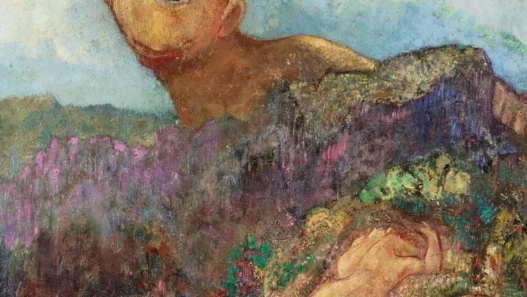
Beyond these, museums such as the Museo Reina Sofía in Madrid include examples of some of his most underated dark symbolist compositions, while other European collections, like the Kröller-Müller Museum in the Netherlands, feature major works such as The Cyclops, showing how widely his visionary art is appreciated today
If this post has sparked your curiosity and you want to experience Redon’s work in person, the good news is that his paintings and drawings are held in some of the world’s finest galleries.
What do you see when you meet its gaze?
For me, it’s a deep mourning that we carry forever in our souls for the parts of ourselves we have lost along the way. Parts that have become small and insignificant, like the creature we walk past every day and squirm at when it creeps in through an open window. But maybe that’s exactly the point. This tiny, weeping figure is a reminder that we all feel the fragile consequence of time pressing down on us. And yet, somehow, we continue on.
Further Reading: