




Greek mythology became the language of art for nearly five hundred years. Some myths were painted on vases before they were ever written down. In some cases, a vase is the only proof a myth existed at all. Which means the painting wasn’t illustrating the story. It was the story.
Put this to the test. Walk into the V&A, the Uffizi, the Louvre, the National Gallery. You’ll find room after room of gods, goddesses, monsters and heroes frozen in paint and marble. If you don’t know the stories, these pieces feel ambiguous. Dazzling, yes. But closed off. Knowing the stories changes everything.
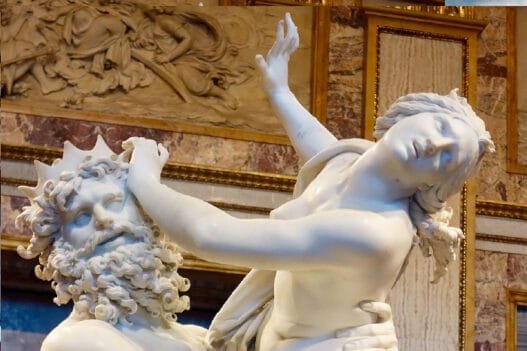
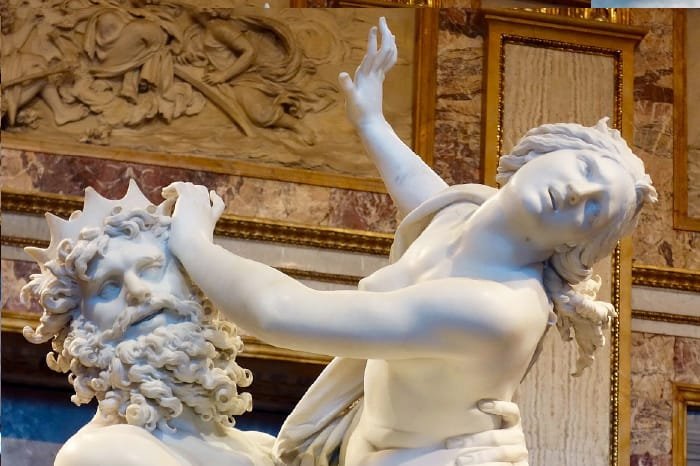
Art is always an expression of the artist, layered with the myths and stories we tell each other. Why Botticelli painted Venus the way he did. Why Bernini carved that particular moment of Persephone’s abduction. Why Medusa keeps appearing in paintings across centuries, always staring directly at you.
That’s what this guide is about. The myths behind the most iconic works, and what artists were really saying when they chose to paint them.
But the heartbreaking part of it all is this.
Not a single ancient Greek wall painting has survived. Vase painting is the only remaining example of Greek painting. The originals are gone. What survived did so almost by accident, buried in tombs, lost in shipwrecks, dug up centuries later.
The silver lining is that the stories survived even when the paintings didn’t. And as long as we keep reading the symbols, they always will.
Greek Mythology in Art: The Stories That Won’t Die
Mythology has always been a source of inspiration for artists, but underneath that is something far more uncomfortable. We only care about stories we can relate to. And the ones that last? They fracture our moral compass. They have us questioning why the human condition is so troubled, and why we keep repeating the same mistakes across centuries. Picture yourself standing in front of Prometheus.
He looks like any ordinary man. But he stole fire from the gods and gave it to humanity, knowing exactly what it would cost him. Every artist who has ever painted him is asking the same question: was it worth it? Most people think of Greek mythology as something you read. But for most of its history, it was something you heard. Spoken aloud around fires, performed by travelling singers, passed between generations long before anyone wrote it down.
The paintings came later, the visual record of stories people already knew by heart. When Rome conquered Greece, they did something that would secure that culture for centuries to follow. They adopted the myths wholesale, renamed the gods and exported them across an empire that stretched from Scotland to Syria. Jupiter was Zeus. Venus was Aphrodite. Neptune was Poseidon.
By the time the Renaissance rediscovered classical antiquity, the myths had already travelled further than any army. They weren’t being revived. They had never left. When Christianity spread across Europe, it could ban the old religions but it couldn’t erase the stories. The myths went underground into allegory, symbolism and art. Renaissance painters used mythological subjects as cover, depicting desire, grief and moral complexity through gods and goddesses in ways that would have been impossible through scripture alone.
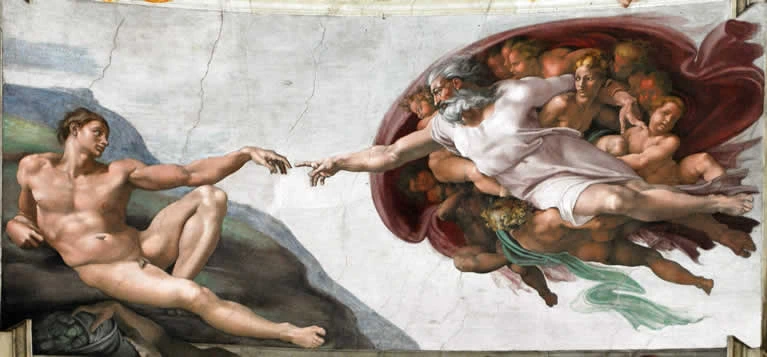
The Church approved the canvas, allowing these works to hang in its most sacred spaces. Raphael painted classical philosophers inside the Vatican walls. Michelangelo filled the Sistine Chapel ceiling with the human form in all its mythological grandeur. It comes as no surprise, when you look deeper at the symbolic choices, that each artist was smuggling the meaning in all along.
That’s why these images still stop us in our tracks. They’re not decorating a story. They are the story.
Why Greek Mythology Still Matter
Take Medusa. She appears in classical sculpture, Renaissance painting, Baroque ceiling frescoes, and contemporary street art, her face changing across every century, her meaning shifting with every culture that inherits her, and yet she never disappears. That’s the thing about these figures. They aren’t just characters from an ancient story. They are mirrors we keep holding up to ourselves, and what we see in them changes depending on who we are, and what we need them to mean.
Greek artists were uniquely obsessed with rendering the human body in idealised, mathematically precise form, not out of vanity, but because they held a deeply held belief that beauty was a mirror of the immutable laws governing the cosmos, and that physical perfection and moral virtue were not separate qualities, but two expressions of the same truth.
When they sculpted a god, they weren’t simply depicting a character from a myth, they were making a philosophical argument about the nature of reality itself, one that Plato would later articulate plainly: art had to serve a purpose, beauty was not decorative but instructional, and anything that didn’t point toward the good had no business being made at all.
By the Classical era, sculptors like Phidias and Praxiteles had mastered dynamic poses, accurate anatomy, and expressive realism, achieving all of this while maintaining that impossible idealisation, the no blemishes, the balanced musculature, the serene expressions that made their subjects look less like people, and more like the idea of people.
Which is perhaps the deepest irony of Greek sculpture.
The process of carving something so alive, so warm in its proportions, and so human in its gestures, required a material so cold and unreachable that the figure could never quite escape it. It remains frozen in time, a ghost in a shell that is heavier than any heart can hold.
These artworks transcend time not because of their technique alone, but because they tap into something deeper: archetypes, transformation, and the human condition.
Carl Jung and the Hidden Language of Greek Myth
Nobody understood the staying power of these stories better than Carl Jung, the Swiss psychiatrist who spent his career arguing that mythological figures weren’t just characters from ancient tales, but maps of the human psyche that every person on earth carries whether they know it or not. Jung called this the collective unconscious, a layer of the mind deeper than personal memory or individual experience, where certain images, patterns, and figures recur across every culture, every century, and every civilisation that has ever existed.
He called these recurring figures archetypes, and when he began cataloguing them, he kept finding the same faces. The Hero. The Shadow. The Great Mother. The Trickster. The figures that Greek mythology had already named thousands of years earlier: Perseus, Hades, Demeter, Hermes. Jung wasn’t discovering something new. He was giving modern psychological language to something the Greeks had already understood intuitively, that certain human experiences are so universal, so hardwired into what it means to be alive, that every culture independently invents the same characters to describe them.
Why is this specifically related to Greek mythology? Because these myths are some of the most interconnected, layered, and psychologically dense stories you’ll find in any culture, and nowhere is that more visible than in the family tree of the gods themselves, which is less a genealogy and more a detailed map of how power corrupts across generations. The pattern repeats with eerie precision. Each generation represents a psychological evolution. The primordials embody raw, chaotic forces. The Titans symbolise natural order and elemental power. The Olympians represent the structuring of society, intellect, and morality. Uranus suppresses his children out of fear. His son Cronus overthrows him, then swallows his own children for exactly the same reason. Zeus escapes, leads a war against his father, wins, and becomes king of the gods, then spends eternity terrified that one of his own children will do exactly what he did. The cycle never breaks. It just repeats with new names. That’s not mythology. That’s family. That’s history. That’s us.
The most compelling archetype, and the one that feels most urgent right now, is Narcissus, painted by Caravaggio in 1597. We have all seen our reflection, watched it age, noticed the vibrancy slowly dissolve with experience, and felt how deeply uncomfortable self-image has become in the age of social media. The myth isn’t the story of a boy and a pool of water. It is, as Jung would say, a map of a psychological state that human beings have always been capable of falling into, and perhaps always will be. We can recognise ourselves in the reflection, but only if we’re willing to look honestly. Most of us aren’t.
For artists, this is the deepest gift Greek mythology offers. When you paint Prometheus, you are painting every person who ever defied authority at enormous personal cost and asked themselves afterwards whether it was worth it. When you paint Persephone being pulled into the underworld, you are painting grief, transition, and the terrifying moment when the life you knew disappears and something entirely different begins. The myth gives you the image. Jung gives you the reason it still works.
Joseph Campbell, who built on Jung’s ideas, put it simply: the myth is the public dream, and the dream is the private myth. What that means for art is this. Every painting rooted in Greek mythology is operating on two levels at once, the story on the surface and the psychological truth underneath it, and the greatest works are the ones where both levels are fully alive.
The Birth of Venus — Botticelli (c. 1484–1486)
What do you really know about the Birth of Venus? The painting was essentially commissioned as an educational tool, by the notoreous Medici family, who hired the philosopher Marsilio Ficino to educate their young heir Lorenzo di Pierfrancesco, and Ficino believed that young people learned better through images than abstract ideas. This may sound virtous, but The Birth of Venus begins with an act of mutilation. Cronus castrated his father Uranus and threw the severed flesh into the sea. Venus rose from the foam that formed around it. The goddess of love and beauty was literally born from an act of violence and severed flesh. Botticelli didn’t paint that part, but every Renaissance viewer who knew their mythology knew exactly what had just happened before that serene shell arrived on shore.
Botticelli was chosen specifically to paint a visual argument about beauty, truth and goodness. But many sources say Botticelli may have been in love with the model, who was already dead. Art historians still argue about whether the face of Venus belongs to Simonetta Vespucci, the woman widely celebrated as the greatest beauty in Renaissance Florence. What is not disputed is this: Simonetta died at 22, years before the painting was finished, and Botticelli spent the rest of his life painting variations of the same face. He never married. And when he died in 1510, thirty four years after her death, his final wish was to be buried at her feet. That wish was honoured. Whether Venus is Simonetta or not, the painting carries the weight of that story whether Botticelli intended it to or not.
When we study the painting, we can notice the orange trees are almost certainly a Medici reference, their coat of arms featured golden balls resembling oranges. The laurel wreath on the figure covering Venus is likely a pun on the name Lorenzo. Botticelli hid his patron’s identity inside the painting.
Venus’s body is anatomically impossible, look at her pose, her neck is too long, her left arm is physically impossible in the position shown, and her weight distribution could not exist in a real human body. These are not mistakes. Botticelli deliberately made her unnatural, not just idealised but biologically impossible, because he was painting an idea rather than a person. It has been noted that it was deliberately borrowed from ancient Roman sculpture, specifically the Venus Pudica, the Modest Venus. Renaissance audiences would have recognised it immediately. Botticelli was in direct conversation with antiquity.
For me, the most radical thing about this painting was its scale. Large format nudes painted for private homes were essentially unheard of. Without the mythological framing, without Venus being Venus, it would have been scandalous. The myth gave Botticelli permission to do something nobody had done before.
Look closely and you will notice that nobody in the painting is actually touching. Zephyrus blows from a distance, the Hora of Spring rushes forward with her cloak but hasn’t reached her yet, and Venus stands completely alone on the shell, one hand covering her breast, the other gathering her hair. For a painting that is supposed to celebrate love and beauty, there is a profound isolation at its centre. She has just arrived into the world and already nobody can quite reach her.
Perhaps that is the point. Beauty, real beauty, the kind that stops a room and makes people feel something they cannot name, has always been untouchable. We circle it. We reach for it. But the moment we think we have it, it has already moved on. The Neoplatonic idea behind the painting says exactly this: physical beauty is not the destination, it is the doorway. Botticelli didn’t paint Venus to make you desire her. He painted her to make you feel something you couldn’t explain, and then follow that feeling somewhere deeper.
The Gods and What They Represent
From Zeus, Athena and Apollo to heroes like Heracles and Odysseus, these figures form a key to understanding the human mind and why it operates the way it does. Here are three of the most significant.
Zeus — King of the Gods, Symbol of Power and Authority
Athena — Goddess of Wisdom, Strategy, and Art
Hades — God of the Underworld and the Afterlife
Symbolising death, the unseen realm, and hidden wealth, Hades represents the turmoil within us. In Greek storytelling he is a silent but powerful force, governing the underworld with quiet intensity and shaping how we visualise the afterlife through both ancient and modern lenses. The most famous artwork: The Rape of Persephone by Bernini.
Talking Points for Mythology Lovers
- Why do ancient myths still resonate in modern art?
- What role does personal myth-making play in contemporary practice?
- Can mythology help artists explore identity and cultural heritage in a globalised world?
For a deeper dive into how artists use myth to shape emotional and symbolic landscapes, explore:
Actionable Creative Checklist
Whether you’re an artist, writer, educator, or designer, Greek mythology offers rich symbolism and timeless narrative power. Use this checklist to spark ideas and deepen your connection to classical stories.
Get inspired by:
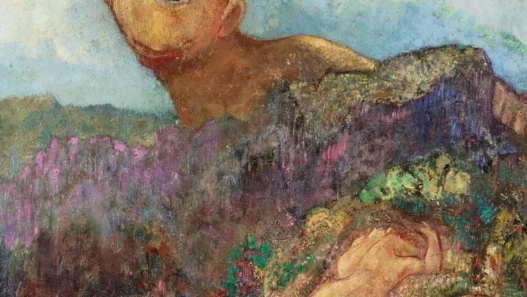
Odilon Redon (dreamlike mythic worlds)
Leonora Carrington (folkloric surrealism)
Jean Delville (Symbolist narrative painting)