




Lyrics by Lorenz Hart, 1934: “Blue Moon, you saw me standing alone* *Without a dream in my heart, without a love of my own…”
Every day the sun gives us the world as it is. Every night the moon gives us the world as we imagined it.
The moon is one of the most consistent and stark presences in what I can only call the celestial library, a sky full of symbols we have been reading for thousands of years, and still misreading today.
We can capture it in high definition now. We can see every imperfection, every crater, every ancient footprint left by time and collision. And yet when most of us think of the Blue Moon, we think of two things: a second full moon in a single month, or a phrase we use when something almost never happens.
We are looking at it. We are not seeing it.
I remember visiting the countryside once, no light pollution, no sound of machinery, nothing but stars and the moon filling the entire sky. It provided enough light to see the shimmering blades of grass, reflecting the stillness of the night back into the atmosphere. Standing there, I felt two things at once. The pull of it. And the loneliness of it.
This strange rock in the sky, floating in silence for billions of years, carrying every myth humanity has ever placed on it, and none of them its own. We’ve given voice to something that just exists, how ironic.
Before the paintings, before the songs, there was just the calendar problem. Most years carry twelve full moons. But the lunar cycle does not divide neatly into our months. Every two and a half years or so, a thirteenth full moon appears. An extra. An anomaly. A moon that technically should not be there.
So like everything we find unusual, we named it. We said: this one is different and then started painting it.
The Artists Who Painted What They Could Not Name
Long before the Blue Moon had a name, the moon itself was already one of the most loaded symbols in human visual history. It governed calendars, tides, harvests, and the rhythms of the body. To paint it was to paint time itself.
In ancient Egypt the moon was tied to Thoth, god of wisdom and writing. In Greek art, Selene drove her silver chariot across the night sky. These were not decorative choices. They were cosmological statements. The moon in the frame said: what you are looking at is connected to something far larger than this canvas.
The Romantic painters felt this instinctively. Caspar David Friedrich’s T*wo Men Contemplating the Moon* (1825) shows two figures standing with their backs to us, looking up at a crescent moon through a tangle of bare winter trees. We never see their faces. We only see what they see.
Friedrich understood something the ancient painters also knew. The moon is not something you look at. It is something you look toward.
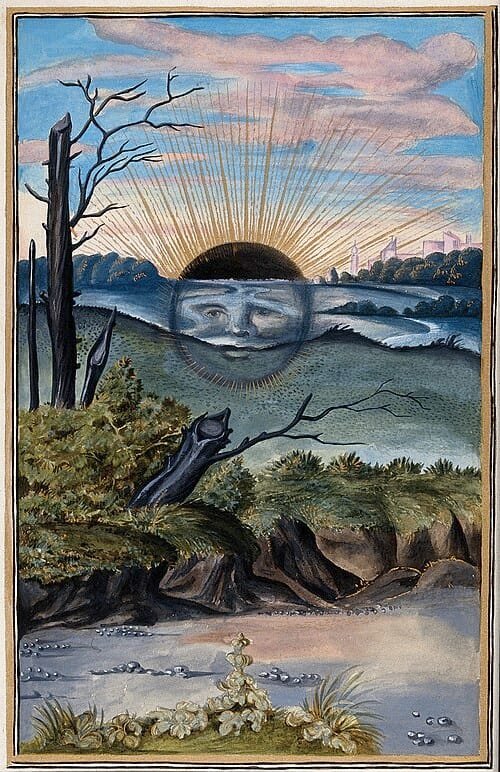
If that idea of figures turned away from us, facing something vast and unknowable, interests you, I wrote about a painting that does the opposite in The Black Sun. Same sky, very different feeling.
The Paintings That Got There First
Two Men Contemplating the Moon was one of the first paintings I found when I started looking at this subject. And I think I understand why it stopped me.
Friedrich painted himself into this. The two figures are him and his student August Heinrich, standing together at the edge of a forest, looking up at a crescent moon in its final phase. A moon that is dying, slowly leaving our world of hue and contrast.
The oak trees around them are contorted, almost restless, which in German Romantic symbolism was deliberate. Oaks represented mortality and the ancient world. Friedrich was painting the feeling of standing at the edge of something ending, with someone beside you, neither of you speaking.
I keep returning to Redon’s The Black Sun, a painting I have written about elsewhere, and how in both works there are arms wrapped around the other figure while they witness the end of something and the start of something new. The fear is detached through the stillness.
Their attire tells you these are educated men, and their posture tells you they are not here for leisure. They came to think and observe. Leonardo da Vinci believed observation was the absolute foundation of all knowledge and creativity. He coined the term “saper vedere’, knowing how to see, and his notebooks return to this idea constantly. Perception is not passive.
It is the most active thing a human being can do. If you have never read Leonardo’s Notebooks, start there.
What strikes me is that we never see their faces. We only see the moon they are looking at. Friedrich understood that the moon means something different to everyone who looks at it, and the moment he showed us their expressions, it would have become their meaning, not ours.
This painting has nothing to do with the Blue Moon. And yet it is a perfect cornerstone for understanding why the moon transcends art. Look closely enough and the chaotic environment nestling that crescent is a metaphor for our own lives, for how we handle change, uncertainty, and the strange comfort of standing beside someone at the edge of something new.
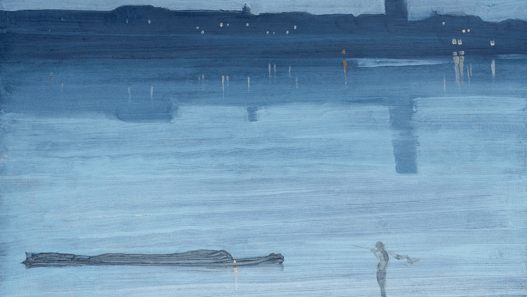
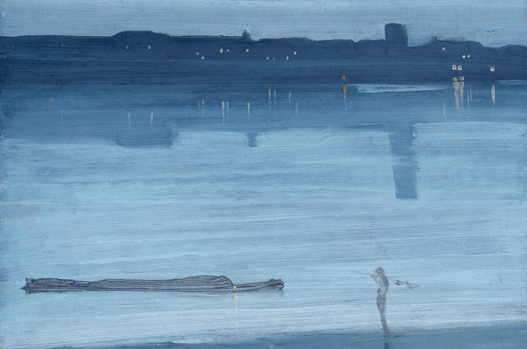
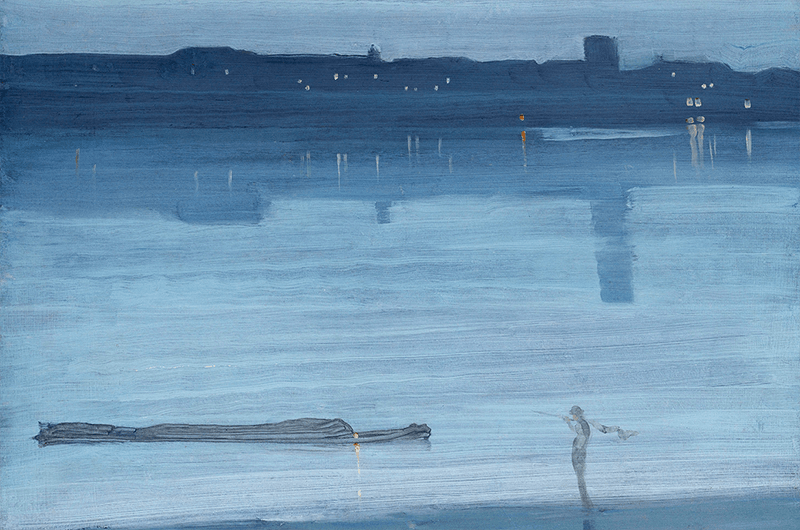
James Whistler took a different approach entirely. His Nocturne: Blue and Silver, Chelsea (1871) dissolves the Thames into the atmosphere. Soft, silvery, barely there.
Unlike the statement moon in Friedrich’s painting, this moon is a mood. And the most quietly radical thing about it is that the moon is not even visible. It is hidden off-canvas entirely. Whistler leaves us to feel the time of day rather than see it. The light trails and scatters across the water, a lone figure breaks the stillness of the foreground, and somehow we understand exactly what this moment is. We have all stood somewhere like this.
What strikes me most is the orange lights. Floating like lanterns across the opaque and translucent buildings, they carry a warmth that has no right to exist in a painting this cold and quiet. But they do. And they bring with them a sense of yearning.
Something like looking forward to a warm meal after a long walk home under the moonlight.
This is what the Blue Moon does too. It arrives in the coldest part of the dark and makes you feel something you were not expecting to feel.
When was the last time you felt something warm and inviting in the darkness of the night?
Then there is Alphonse Mucha’s Clair de Lune (1902). When have we not associated the beauty of the moon with the feminine? In romance and symbolism they are the same thing. Mucha’s work is almost a window into what art and intimacy would look like if dressed for the public. He hides subtle expressions, gestures and personal feelings into many of his pieces, and you feel it most in the subjects he chooses to paint. This moon belongs to one person and their feeling, not to the whole sky.
Clair de Lune is a beautiful arrangement of the sacred geometry we witness every time we look at the night sky. The central figure, shy and luminous, is adorned with the night sky draped over her, unified by glowing circles. If anything speaks to feminine energy and spiritual practice, it is the circle. Circles represent wholeness, the cyclical nature of life, and a kind of equality that a rigid line pointing toward a fixed goal can never offer. The unbroken shape reflects intuition, creation, and the natural flow of things. The moon has always moved in circles. So have we.
There is no Blue Moon in this painting. But the spirit of one is everywhere in it. That sense of a rare and private celestial moment, witnessed by one person, quietly celebrated. A twilight festival of one, that somehow feels like it belongs to all of us.
And finally, Georgia O’Keeffe’s Lake George by Moonlight (1922).
We have tackled the moon as romance, as mortality, as longing. In this painting, the moon is none of those things. It is structural. It is balance. And it is by far the most abstract example of the moon’s quiet power in this collection.
The way I want you to approach this painting is as if it’s a lucid dream. Can you find the moon?
It is a tiny, pale shape at the very top edge of the canvas, almost perfectly centred. While the deep night sky and the water below are filled with rich blues and dark greens, the moon itself and its reflection in the centre of the lake appear almost white. O’Keeffe understood something that every painter who works with light eventually discovers. The reflection of an object tells you as much about the world as the object itself. The moon above and the moon below. What exists, and what the water makes of it.
O’Keeffe painted the moon deliberately small and high, forcing your eyes to travel through rolling green hills and dark mountains before you find it. That journey is the point. The moon, like the sun, transforms the entire world around it even when it occupies only a few millimetres of canvas. Its power is not in its size. It is in what changes because it is there.
This is the Blue Moon distilled to its simplest truth. Something small and rare, easy to miss, that quietly changes the colour of everything around it if you know where to look.
The Blue Moon and the Art of Wanting Something Rare
Here is what connects all of these painters, across centuries and styles. They were not painting the moon. They were painting what the moon does to us. The way it pulls something out of us we did not know was there.
The Blue Moon concentrates that feeling. It is the extra moon, the one that arrives after you thought there would be no more. And because it was not supposed to be there, we made it mean more than all the others.
In almost every spiritual and symbolic tradition, the Blue Moon carries associations with rare opportunity, heightened intuition, and the kind of clarity that only comes when you have been waiting long enough. Some practitioners consider it the most powerful moon of any cycle, not because it is astronomically different, but because rarity itself creates meaning.
Anselm Kiefer’s Man Under a Pyramid (with Moon) (1978) understood this. His moon is consumed with myth and memory, pressing down on the figure beneath it like accumulated history. If an artist can tell you their entire story through one painting, it truly is a testament to the hours of refinement throughout their lives. Kiefer’s moon was never the moon above us. It was the moon inside us.
One thing kept following my thoughts across every painting in this article. The colour.
Whistler’s blue Thames. Mucha’s blue night sky.
O’Keeffe’s blue lake. Blue has been present in every image we have looked at, and it has never once meant sadness.
When we deconstruct the colour itself, something remarkable surfaces. Long before blue was used to describe a sad mood, it was one of the rarest and most expensive treasures in the ancient world. True blue pigment did not come from common soil. It had to be mined as a semi-precious stone called lapis lazuli from the remote mountains of modern-day Afghanistan, travelling thousands of miles along the Silk Road.
Because this stone was so scarce, ancient Egyptians invented the world’s first synthetic pigment by baking sand and copper in furnaces, while ancient India cultivated the indigo plant to create a dye so valuable it was called Blue Gold. Blue did not represent gloom. It was a hard-won symbol of wealth, divine power, and the courage to travel far from home.
The Blue Moon was never really blue. But the colour we gave it was never really sad either. Both are lies we inherited without questioning. Both are worth looking at again.
Why We Needed the Lie
Truth will reveal itself naturally. But sometimes we need a lie to believe a myth.
The Blue Moon is a calendrical accident, a quirk of arithmetic. It carries no more light than the full moon before it or after it. And yet one of the most precious things we cherish on this earth is meaning. And meaning is almost always something we impose rather than discover.
The ancient Egyptians imposed it on the moon when they tied it to their gods. The Romantics imposed it when they stood beneath it and felt the sublime. We imposed it when we took a mistake in a 1946 magazine and built a phrase around it that now appears in songs, paintings, greeting cards, and in the mouths of people reaching for a way to describe something they have been waiting for their whole lives.
Is the world enough without it?
We have looked at the sky and found hope there. We have looked at a colour and made it mean divinity, then sadness, then rarity. We have looked at an accident in a calendar and decided it deserved a name. Because we are the kind of creatures who cannot leave things unnamed.
To paint the Blue Moon, or to write about it, is to participate in this same ancient project. There is meaning to be found from the lens you look through, shaped by your memories and your experiences. You are adding to everything humanity has ever said when it looked up and decided the darkness needed a story.
Once in a blue moon, we get to do that.
And here we are.