Every culture that has ever existed has worshipped the sun. It is the most universal symbol in human history: life, warmth, clarity, god. A story told across every ancient civilisation. So what happens when you take that symbol and drain it of everything that made it safe, while leaving it in the sky?
You get something far more interesting.
The black sun keeps the shape of comfort and removes the comfort itself. That is exactly what makes it so durable as a symbol. It has appeared in alchemical manuscripts, Renaissance engravings, Symbolist paintings, Surrealist forests and Jungian psychology. Each tradition found something different in it, but all of them were circling the same idea: that there is a version of the sun that does not illuminate, and it may be the more honest one.
Sol Niger — the alchemical roots
To understand where this symbol comes from, you need to go back to the alchemists.
The earliest recorded use of the black sun as a symbol comes from medieval and Renaissance alchemical writing, where it was known as Sol Niger, Latin for black sun. It referred to the first stage of the Opus Magnum, the Great Work, a process alchemists believed could transform base matter into gold.
Alchemists have always occupied a strange space in our imagination. They worked with dark substances, their practice sitting somewhere between science, spirituality and obsession. Their whole project was transformation, turning something base and broken into something precious.
Sound familiar?
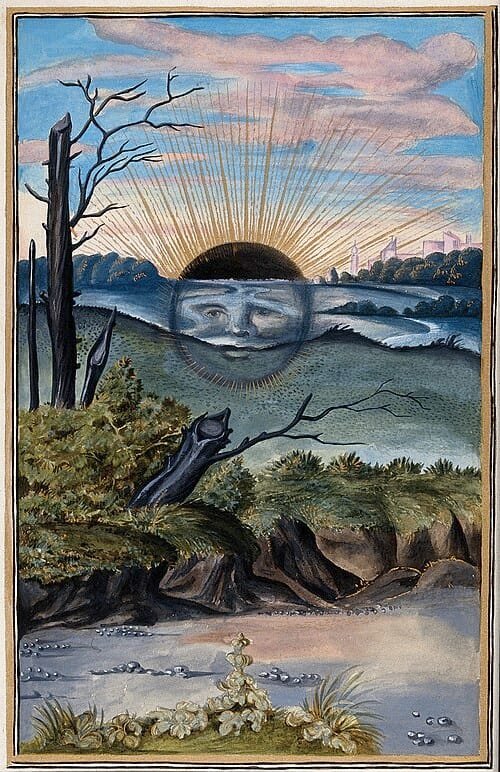
That first stage was called the nigredo, the blackening. Raw matter had to be broken down completely before it could be rebuilt into something pure. The black sun presided over this stage. Crucially, it was not a symbol of failure or despair. It was a symbol of necessary dissolution. You could not skip it. The darkness was the work.
Most of us know that feeling. The period before something changes, where everything feels like it is falling apart rather than coming together. The alchemists had a name for it. They just drew it as a sun with no light.
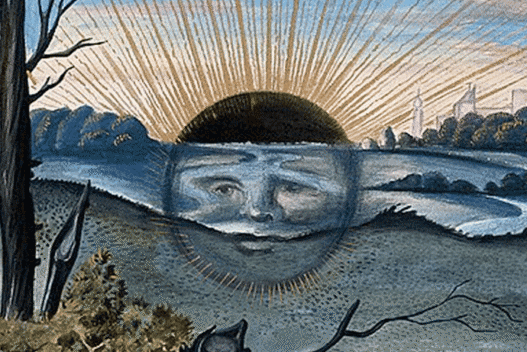
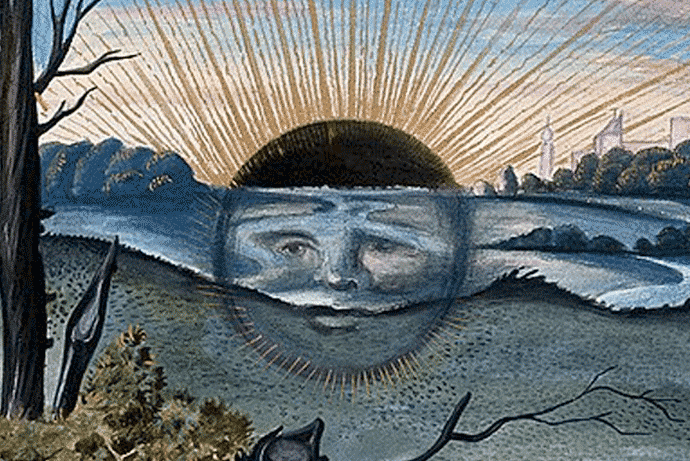
The most vivid visual record of Sol Niger appears in the Splendor Solis, an illuminated alchemical manuscript from 1532 to 1535. Its paintings are among the most extraordinary in the alchemical tradition, and the black sun sits at the heart of its symbolic sequence. Not as an ending, but as a beginning. The gold was always on the other side of it.
The literary bridge
The symbol might have stayed inside alchemical tradition had it not been carried into literature. That is where things get interesting.
The French Romantic poet Gerard de Nerval was not someone who wrote about darkness from a safe distance. He suffered severe mental breakdowns throughout his life, was institutionalised multiple times, and died by suicide in 1855. A year before that, he wrote of “le soleil noir de la Melancolie,” the black sun of melancholy, in his poem El Desdichado. The title translates roughly as “the disinherited one.” A self stripped of everything, including its light.
It was one line. But it lodged itself in the French literary imagination and never left.
Nerval’s black sun was the darkness that descends on a mind that has lost something it cannot name. That shift, from a symbol of transformation to a symbol of inner darkness, is the bridge between the alchemists and the Symbolist painters who came after.
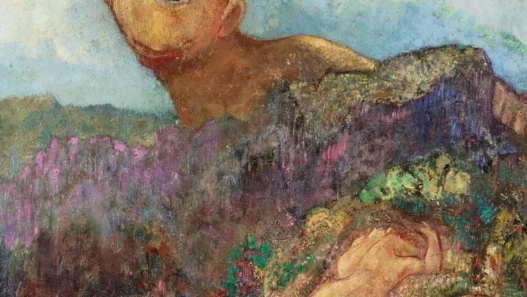
Odilon Redon almost certainly knew the line. His entire early career, a series of charcoal works he called Les Noirs, reads like a visual translation of it. Floating faces, creatures half-formed in shadow, figures standing at the edge of something they cannot see clearly. You can feel Nerval in all of it, the sense that the darkness is not empty but inhabited.
Artists Who Painted the Black Sun
Albrecht Dürer’s Melencolia I (1514) is the first major painting to inhabit the territory of the black sun, without ever depicting it directly. A brooding winged figure sits surrounded by the instruments of geometry and time: compasses, an hourglass, a magic square. She does nothing with any of them. The sky is storm-dark. A comet crosses what should be a sun.
Dürer was painting the condition the black sun describes: a mind that has seen too much and cannot move. It is the visual ancestor of everything that followed.
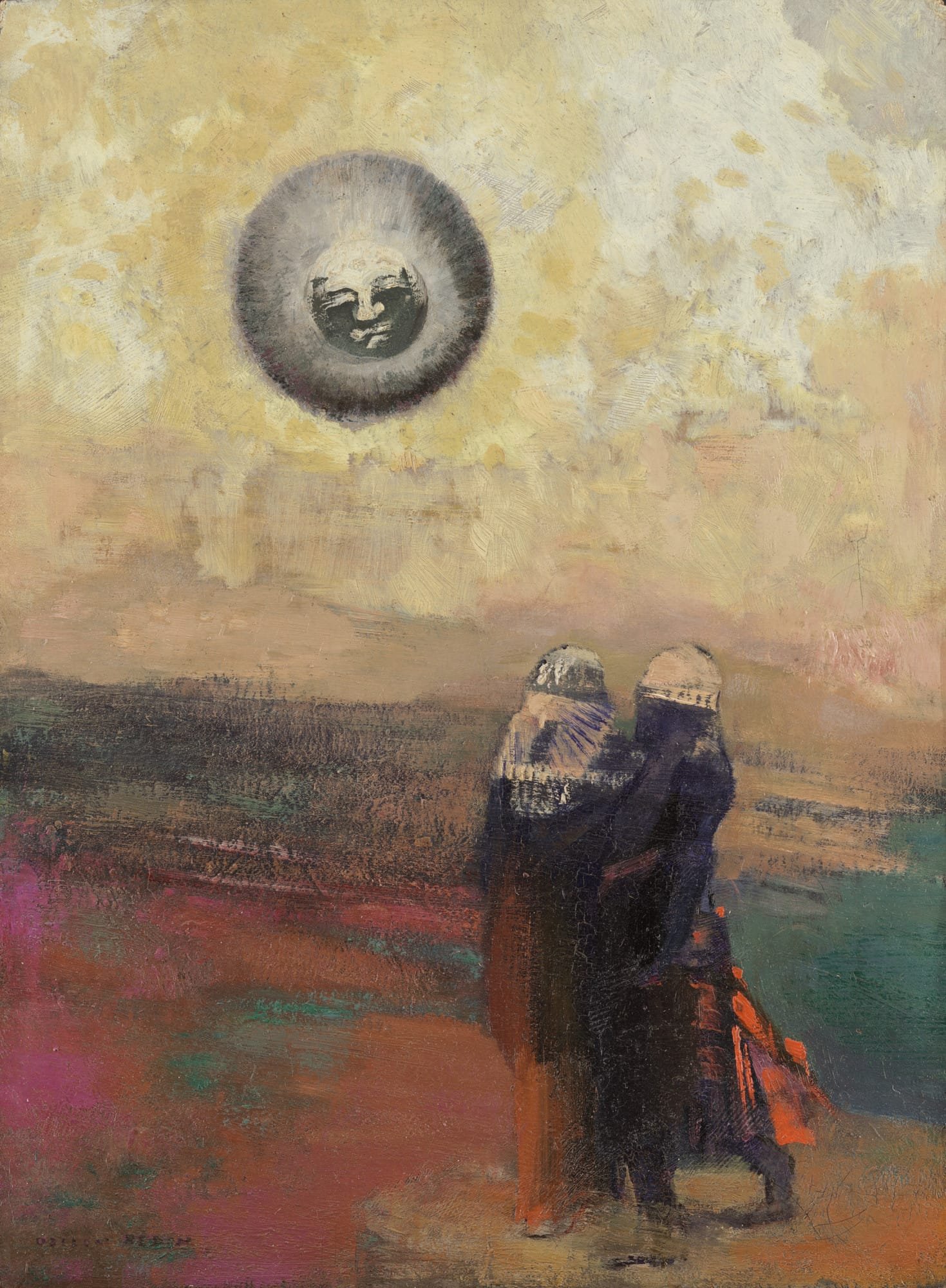
Redon’s The Black Sun (c. 1900) makes the symbol explicit. Two cloaked figures stand with their backs to us, gazing up at a dark orb that bears a human face. The sky around it is warm and golden, which makes the darkness at its centre stranger, not softer. The sun watches without warming. It presides.
Look closely at the space between the two figures. In the shadow there, barely visible, one arm reaches around the other. The void is absolute and still the instinct toward each other survives it. That detail is the emotional heart of the painting. Redon was not painting despair. He was painting what people do in the presence of it.
Redon was not alone in this territory. Francisco Goya painted his Black Paintings directly onto the walls of his own home between 1819 and 1823, Saturn devouring his son, a dog half submerged in rising sand, darkness consuming everything from within. Max Ernst’s Surrealist forests feature inverted suns and blinding discs, light reframed as threat rather than comfort. Hilma af Klint went further still, her abstract cosmograms reducing the sun to a dark orbital form, a spiritual force stripped of its warmth entirely.
Each of them arrived at the same place from a different direction. The sun as something that watches rather than gives.
Jung and the shadow self
So far we have traced the black sun through alchemy, literature and painting. But it was Carl Jung who finally gave it a psychological language that stuck.
Jung wrote extensively on Sol Niger in his study of alchemical symbolism, arguing that the alchemists were not describing chemistry but the inner life. The nigredo, the blackening, was all about the shadow, the part of the self that consciousness refuses to acknowledge. Some people may view this as something dark and dangerous, but this territory serves one main purpose. To reflect the truth you hide from.
Think of it as a shapeless presence that follows you everywhere. You have built it yourself, piece by piece, from everything you refused to feel. You cannot remove it. By trying to redact this formless void, you actually end up creating a bigger hole that will swallow you entirely. The trick is to learn to see it, to walk towards it with eyes open. Which is ironic, because it is like sleepwalking, except it is your own home and you know where everything is. It is the art of sitting with loneliness rather than running from it.
In Jung’s reading, the shadow is everything we have pushed out of the light. The impulses, fears and failures we do not look at directly. The black sun is the moment you are forced to confront them.
In my experience, it is actually the necessary darkness before genuine self-knowledge becomes possible.
The alchemists called what came after the albedo, the whitening. Jung called it individuation. The gold was still on the other side. Gold, for centuries, symbolised something beyond human retention. Think about how the Egyptians buried gold not primarily as a symbol of wealth, but as a spiritual tool to achieve immortality. Because gold never tarnishes, rusts, or decays, they viewed it as an indestructible metal tied to the gods. And we know this, so we search the depths of the world looking for that shining beacon.
What makes this reading so enduring is that it connects the symbol across every tradition it has appeared in. The alchemist’s nigredo, Nerval’s melancholy, Dürer’s paralysis, Redon’s void are in essence all describing the same interior experience. The black sun is what it feels like to be in the dark before the turning point, without knowing it is a turning point.
What it means
The black sun is an oxymoron. Let’s think about this for a moment. A sun by definition radiates light and black by definition is the absence of light. Putting them together creates something that cannot physically exist, which is precisely what gives the symbol its power.
The thing I love the most is that it sits in good company. “Living death,” “deafening silence,” “cruel kindness.” The contradiction is not a mistake, it is the whole point. The tension between the two words is what forces the mind to stop and reach for a deeper meaning.
What makes the “black sun” particularly interesting as an oxymoron is that it does not cancel itself out the way some do. You do not read it and think “that’s impossible, moving on.” You read it and feel something.
The shape of the sun is still there, the familiarity, the scale, the presence. But the light is gone. What remains is a sun that observes without giving.
Every tradition that has encountered this symbol has arrived at the same conclusion. You do not go around the black sun. You go through it. The gold, the light, the turning point, all of it is on the other side of looking directly at what you have been avoiding.
I travelled through India some years ago and stopped to photograph the sun. Something I had never really done before. What struck me was how differently it felt there, worshipped, present, enormous. Then night came, and I found myself lying awake thinking through the day. What I had done. What I hadn’t. The sun was gone but I could still feel it watching the hours.
That is my black sun. Not darkness. The invisible sun at night, holding a mirror up to everything the daylight witnessed.
Maybe that is what it means for all of us. Not the absence of light. The presence of everything the light refused to show you.