The Blue Moon Is a Lie We Needed
Why Artists Have Painted the Devil for 1,500 Years

Why Artists Have Painted the Devil for 1,500 Years

Every time humanity painted the Devil, it was painting a mirror, and the face in that mirror kept changing. From an almost angelic blue mosaic in Ravenna, to Bosch’s hollow-stomached monster, to Blake’s beautiful and defiant Satan, the Devil in art was never really about evil. He was a barometer for whatever a society couldn’t look at directly. This is the story of what five centuries of painting the Devil reveal about human fear, and what it says about us now.
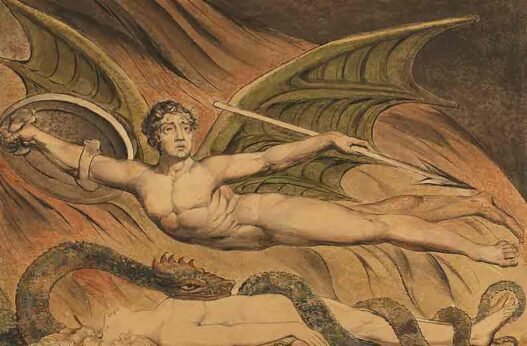
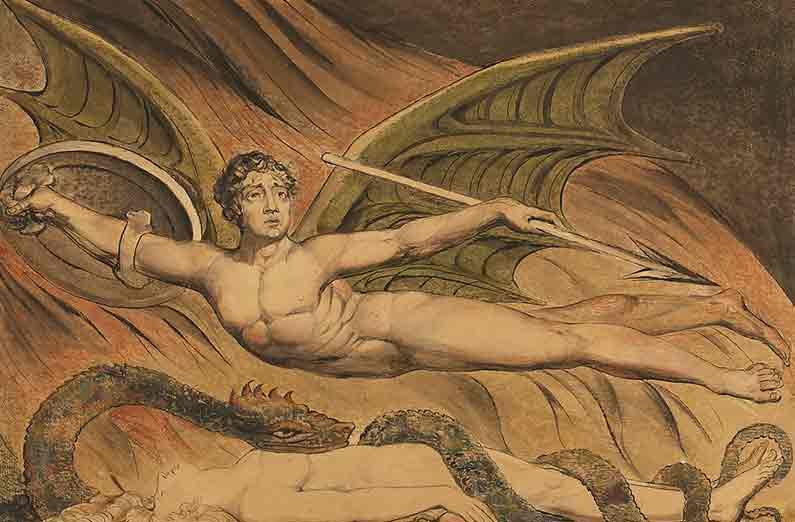
Satan Exulting over Eve, watercolor by William Blake. Satan Exulting over Eve, watercolor by William Blake.
Satan Exulting over Eve, watercolor by William Blake.
Every time humanity painted the Devil, it was painting a mirror. And the face in that mirror kept changing. The thing about mirrors is that depending on the surface, we can either see who we truly are, or a mask of what we’ve become. Even Narcissus knew this, falling in love with his own reflection on still water. The things we feared most in ourselves kept changing too.

The Earliest Painting of the Devil Wasn’t Frightening at All
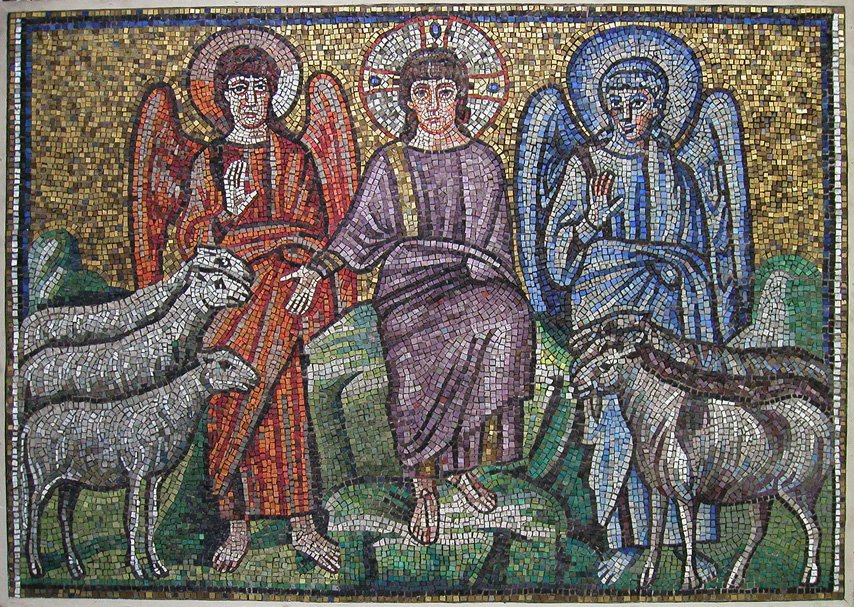
6th-century Byzantine mosaic of Christ separating the sheep from the goats, with a blue angel believed to be the earliest depiction of Satan, Sant'Apollinare Nuovo, Ravenna
A 6th-century Byzantine mosaic from Sant’Apollinare Nuovo, Ravenna, Italy. The blue angel on the left is believed to be the earliest surviving depiction of Satan in Western art.
The first Devil ever painted wasn’t even scary. In one of the oldest known depictions in Western art, the Devil is blue. What’s strange is the blue is almost angelic blue, created entirely out of mosaics in Ravenna, Italy. This blue being seems as ordinary as anyone standing in the same line as you, waiting to make an order. This creation represents what the Devil really is. He is one of us, someone to sit beside, even shelter, until you understand why he exists. Sharing the same space and energy. Look closely at the painting and you’ll see he stands beside Christ during the Separation of the Sheep and the Goats. In this story, you genuinely cannot tell which figure is which, and at the very moment Christian art invented the Devil as a visual figure, it made him almost indistinguishable from the divine. In modern times, we’ve seem the Devil humanised, if you’ve seen the movie Constantine, it’s clear the Devil is most frightening when he almost fits. That’s the same logic as the Ravenna mosaic. The 6th-century artists who painted the Devil almost angelic were sending a different message. The thing that truly unsettles us isn’t the monster. It’s the thing that looks like it belongs, until it doesn’t.

Why the Devil Became a Monster in Medieval Art
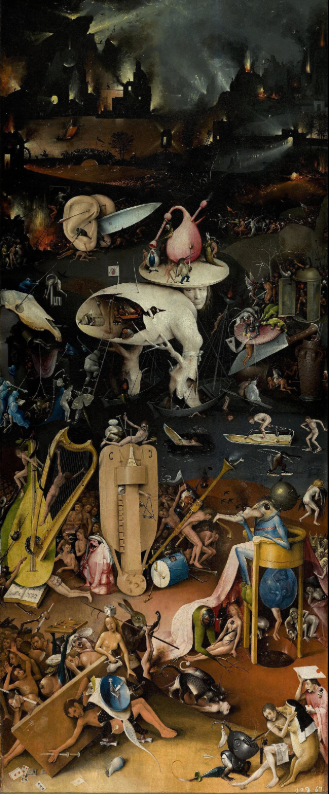
Detail of the Tree-Man figure from Hieronymus Bosch's The Garden of Earthly Delights, showing a hollow torso containing tormented sinners
Detail from the Hell panel of Hieronymus Bosch’s The Garden of Earthly Delights (c. 1490–1510), showing the Tree-Man figure with a hollow torso where sinners are tormented.

The Church needed him frightening. So the artists went to work.

This is truly the role of the artist. How many of you pluck an idea from the sky, then strip away everything that isn’t palatable, until it’s easier to digest? Pan’s goat legs. Satyrs’ horns. The animalism of things that lived outside, beyond human control. When the artists went on this journey, they added bat wings, clawed hands, and rot. Anything that would reach into the underworld and relieve our nightmares onto the canvas. Bosch gave his Devil a hollow stomach that was also a room in hell, where sinners were being digested alive. It was not subtle. It wasn’t meant to be.

This is what collective fear looks like when an entire civilisation agrees to paint the same nightmare.

But here’s what I find genuinely fascinating. The body they built for the Devil was assembled from things that already existed. Pan. Satyrs. The wilderness. The flesh. There is nothing original about the Devil, and why would there be? We are most afraid of things we can already see in plain daylight. Creatures we know exist, with overgrown limbs, textured and cracking. The Church didn’t invent a monster. It took everything it considered dangerous about human nature, bundled it into one figure, and gave it a name.

Jung would call this the Shadow. The part of the self that cannot be integrated, so it gets externalised. The Devil was everything the artist feared, pressed to the other side of the coin, cast opposite to Christ.
Monthly Checklist
Put it into practice
Each month a new symbol, a new theme, and a set of tasks to help you see art differently. Check off what you explore — your progress saves in your browser.
Open the checklist →

Then the Romantics looked at him and felt something unexpected: recognition.

If you’re anything like me, you will struggle to put romance and the devil in a sentence, but stay with me for a moment.

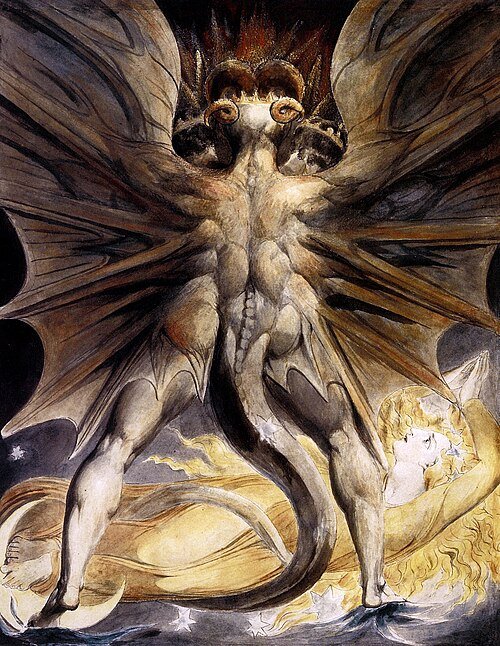
William Blake, for all his spiritual, dreamlike, and symbolic works, didn’t paint Satan as a creature to be feared. He painted him with outstretched arms, muscular and lit from within. His specific blend of biblical visions and poetry takes a figure of terrible beauty and complete defiance and strips it down into living flesh, and as we all know, flesh is very opulent in Christianity and has multiple layered meanings.

The Devil was the part of humanity that refused to submit. This was not a theological argument, it leans more on the political side. Blake was writing and painting at the height of revolution. The American colonies had just told a king where to go, and it was no surprise that France was next.

I find this the most unsettling turn in the whole story. Because his Satan is one of the most compelling figures in the history of art, and equally one of the most frightening, but because it reveals something uncomfortable: the Devil in painting was never really about cosmic evil. It was always a container for whatever the current age needed to reject, or secretly admired, or couldn’t admit out loud.

If you see Blake’s creations, you know he has a rebellious streak, and this painting of the Devil is one of them.

What does that say about all the other centuries that made him a monster?

William Blake's painting of the Great Red Dragon looming over the Woman Clothed with the Sun, from the Book of Revelation
William Blake's depiction of the apocalyptic Red Dragon from the Book of Revelation, part of his Great Red Dragon series (c. 1805–1810).

Goya painted the Devil on the wall of his own house

Truth will reveal itself naturally. But sometimes we need a lie to believe a myth.

The wall he looked at every day. The Great He-Goat that he painted in the last years of his life, when he was deaf, isolated, and watching the world he’d survived tear itself apart. One of my favourite books on this stage of his life is called Goya’s Ghost. This will give you a deep insight into how an artist so prolific would fall into a void when the one thing is taken away from them.

Now, back into the four walls of his house. This enormous dark goat presiding over a crowd of hollow, terrified faces. There is no beauty in it, just a mass of people, gathered in the dark, around a presence none of them are leaving. We can stop on this for a moment and think back to the fact that Goya had lived through the Inquisition.

Through war. He had watched ordinary people do extraordinary things to each other, and what he painted on that wall wasn’t a supernatural force. It was something far worse.

A crowd. And what a crowd becomes when nobody leaves and nobody’s watching.

Look at the faces again and think how often you see them in your world. But for Goya, they are familiar. They are the faces Goya had already drawn once before, in another room of his memory, the same slack jaws, the same hollowed eyes, lined up in rows on the etching plates of his war years.

Bodies stacked at Chinchón. Men shot in ditches at dawn. He had put those faces in front of firing squads and called it Los Desastres de la Guerra, and now here they were again, decades later, gathered not to die but to worship.

There is something fitting in the fact that we don’t have the whole crowd. When the painting was torn off the wall and dragged onto canvas in the 1870s, a section of the right side was lost in the process, gone forever. The way so much of what Goya painted was eventually lost, the way bodies are lost in a war, the way faces are lost in a crowd that has stopped counting its own number.

We are missing part of the mob, but it hardly matters. The point was what happens to the rest of them, the ones who stayed in frame.

The shape psychology goes mostly unnoticed. The circle, in this format, has always symbolised ritual. For centuries, it was a show of unity with a group of people who have the same belief system and are there for all the same reason.

Satan looms [in the form of a goat], a black shape cut out of the moonlight, presiding over a whose faces have already given up on hope. Goya was around 75 when he painted it. Alone, deaf, and falling apart in body and mind. Seeing people appear since he couldn’t hear them.

The creepy observation is how the goat only needs them to stay. That is the whole of its power, and it is the same power a mob has, the same power an army has, the same power a massacre has. It’s not direct, but symbolised in the shadows, from below, multiplied by the dark and by the silence and by every face that does not turn away.

Here’s my actual take

The Devil measures heat, and we know the Devil exists in the underworld, where it’s hot beyond what we can imagine.

When a society is most afraid of chaos and the body, the medieval Devil: grotesque, animalistic, flesh-driven, arrives. When it’s afraid of conformity and the death of the individual, the Romantic Devil: beautiful, defiant, free, shows his face. Then when we think of what the Devil is made up of, it’s all these fragments in our mind, skinned together to create a scary form.

How close is the Devil to us? I don’t mean in proximity, I mean when we look in the mirror. Or better yet, stirring the thoughts in our mind.

He is whatever we cannot look at directly in that moment.

Which means the most interesting question isn’t what the Devil symbolises. It’s what he was being used to hide. What each century refused to acknowledge about itself, and painted red, and gave horns, and put outside the gates.

Because the thing about a mirror is that it only works if you’re brave enough to look.

Previous Post
Whistler's Nocturne Blue and Silver Chelsea 1871 moonlit Thames painting blue moon symbolism in art

The Blue Moon Is a Lie We Needed