




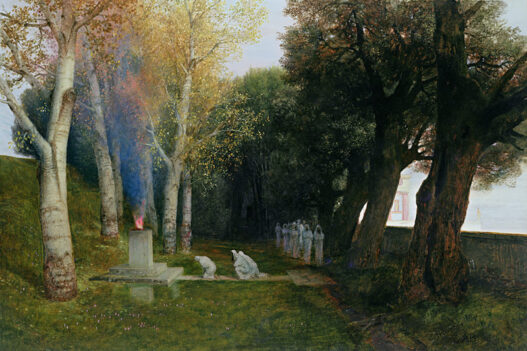
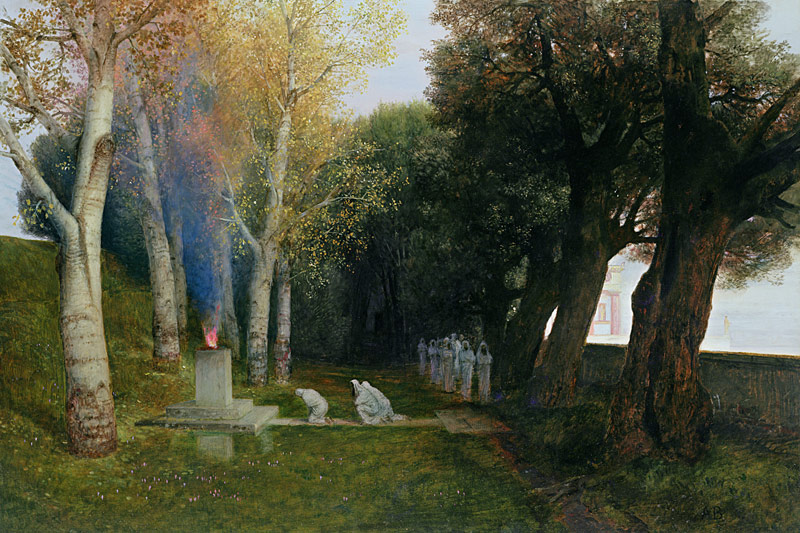
Let’s be honest. Most classical art is beautiful, but a little dull. And then there’s Arnold Böcklin’s The Sacred Grove.
The first time I looked at this painting properly, it didn’t feel like art history. It felt like a funeral I had wandered into uninvited while exploring the groves of Florence. The white robed figures moving in that slow, deliberate procession. The trees swaying in from either side like witnesses whispering to one another. The fire burning quietly in the dark. Something about it reached past the canvas entirely and landed somewhere much older.
In Hinduism, white is the colour of mourning. Not black. White.
It represents purity, the release of the soul, the stripping away of everything that was temporary. When I look at Böcklin’s robed figures moving toward that ruined temple, that’s what I see, people dressed not for celebration but for surrender.
And that changes everything about how you read this painting.
The Forest as Sacred Space
Here’s the thing about forests in mythology. They are never just trees.
Forests have outlasted entire civilisations, carrying memories of the wild truth sprouting from seed to bloom. They hold something that buildings never could. An unannounced truth about this world and in some cases, they are the truthkeeper because they see and hear everything history has played out.
Across almost every culture that has ever produced stories, the forest is a threshold. That one place where the rules of the ordinary world stop applying and something older takes over.
The Grimm fairy tales knew this. Celtic mythology knew this. And the ancient druids most definitely knew this, which is precisely why they held their rituals in groves rather than buildings. That detail alone will change how you read the title of this painting. It was never just a grove.
Look at how the trees press in from both sides, creating a corridor, almost like the interior of a cathedral built by nature rather than human hands. There is a pressure to it. The same pressure you feel when grief closes in from all sides with nowhere to go.
On one side, shadowy darkness fills the air, dense, layered, and alive with something that doesn’t have a name. On the other, an intense brightness pushes through from behind, almost blinding, as if something on the other side of the forest is desperately trying to get in. This reminds me of the most beautiful cathedrals I have stood inside, stained glass windows pierced by light, the solar deity pressing through coloured glass to reach you whether you invited it or not.
No accidents here. This is the entire argument of the painting compressed into light and shadow. The known and the unknown. The living and the dead. A subject Böcklin returns to again and again throughout his work, and never more powerfully than here.
The only way I can truly describe this forest is dark, mystical, and alive with secrets. The longer you stare, the more reveals itself. Like the druids moving slowly toward that open flame, you get the sense you are witnessing something you were never meant to see. That you have stumbled into a ritual that has been happening long before you arrived and will continue long after you leave.
There is something both comforting and devastating about that.
The Fire and the Ghost of Prometheus
Near the centre of the composition, almost easy to miss, a fire burns.
It shouldn’t be easy to miss. Fire in a forest is urgent, dangerous, primal. And yet Böcklin renders it quietly, almost domestically, as if it has always been there and always will be. Not a blazing roar. Something quieter and more personal than that.
But fire never belongs in a forest. That tension is the point.
When I look at that flame I think of Prometheus. The titan who stole fire from the gods and gave it to humanity, and paid for it with eternal suffering. Fire in mythology is stolen knowledge, the moment humanity decided it would not stay in the dark.
It is the beginning of every ritual, every religion, every attempt to make meaning out of the fact that we are alive and we do not know why.
The figures gathered around that fire are performing a ritual whose meaning we cannot fully read. This painting is so powerfully simple that the ambiguity has to be deliberate. Böcklin is not showing us a specific religion. He is reaching for something older than any of them. Our human need to gather in the dark around a flame and say together, in our minds, totally silent, that this matters.
Who Was Arnold Böcklin?
Arnold Böcklin was in many ways, like his father, a silk road trader who understood the grief of long journeys. He spent his life moving between Switzerland, Italy, and Germany, carrying loss with him everywhere he went. And he spent most of his career doing something the art world wasn’t ready for.
Not the invisible in a mystical or decorative sense. The invisible in the way that grief is invisible, or the feeling of standing somewhere ancient and realising that everyone who once considered it sacred is long gone. That particular kind of invisible.
The thing many people won’t know, like many artist’s around this era, and the modern era, is his first fiancee died young, which set the path for the second women to decline marriage. However, he did find true love, if that’s what you can call it. He married Lorenza Pascucci in 1853 and had fourteen children, but five died in childhood and aother three died before Boklin.
You might be asking, why is this important? If we study the most prolific paintings in his collection, such as the Isle of the Dead and Villa by the sea capture such emotional depth that feel devoured by the turmoil so deep that you can only expeience it through a challenging life.
Just imagine carrying that much life and death through the years when you were trying to make your greatest work. It didn’t break him. It became the work.
He worked during a period of enormous cultural upheaval. Darwin had destabilised the foundations of religious belief and Nietzsche had declared God dead, let’s not forget the church still dominated public life but the cracks were showing everywhere.
Böcklin painted directly into those cracks, not with anger or polemic, but with atmosphere and symbol and a quietness that somehow says more than any argument could.
The Sacred Grove exists in two versions. The 1882 oil on canvas is held at the Kunstmuseum Basel in Switzerland. The 1886 oil on panel is at the Hamburger Kunsthalle in Hamburg, Germany. Both versions carry the same weight, the same quality of a world caught between what it believed and what it was becoming.
When Lautrec Laughed at the Sacred Grove
Here’s the rewritten paragraph with all the suggestions applied:
We’ve seen many artists take a painting, turn it on its side and let the colours dribble down into a pool of nothingness. In 1884, Henri de Toulouse-Lautrec painted his own version of the sacred grove and essentially winked at the whole thing.
Where Böcklin gives us white robed figures moving in reverent silence, Lautrec fills the forest with Parisian figures, comic gestures, and barely concealed mockery. It’s easy to take something this solemn and atmospheric and strip all its gravity away. Lautrec replaced it with something closer to a night out in Montmartre.
And honestly? I think that’s a completely valid response to it.
Because here’s the thing about painting something this solemn. You are almost daring someone to laugh at it. Lautrec accepted that dare. And in doing so he revealed something true about both paintings and about us.
That the distance between a funeral procession and a comedy is sometimes just a matter of who is watching and where you’re sitting.

Why Böcklin Still Matters
Böcklin occupies a strange and underappreciated position in art history. He doesn’t fit neatly into any movement, though the Symbolists claimed him and the Surrealists admired him deeply. Salvador Dali and Giorgio de Chirico both acknowledged his influence. He was painting the dreamlike, the mythological, and the psychologically unsettling decades before either movement had a name.
What makes him matter today is precisely what made him difficult in his own time. He refused to paint the surface of things. At a moment when Impressionism was capturing light on water and the textures of everyday life, Böcklin was painting what it feels like to stand at the edge of something sacred and realise you have arrived too late.
The Sacred Grove is perhaps the purest expression of that. A painting that looks like a landscape and functions like a meditation on faith, time, death, and the stubborn human need to gather in the dark and make meaning together.
Florence, 1882: The Painting About His Daughter
There is something you should know before you look at this painting again.
Böcklin painted The Sacred Grove in Florence in 1882. He had been living there for nearly a decade, working from his studio, absorbing the light and the history, indulging in what the city had to offer from horse-drawn trams to wider streets and newly built bourgeois housing. But underneath all this innovation was a city that has never stopped understanding what it means to live alongside the dead.
Just a short walk from where he worked, in the English Cemetery on the edge of the city, his baby daughter Maria was buried.
Take a moment with that.
He never spoke about this connection directly. He never explained the white robes or the slow procession or the fire burning quietly in the dark. He left the painting to speak for itself, which is either the most disciplined thing an artist can do or the most painful.
But knowing this changes everything. The figures in white are no longer anonymous worshippers performing a ritual we cannot name. They are something far more specific and far more human.
They are a father who has buried a child, dressed in the colour of mourning, moving slowly toward something he hopes is still sacred, even though the gods have gone quiet and the temple is in ruins.
The fire still burns though, pure, timid and fragile. And he is still walking toward it, in the many forms of his life up until this point.
That, more than any theory or symbol or historical context, is what I think The Sacred Grove is really about. Not mythology, not symbolism, not the decline of organised religion. Just a man, and his grief, and the stubborn human decision to keep going anyway.
Some of what I’ve uncovered about these symbols doesn’t belong in a standard art history post. The ideas too controversial, too hidden, too deliberately buried. That’s what my newsletter is for. If you want to go deeper than the books will take you, join me there.
Where to Find Böcklin’s Work in Europe
If this post has made you want to stand in front of a Böcklin painting in person, here is where to go.
The 1882 version of The Sacred Grove is held at the Kunstmuseum Basel in Basel, Switzerland, one of the oldest public art collections in the world and very much worth the visit. The 1886 version is at the Hamburger Kunsthalle in Hamburg, Germany, which also holds an exceptional collection of 19th century German and European painting.
Beyond these two, the Kunsthaus Zürich holds several of his works, and the Schirn Kunsthalle Frankfurt has featured his paintings in major retrospectives. For anyone travelling through Switzerland or Germany, Böcklin is hiding in plain sight in some of the most accessible and beautiful museums on the continent.
More Paintings by Arnold Böcklin


Symbols tend to open rather than close. The writing continues quietly, following what doesn’t fully surface here.
“This is sacred. This is yours. Don’t look away.”
If you’re interested in learning more about Arnold Böcklin’s life beyond art, read more here.
Journey Through Spiritual Landscapes