




Nighthawks — Edward Hopper (1942)
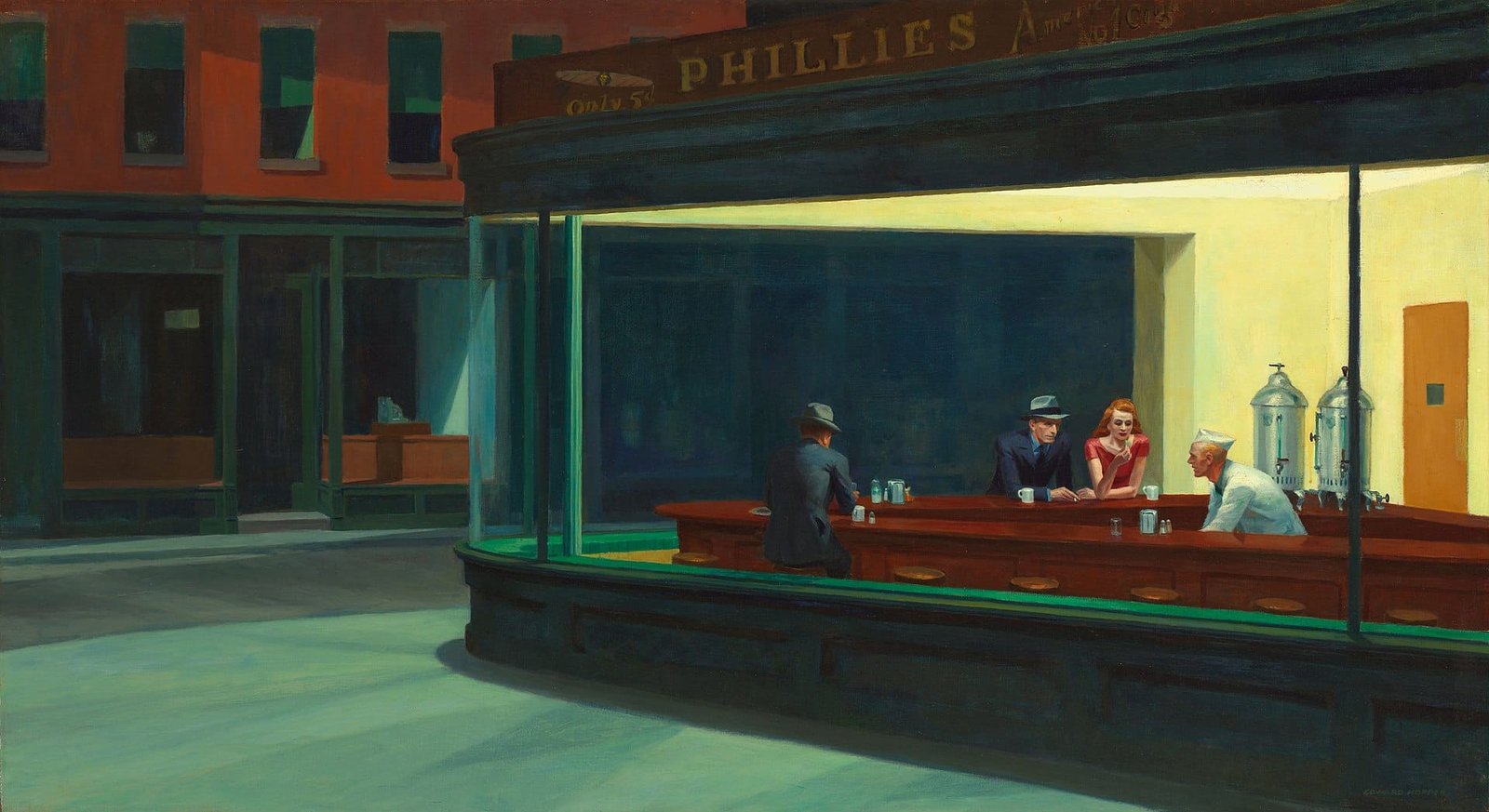
When I walk through a city at night, I can’t help looking into café windows to see who’s inside. Every window becomes a frame, a moment caught in passing. Hopper builds Nighthawks out of exactly that moment, and he carries the emotion through colour and mood.
Four people sit in an all-night diner on an empty corner, under a sickly yellow-green light. Look at the couple, side by side, their hands almost touching, yet neither looks at the other. Her red dress is the only warm thing in the room. Then there’s the man on his own, shoulders hunched, his back to us, his face something we never get to see.
The counterman is the only one working, and the only one who seems to notice anyone. But he’s probably just trying to get through his shift, those last few hours stretching out like the shadows under the artificial light.
Now look at the glass. Glass can be a shelter, a private space away from the moving world. Here it works both ways: it keeps the night out, and it keeps them in. There’s no visible door. The people inside are on display, yet sealed off from the city and from each other. Hopper later said he was probably painting the loneliness of a large city without meaning to.
And where are you standing? Outside, on the dark, empty street, looking in. Hopper has made you the loneliest person in the painting.
The last time I ate alone in a café, I kept waiting for another solo diner to mirror me. For the longest time, only couples, families and people grabbing a quick coffee came in. Then a man in a long jacket, with cropped hair, walked through the door and looked around for somewhere to sit quietly. The seat opposite me was empty, so the odds were good. He sat down, drank his coffee in silence and left.
To anyone looking in through the window, we were keeping each other company. That was far from the truth. Or was it?
He later said he was probably painting the loneliness of a large city without meaning to.
We go deeper in What Edward Hopper’s Nighthawks Symbolises.
Christina’s World — Andrew Wyeth (1948)
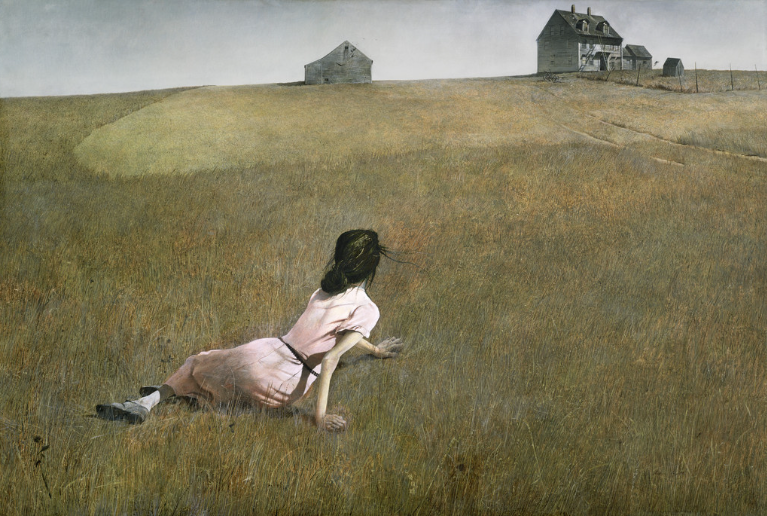
When I look at this painting, I want to reach out a hand to the woman in the grass, straining towards a home that seems just out of reach. The real story is even more heartbreaking.
The woman was Christina Olson, Wyeth’s neighbour in Maine, who had lost the use of her legs to a degenerative illness and refused a wheelchair. Wyeth saw her crawling across the field. The symbol here is distance: a few hundred yards of grass that, for her, is an expedition. Her face is turned away, so we can’t read her expression, only her effort.
The muted tones suggest a sad moment anyone could feel, but this painting is very specific. It’s the kind of artwork where you need to read the little placard beside it to understand what you’re really looking at.
The idea of losing the ability to walk saddens me. But Christina’s choice moves me more. She refused a wheelchair, and with it a life of being pushed, lifted and helped. She chose to get there on her own, however long it took.
But what loneliness does that breed? When you refuse to be carried, every crossing is made alone.
Automat — Edward Hopper (1927)
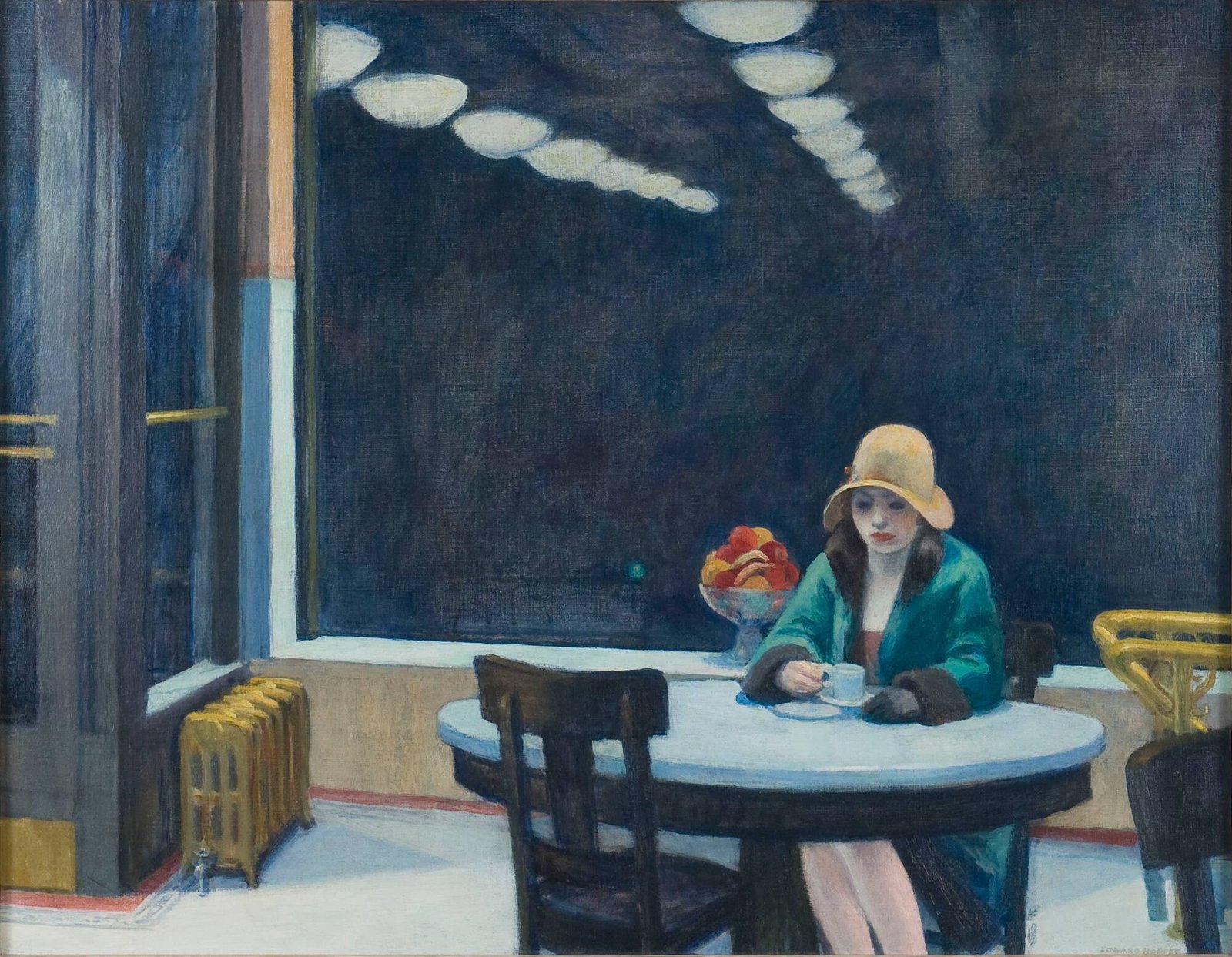
Fifteen years before Nighthawks, Hopper had already found his subject: a woman, a cup of coffee, and a window full of night.
She sits alone at a small round table, still in her coat and hat, looking down into her cup. The cup matters less for what’s in it than for where it makes her look: down, and inward.
Everything about her says she isn’t settling in. She has taken off one glove, but not the other. I can totally relate to this. In a London winter, it’s normal to keep one glove on and take the other off to grip a hot cup. We’re always half in, half out, just like her, stuck deciding whether to stay or go. The chair across from her is empty. Is she waiting for someone who hasn’t come, or has she simply run out of places to be?
Then look behind her. The huge black window should show the street, but it shows nothing outside at all. It’s an empty void, broken only by the reflection of two rows of ceiling lights running back into the dark. Glass again, just like Nighthawks. But this time it isn’t a wall between her and the city. It’s closer to a mirror, turning her inward, as if to say there’s no world out there, only the room she’s already in.
So why an automat? It’s a question worth asking of any place: why here? For Hopper, the setting was the symbol. In the 1920s, automats were the height of modern life. You put a coin in a slot, opened a little glass door and took out your sandwich or slice of pie. No waiter, no cashier, no one to ask how your day was. Even the small talk had been automated.
Sound familiar? Self-checkouts, ordering on an app, collecting food from a locker. A hundred years later, we’ve built whole cities of automats.
The model was Hopper’s wife, Jo, who posed for almost every woman he painted. So the loneliest woman in this painting was the person he saw every day. I find that the most haunting detail of all.
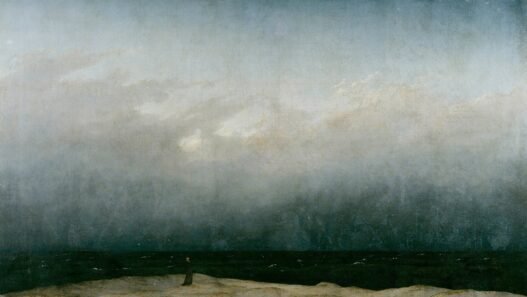
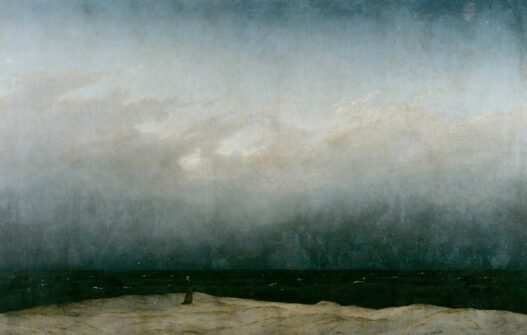
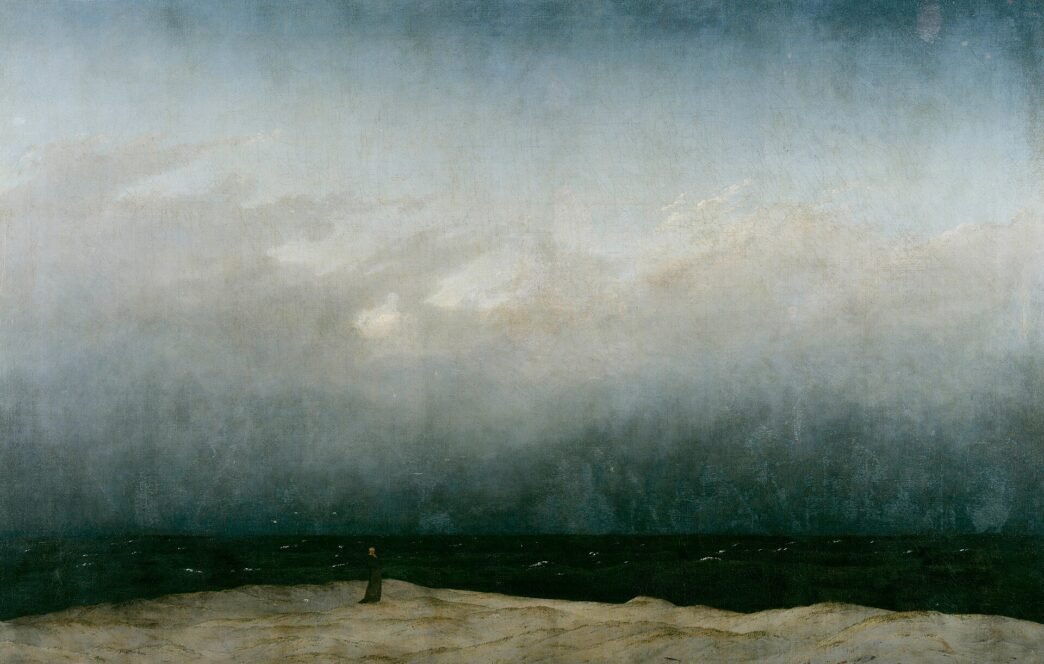
The Monk by the Sea — Caspar David Friedrich (1808–1810)
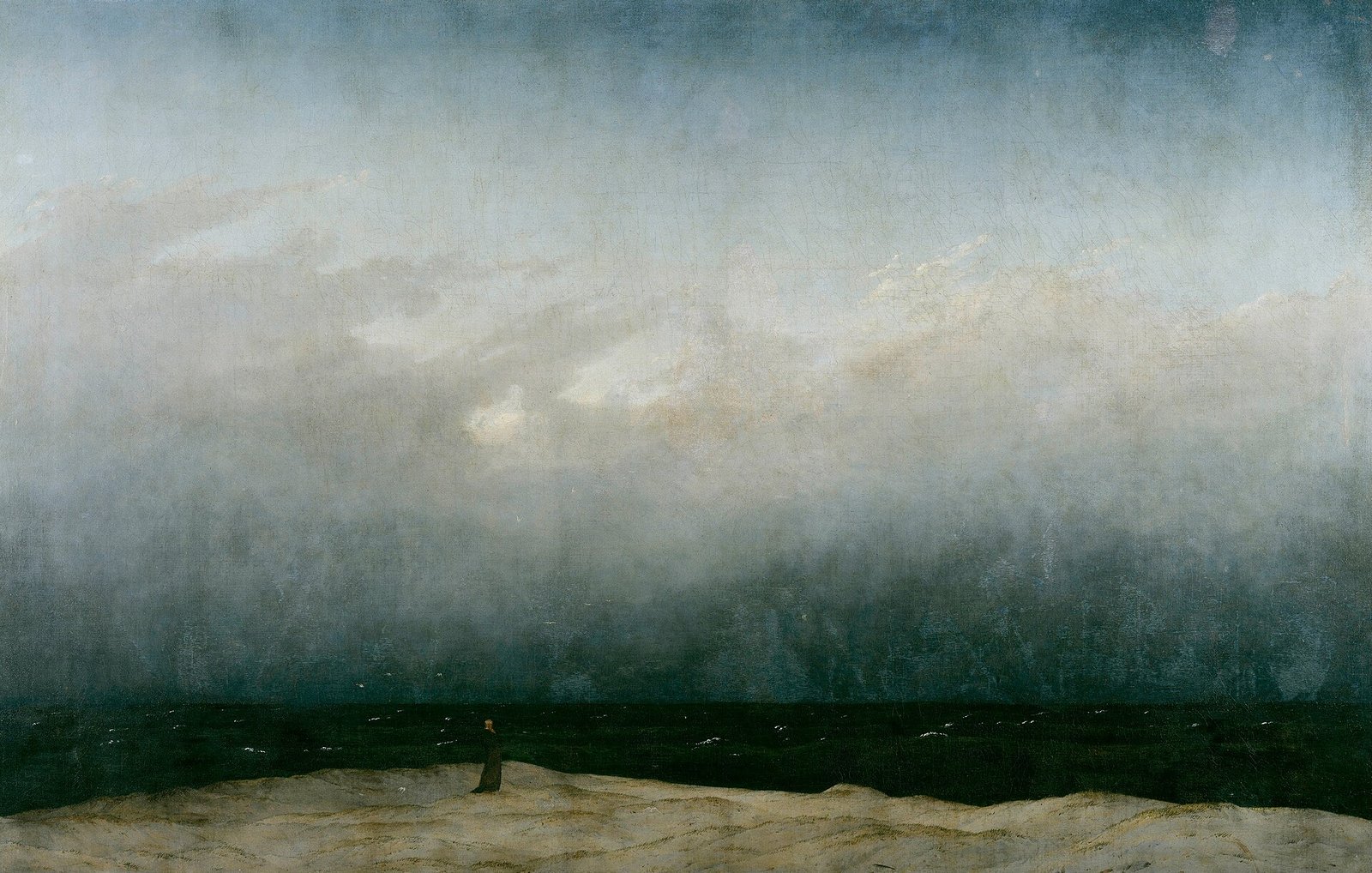
After two diners full of people, here’s loneliness with nobody else in it at all.
Glance at this painting and you’ll miss the entire point. Look past the wall of grey and you’ll find him: a tiny figure in a dark robe, almost lost against the sea. There’s no path, no shelter, barely another living thing. Nothing for your eye to land on except him.
The symbol here is scale. The figure is so small that loneliness stops being about missing a person. It becomes a question about our place in the universe. When it was first shown in 1810, people didn’t know what to make of it. A painting of almost nothing was a shock. The writer Heinrich von Kleist said looking at it felt as if your eyelids had been cut away: you can’t look away, and there’s nothing to protect you from all that space.
Modern technology keeps finding secrets buried in the sand. X-rays show Friedrich first painted boats on the water, then painted them out. He took away the monk’s last bit of company. Every decision moved in one direction: less.
Many people see the monk as Friedrich himself, and having read his biography, I think they’re right. As a boy, he watched his younger brother drown trying to save him after he fell through the ice. He carried that grief all his life. Knowing that, the figure on the dune looks less like a monk and more like a man standing at the edge of something he can never cross.
The sea is unforgiving. I remember walking along a beach as the clouds started to gather. The cold swept in, and suddenly my jacket felt useless against what was coming. The wind filled my lungs so completely that every breath was hard work. Then it settled, and I felt a strange sense of calm.
That’s the gift of this painting. In a city, loneliness feels like being forgotten. Here, it feels like being in the presence of something bigger than you.
Melancholy — Edvard Munch (1891)
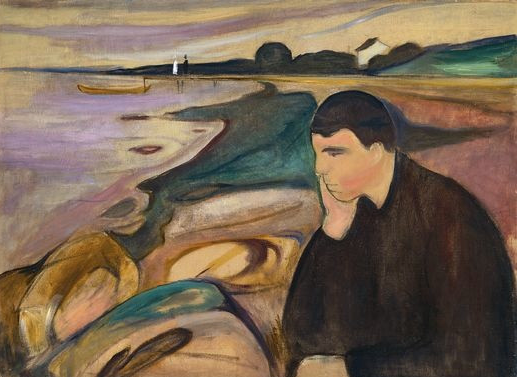
If loneliness could dream, this is the painting it would dream.
A man sits hunched at the edge of the shore, his head resting on his hand. Behind him, the coastline curves away in long, flowing lines. Far in the distance, a couple walks down a jetty towards a boat.
Look at the shapes. Everything is soft: rounded rocks, gentle curves, a boat that almost melts into the stones. These are the shapes of calm, composed thought. But they wrap around a man who is anything but calm. That’s the tension Munch builds: a peaceful evening on the outside, a storm on the inside.
The man was Munch’s friend Jappe Nilssen, heartbroken after a love affair ended. He stares out at the one thing that never changes: the rippling sea.
And the couple behind him? They might be real, or they might be a memory, a projection of what he’s just lost. Either way, Munch uses the shoreline to lead you to them. Follow its curve and your eye is pulled away from the man, straight towards the people leaving. The soft lines run right into the middle of a broken heart.
The pose, head resting on hand, is one of the oldest symbols of melancholy in Western art. If you know The Scream, this is the other side of the coin. The Scream is anguish thrown outward at the world. Melancholy is the same pain turned inward, in silence.
So, which one are you closer to today?