Why does Icarus fly so close to the sun? When you think about it, it’s quite simple. Why do we do anything that is self-destructive?
For over 2,000 years, artists have kept returning to the myth of Icarus, this one boy and his one terrible moment. From Roman wall paintings to Bruegel, Draper and Matisse, the fall of Icarus has been painted again and again, and each time it means something slightly different.
At its heart, Icarus is a symbol of ambition, freedom and the danger of overreaching. The Greeks called that overreaching hubris. His wings stand for imagination, the sun for the divine, and the sea for the fall that waits below. In this post, we’ll look at the myth itself, the paintings that brought it to life, and my favourite symbols hidden inside them, and truly ask why a story about failure still pulls us in.
The Myth of Icarus in Brief
Trapped on Crete by King Minos, for whom he built the Labyrinth that was made to hide a monster, the master craftsman Daedalus turns to the only exit left: the sky.
Binding fallen feathers with thread and warm beeswax, he fashions two pairs of wings and hands his son Icarus a single, life-saving rule: fly the middle path, safely between the heavy sea spray and the scorching sun. Yet once airborne, the intoxicating rush of freedom makes caution impossible.
Icarus climbs higher and higher until the wax melts, loose feathers scatter on the wind, and his dream of flight ends in a fatal plunge into the sea. It is a single, catastrophic moment, yet artists across the centuries have seen entirely different truths in the fall.
Icarus in Art: Famous Paintings of the Fall
The myth, for me, starts in the vast landscape, and Bruegel agrees. In Landscape with the Fall of Icarus (c. 1560s, Royal Museums of Fine Arts of Belgium, Brussels), Icarus is just two legs splashing in the corner.
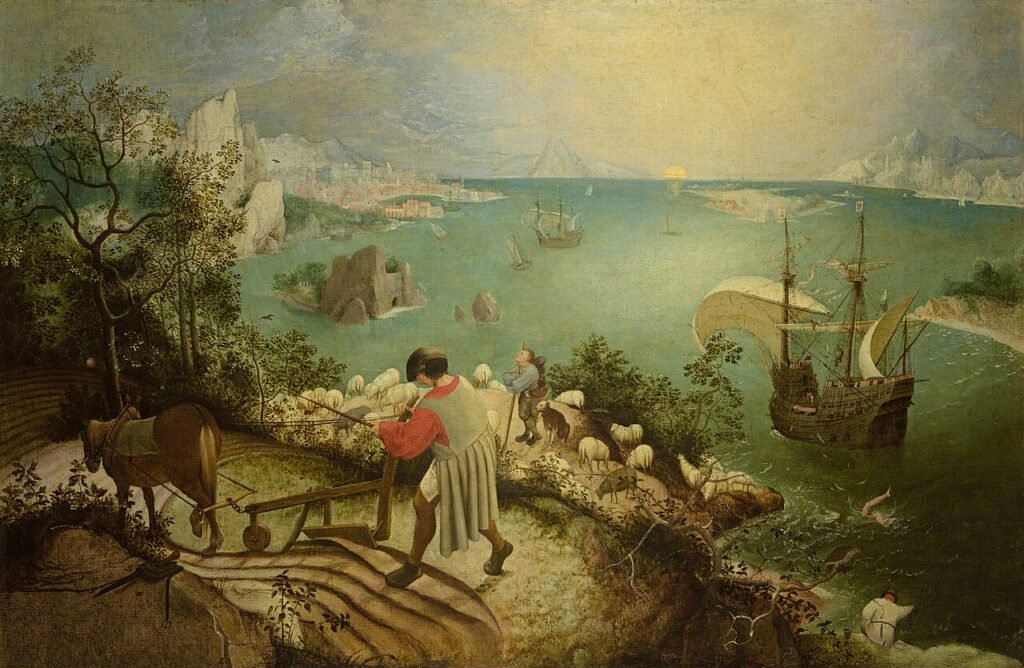
The main point, which I always keep in mind when looking at this painting, is that the world doesn’t stop for one person’s tragedy. The irony is that the ploughman, the shepherd, the fisherman and the ship all ignore him. His epic journey, his inner turmoil and his bravery don’t change a single thing for them. Not every artist felt this way.
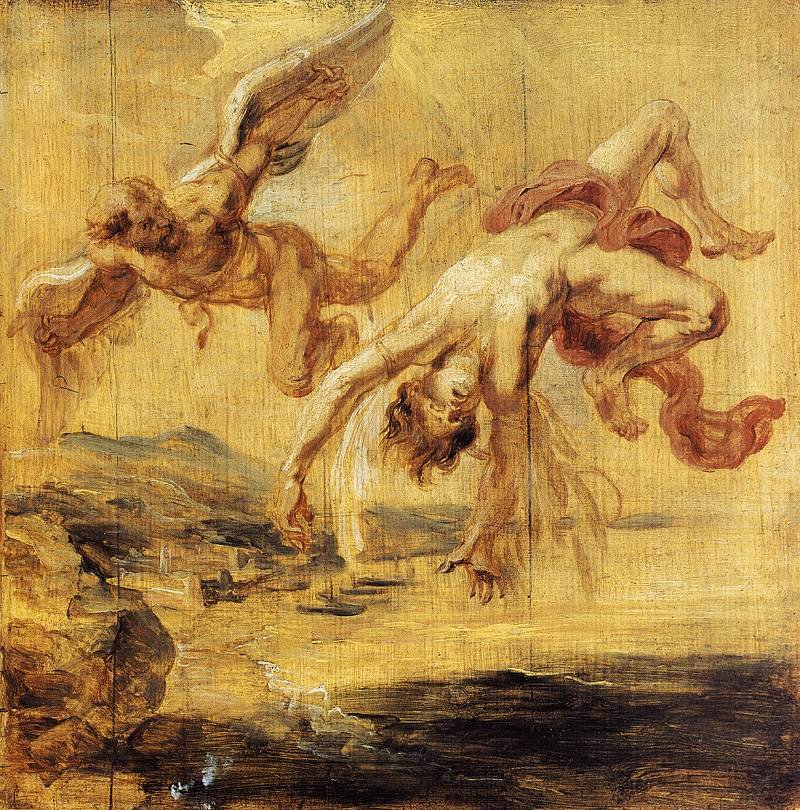
Jacob Peter Gowy’s The Fall of Icarus (1635–37, Museo del Prado), painted from a sketch by Rubens, catches the boy mid-fall, twisting through the air as Daedalus reaches out helplessly.
Frederic Leighton went the other way in Daedalus and Icarus (c. 1869), painting the calm moment before the flight, with the father fastening the wings and the boy already gazing at the sky. This is what hindsight looks like: wondering whether you did everything you could to keep someone safe. Knowing what comes next makes it almost harder to look at.
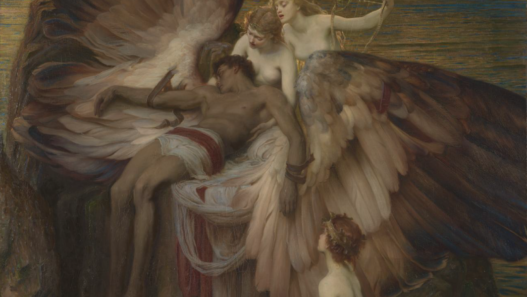
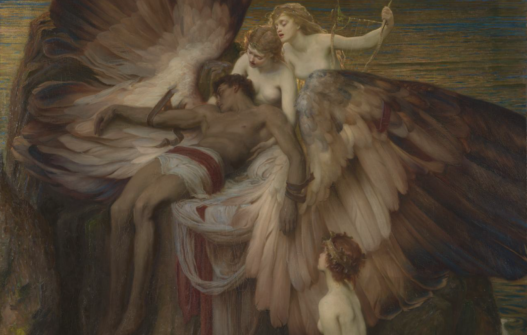
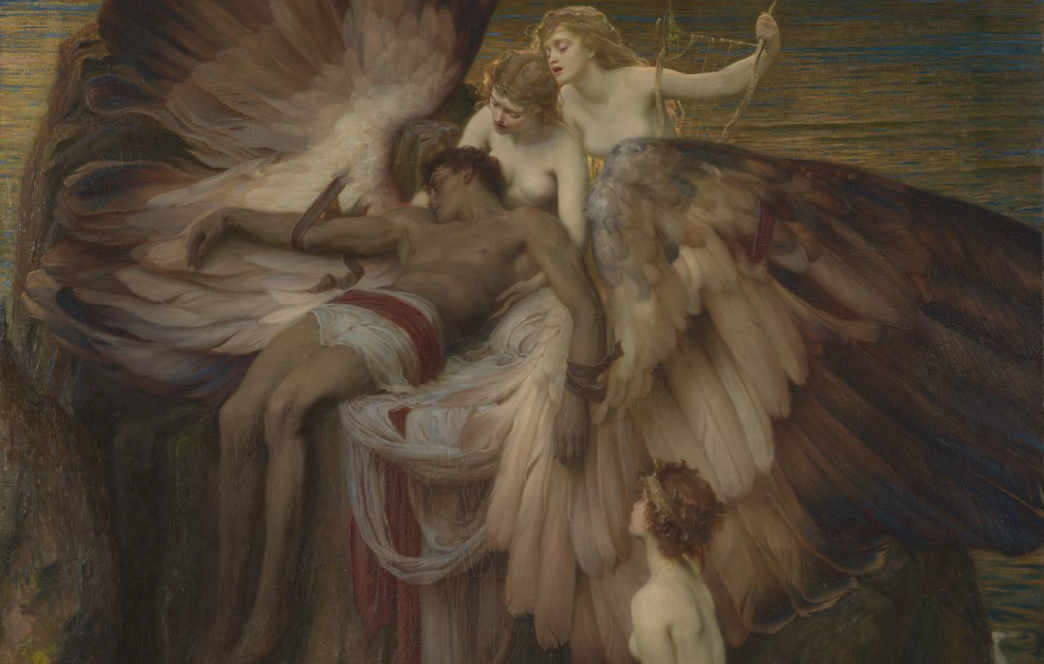
Then there is my favourite version of this myth, Herbert James Draper’s The Lament for Icarus (1898, Tate Britain). This one feels far from morbid, especially with the golden-hour, translucent light shimmering over all the figures.
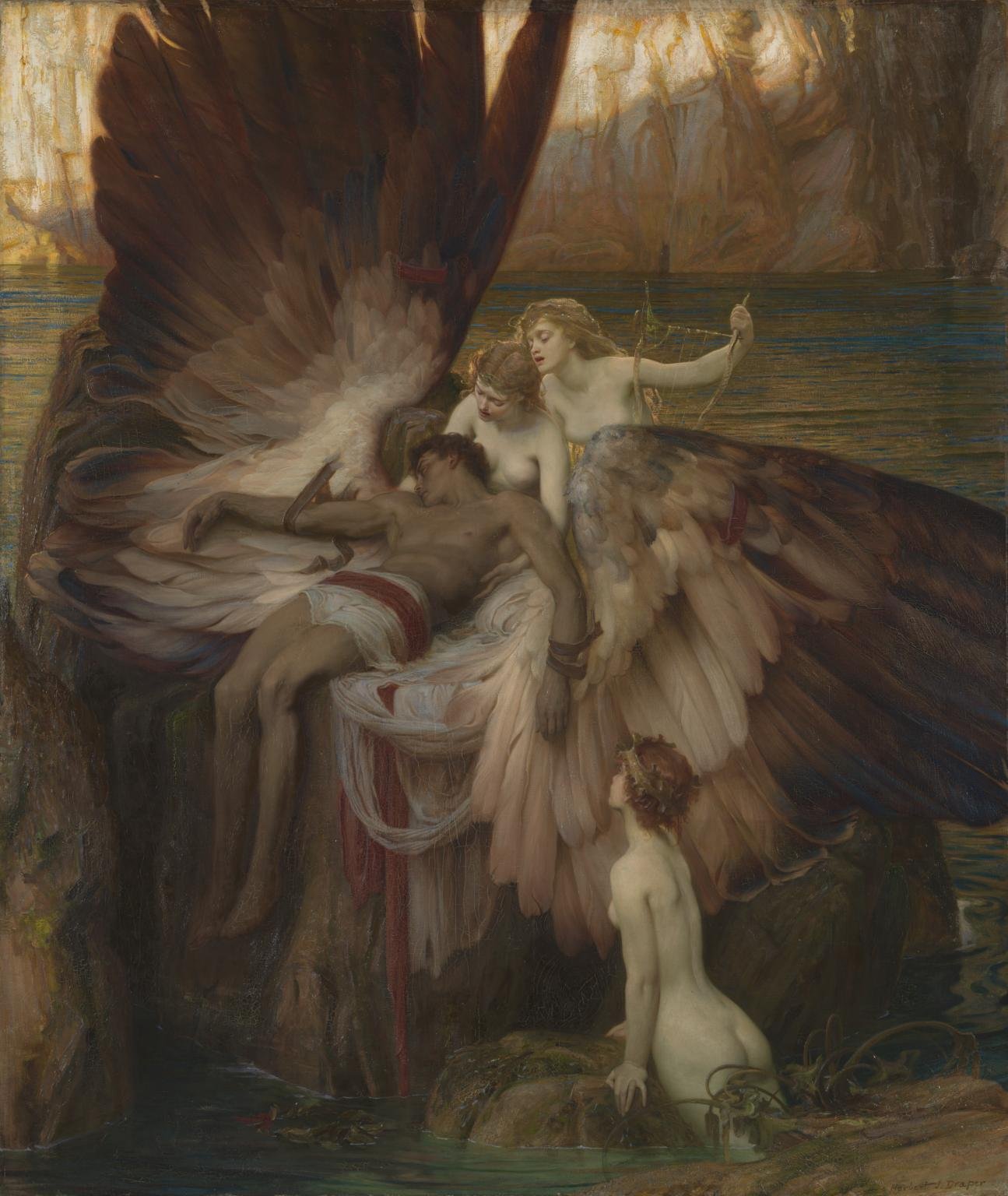
There is no death when you fly this close to the sun, perhaps only enlightenment. The sunburnt wings remind me of how everyone in the UK gets sunburnt during our short summer: the reward is worth the pain. I get sunburnt very easily myself, so this rings true to me. We all know how foolish it is to fly close to the flame, but this painting feels as if the hero has been welcomed like a comet falling from the sky, revered for his bravery instead of his foolishness.
Matisse shows Icarus in the simplest way. His Icarus, a paper cut-out from his book Jazz (1947), looks like something we would find on the wall of an ancient cave, a celebration of emptiness. What I love about this work is that it feels like a cut-out of how the soul might feel when fully absorbed by the sun. The story is stripped to its core: a black body, a red heart, yellow star-shapes around him. Is the figure falling or dancing? Is the sun just one of the many stars floating in the sky that we all aspire to be closer to?
See Matisse’s Icarus in full colour: is he falling or dancing?
The symbols in the Icarus story
Every detail in this myth carries meaning. Artists hid secret messages in their paintings for centuries, and the wings are one of the oldest. They have always stood for freedom and imagination. This is how Icarus found his bravery, and the intriguing part is that they were borrowed from his father. Did he truly earn the wisdom to use them? Did he understand the importance of his gift?
I believe he had no choice. He was intoxicated and overwhelmed by the exhilarating, newfound thrill of flight. His father, Daedalus, had explicitly warned him to keep to a safe middle course between the sun and the sea, neither flying too low (where sea spray would soak the feathers) nor too high (where the sun’s heat would melt the wax). Perhaps there is something hidden in this: being safe is not fun, and obeying instructions might not be something we inherit.
In The Icarus Deception, Seth Godin points out that we almost always forget the other half of the rule. Flying too low is dangerous too: the sea spray soaks the feathers and drags you down into mediocrity, without you ever truly trying. Godin argues it may even be the bigger danger. Fly too low, and all Icarus would ever see is the sun fading further away.
When was the last time you looked at the sun? I hope never directly, but we’ve all taken a glance and we understand the pull. As the light creeps in through my window each morning, I push my face against the glass to breathe in some of that glorious light before the clouds sweep it all away. Icarus was closer to the sun than any human, and he must have felt a divine euphoria coupled with intense fear. Many of you will know the sun means much the same thing across the world: the divine, ultimate truth, glory, a limit humans shouldn’t cross. In Greek terms, flying at the sun is hubris, pride that challenges the gods.
The sea is the opposite in many ways. Where the sun is light, glory and ascent, the sea is darkness, silence and being forgotten. It’s being swallowed by the cold waves until all you can hear is a gentle swoosh of nothingness. I always remember my first time falling into the ocean and how enveloping and different it was from a local swimming pool. The memory still haunts me to this day.
In the myth, Icarus’s wings were held together with beeswax, so the whole dream depended on something that melts. When he flew too high, the wax gave way, leaving scattered feathers as the physical evidence of his fall. In Bruegel’s painting, the loose feathers act as a quiet clue for the viewer. Because a ploughman, a shepherd and a passing ship completely ignore the drowning boy, those drifting feathers are the only sign that a grand dream has just ended in an indifferent world.
In Bruegel, the feathers are a tiny clue that no one notices. In The Lament for Icarus, the wings are enormous, spread across the rock like a cloak, impossible to ignore. One painter whispers the tragedy and the other mourns it out loud.
It’s one of the loneliest moments ever painted, but it’s not the only one. See the loneliest paintings ever made →
Father and Son
There is one part of the myth that I relate to the most: the relationship between father and son. Daedalus is the cautious adult, Icarus the reckless young one. The myth is full of physical symbols, like the sun, the wings, the wax and the thrill of exploration, but I want to shine a light on the relationships we have with the people in our lives.
Is this a story about a parent who can’t protect his child? What does letting go truly look like? Was Daedalus trying to tell his son something important, and did Icarus fail to understand?
The softest, most heartbreaking moment comes at the very end. Daedalus calls out for his son, searching the sky, until he sees feathers floating on the water. In Ovid’s telling, he curses his own skill. The very invention that set them free is what took Icarus from him. He buries his son on a nearby island, which still carries his name today: Icaria. Those light, soft feathers drifting on the waves become the last memory of his beloved son.
This is why I find Leighton’s painting so moving. It shows the father fastening the wings onto his son, one last act of care before he lets him go.
Daedalus lost his son to the sky and Orpheus lost his love with a single glance.
Warning or Hero?
For most of history, Icarus was a warning. Ancient writers and Renaissance artists used him as a lesson in pride: listen to your elders, know your limits, and if you fly too close to the flame, you will get burned. That’s the lesson we all learn growing up.
But from the 1800s onwards, poets and painters started to see him differently. They admired him. At least he flew. Draper’s mourning nymphs belong to this new view, where Icarus isn’t a fool to be judged but a hero to be grieved.
Psychology has its own take. The American psychologist Henry Murray coined the term “Icarus complex” for a pattern of soaring ambition followed by a crash. Jungians link Icarus to the puer aeternus, the eternal youth who won’t come down to earth. Icarus isn’t the only myth hiding a psychological wound. Medusa’s might be even darker.
I think every artist has a little Icarus in them. We chase the light in our work, knowing it might not hold, and sometimes we get burned in the process.
What can you take from this myth?
So, why does Icarus fly so close to the sun? I think the answer is in the paintings themselves. In Bruegel’s, the world keeps ploughing its fields and sailing its ships, and hardly anyone notices when we fall. In Draper’s, it’s the last golden moment of a voyage into the sun. And in Matisse’s, the heart is still dancing. Is the fall truly worth the flight?
Maybe that’s why we do self-destructive things. It isn’t that we don’t hear the warning. It’s that, for one moment, the light feels more real than the ground beneath us.
The Renaissance saw a warning, the Victorians saw a tragic hero, and the moderns saw a leap of the heart. Which one do you see? Tell me in the comments.
If Icarus moved you, these Greek myth paintings will stay with you forever