








Medusa is one of the oldest and most misread symbols in Western mythology.
But here’s the thing, she wasn’t a monster to begin with. She was a priestess. Beautiful enough that a god wanted her and punished for it. Transformed into something so terrifying that a single glance meant death, and then hunted for the very monstrousness that was forced upon her.
She appears on shields, temple walls, Versace handbags, and the courthouse steps.
For three thousand years, her image has protected soldiers, warded off evil, inspired some of the greatest paintings ever made. And yet she has been almost universally misunderstood.
Most people still understand her as the creature Perseus killed. But the artists, psychologists, and writers who have returned to her for centuries understood something different. They understood that Medusa symbolises what happens when power punishes the powerless and calls it justice.
They understood that her gaze doesn’t destroy you because she is evil. It destroys you because of what she forces you to see in yourself.
This post explores Medusa symbolism from every angle: her origins in Greek mythology, her psychological meaning through a Jungian lens, her reinvention across five centuries of Western art, and why her story is more urgently relevant now than it has ever been.

Was Medusa Always the Villain? The Origins of the Myth
Before Perseus ever picked up his polished shield, Medusa existed as something else entirely. In the oldest Greek sources, she was one of three Gorgon sisters, daughters of the sea deities Phorcys and Ceto, and the only mortal one among them. That detail matters more than it might first seem. Her vulnerability was always part of her.
Homer mentions her only briefly. Hesiod gives her a fuller origin but no backstory of transformation. In these earliest versions, she was simply born a Gorgon, terrifying by nature, not by punishment.
There was no crime. No assault. No divine retribution. She was the mortal one at the intersection of mortality and monstrousness, and her death at Perseus’ hands was not justice for a transgression. It was simply the price of being powerful and killable in a world where heroes need proof of their courage.
Fast forward to the first century AD, and everything changes. It was Ovid, writing in his Metamorphoses, who gave us the story most people know, and who introduced the detail that permanently altered how Medusa would be understood. Medusa did not choose to become what she became.
In Ovid’s version, she was assaulted by Poseidon in Athena’s temple. Athena, enraged by the desecration of her sacred space, punished Medusa, the victim, by transforming her into the snake-haired creature we recognise. The transgression was someone else’s.
If Medusa’s monstrousness was the consequence of someone else’s crime, what does that say about the monsters we create?
This question is why Medusa has never left us. Every generation reinvents her because every generation needs a figure who embodies what happens when power punishes the powerless and calls it justice. The shift from Hesiod’s version to Ovid’s is itself a cultural symbol: ancient Greece needed a Medusa who was simply terrifying, a worthy test of heroism. Rome, under Ovid, needed a Medusa who was wronged, because Rome was increasingly interested in the moral complexity of its myths.
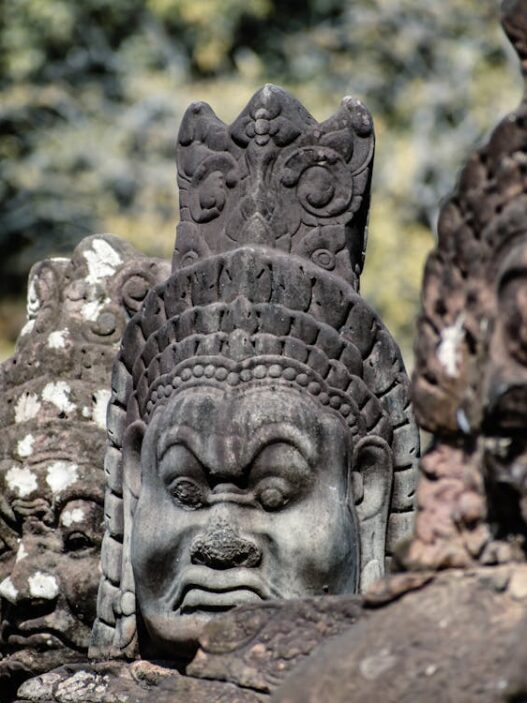
And that shift is visible in the art itself. The Gorgoneion below predates Ovid by centuries. This is not the face of a wronged priestess. This is pure terror made ceramic, a face designed to freeze whatever came near it, hung on a temple wall long before anyone asked how she got there or what she deserved.

We keep returning to Ovid’s version because moral complexity is precisely what we are hungry for. You will find this same pattern across nearly every mythological creature who has endured: the Minotaur, the Sphinx, the Sirens. Monsters born not of evil but of someone else’s fear or violence. I’ve explored this in depth in my post on mythological creatures as symbols of the human psyche if you want the broader context.
Medusa Symbolism Through a Jungian Lens
To understand what Medusa symbolises psychologically, it helps to start with Carl Jung’s concept of the shadow: the parts of the psyche that we suppress, exile, and refuse to integrate. Jung believed that what we push into the unconscious does not disappear. It becomes more powerful. It operates from outside our awareness, shaping our behaviour in ways we cannot see or control.
Medusa is the shadow made mythological. Because she represents what happens when the qualities that should be integrated are instead attacked and punished. She is the Anima, Jung’s term for the feminine aspect of the male unconscious, in its most unintegrated form: exiled to the edges of the known world, transformed into something unrecognisable, and ultimately destroyed rather than understood.
For a deeper foundation on this framework, my post on Carl Jung and the hidden language of symbols covers the core concepts in detail. But for our purposes here, the key insight is this: the shadow does not become less dangerous when you exile it. It becomes more dangerous. And Perseus, celebrated hero and divine instrument, defeats Medusa not by confronting or integrating the shadow, but by cutting its head off.

Perseus as the Unintegrated Masculine
Look more carefully at the equipment Perseus receives before his quest. A mirrored shield from Athena, the same goddess who punished Medusa. Winged sandals from Hermes. The cap of invisibility from the nymphs. Perseus does not defeat Medusa through strength, courage, or understanding. He defeats her through tools given to him by the very divine powers who created the situation in the first place.
In Jungian terms, Perseus is a man confronting the rejected feminine within himself, and rather than integrating it, he eliminates it. He wins. He is celebrated. And then the severed head of Medusa becomes a weapon: carried by Perseus, later mounted on Athena’s aegis, used to destroy enemies for the remainder of the myth.
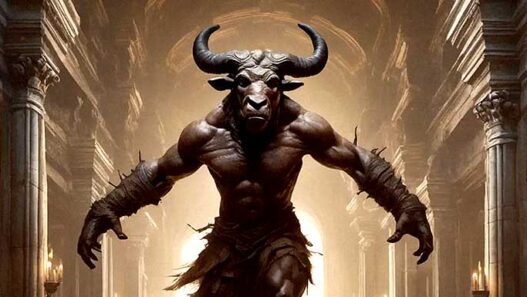
Here’s where it gets genuinely unsettling. The unintegrated feminine does not disappear after decapitation. It gets weaponised. The shadow, unexamined, becomes a tool of the very power that refused to examine it. If you want a direct parallel, the symbolism of the Minotaur follows exactly the same structure: a creature born of shame and violence, imprisoned rather than understood, destroyed by a hero who never once asks why it exists.
What Does Medusa’s Gaze Symbolise?
The most distinctive element of Medusa’s symbolism is her gaze, the look that turns men to stone. This is worth sitting with, because it is doing something very specific.
The word petrified comes from the Greek petros, meaning stone. To be seen by Medusa is to be frozen. Movement stops, thought stops, time stops. And Perseus can only defeat her by refusing to look at her directly. He uses a mirror. He defeats her through reflection, not confrontation.
Think of it this way: the gaze in mythology is almost always a symbol of power and knowledge.
To see is to know. To be seen is to be known. Medusa’s gaze petrifies not because she is monstrous, but because of what she forces you to see in yourself when you look. The monster is not her appearance. The monster is the recognition.
Feminist scholars, most notably Hélène Cixous in her 1975 essay The Laugh of the Medusa, have read her gaze as the silenced female voice made suddenly, terrifyingly visible. The patriarchal response to that visibility is to call it monstrous, and to reward the man who obliterates it. Perseus didn’t face Medusa. He faced his reflection of her. Whether that’s the same thing is a question the myth deliberately leaves unanswered.
There’s something quietly heartbreaking about that. When you can no longer look at something directly, when even a glance turns your soul to stone, the feeling lingers long after the myth ends. A cold, hollow weight. The harbour of a desolate beach at dusk.
Medusa as a Protective Symbol: The Apotropaic Tradition
Long before Medusa became a symbol of female rage or Jungian shadow psychology, she served a completely different function in the ancient world: protection.
The Gorgoneion, her severed head used as a symbol or amulet, was one of the most common protective images in ancient Greece and Rome. It appeared on shields, temple pediments, coins, armour, and doorways. The logic was precise and psychologically sophisticated: if Medusa’s gaze turned enemies to stone, her image could ward off evil. The very power that made her monstrous made her useful.
What’s more, after her death she became more powerful, not less. Her head was mounted on Athena’s aegis, the divine shield of the same goddess who had punished her. If there is a more concise symbol of how power exploits what it has destroyed, it is genuinely difficult to find.
On the flip side, this apotropaic tradition tells us something important that modern retellings tend to miss: the ancient world understood Medusa’s duality intuitively. The thing you fear most, placed correctly, becomes the thing that protects you. This is not a paradox. It is Jungian psychology expressed in bronze, two thousand years before Jung. The shadow, integrated, becomes a source of strength. The Gorgoneion on a soldier’s shield is not separate from the psychological insight about integration. It is that insight.
This same symbolic logic runs through the symbolism of the labyrinth, the structure built to contain something terrifying ends up defining the power of those who built it. Contain the monster and you weaponise the fear of it.
Medusa in Western Art: Five Centuries of Painters Who Got It Right
Few mythological figures have generated a richer or more varied body of art than Medusa. Artists across five centuries have used her image to explore beauty and terror, power and vulnerability, the seen and the unseen. And what is striking, honestly what is remarkable, is how consistently they resist the simple monster reading. Painter after painter, century after century, looked at Medusa and saw not a villain but a mirror.
Caravaggio’s Medusa (1597): The Monster Looking Back
Caravaggio’s Medusa is one of the most psychologically complex paintings of the Italian Baroque, and it begins with a formal choice that is easy to miss: it is painted on a convex shield. The curved surface means the image warps slightly as you move around it. She cannot be fully captured from any single angle. She resists a fixed reading even as an object.

But what makes this painting extraordinary is what Caravaggio chose to depict: the moment of her death. Her mouth is open. Her eyes are wide. The snakes on her head are alive and recoiling in shock. She has just been beheaded and she knows it. This is not a monster. This is a creature experiencing its own annihilation, fully conscious, fully present in the horror of the final moment.
Caravaggio reportedly used his own face as the model. That self-identification is unmistakable. He did not paint her as the other, the alien, the threat. He painted her as himself, specifically himself at the moment of confronting death. The monster and the artist occupy the same face.
Caravaggio’s Medusa is not a warning about the dangers of looking. It is a warning about what we see when we look at our own capacity for suffering. This is entirely consistent with his broader artistic obsession: the extreme chiaroscuro, the psychological intensity, the insistence on depicting the inner state at the moment of maximum crisis. For context on the wider tradition Caravaggio was working within, my post on symbolist artists you should know is worth reading alongside this.
Leonardo da Vinci and the Lost Medusa
Giorgio Vasari describes a lost painting by Leonardo: a Medusa’s head painted on a wooden shield, so realistic that those who first saw it stepped back in genuine fright. The painting is lost, but the description reveals something important: Leonardo was interested in precisely the same thing Caravaggio would be a century later. Not the monster. The reaction.
The power of Medusa, Leonardo understood, was not in the image itself but in the viewer’s response to it. This is entirely consistent with his approach to painting. He was obsessed with depicting the inner state made visible on the face. Medusa gave him the ultimate test case: paint something that makes the viewer feel what the myth describes. Make the viewer almost understand what it is to be petrified.
The Pre-Raphaelites: Painting Medusa With Sympathy
Edward Burne-Jones, Dante Gabriel Rossetti, and others in the Pre-Raphaelite circle returned repeatedly to the Medusa myth, and their approach was unusual enough to be worth noting. Their Medusas are not terrifying. They are melancholic, introspective, often genuinely beautiful despite the serpents. The dominant tone is not dread but sorrow.
This Victorian reimagining is significant. At a time when female sexuality was being rigorously controlled and any deviation was pathologised as monstrous or hysterical, these artists were painting the mythological embodiment of punished female power with tenderness. The Medusa as victim, wronged and isolated and killed for what was done to her, resonated in ways the ancient terror-symbol did not. It is one of the more quietly radical artistic gestures of the period.

Klimt’s Judith (1901): Medusa by Another Name
Klimt never painted Medusa directly. But his Judith, often mistaken for Salome, carries the same symbolic charge. A woman holding a severed head, expression utterly unreadable, dressed in gold leaf. The painting disturbed contemporary audiences deeply. She doesn’t look monstrous. She doesn’t look victorious. She looks resolved.
That’s the most unsettling version of the Medusa archetype, and Klimt knew it. Not the monster. Not even the victim reclaiming her power in a moment of triumphant violence. Just a woman who does not apologise for what she is. Judith with Holofernes’ head, like Athena with the Gorgoneion, is the image of power that refuses to be exiled to a labyrinth, that refuses even in victory to perform either guilt or elation.

You can explore this symbolic tradition in much more depth through my post on 8 symbols every artist should know, including why the severed head recurs across mythology and art as a symbol not of violence but of transformation.
Medusa in Modern Literature: The Story She Never Got to Tell
Like the Minotaur in Borges’ The House of Asterion, Medusa has been given a voice in modern literature that the original myth denied her. And the results are some of the most interesting mythological fiction of the past twenty years.
Natalie Haynes: Stone Blind (2022)
Haynes’ novel retells the Medusa myth from multiple perspectives, including most powerfully Medusa’s own. It is the most prominent recent literary reclamation of her story, and it asks the question that Ovid raised but never answered: what is it actually like to be made monstrous?
Haynes does not simplify Medusa into a victim or a hero. She writes her as a person navigating an impossible position. She is aware of what she has become, aware that she is both feared and hunted, unable to change either fact. It is precisely the Borges approach: the creature at the centre of the labyrinth, waiting not for rescue but for understanding. If this angle interests you, my post on the Minotaur and King Minos explores the same dynamic from a different mythological angle.
Ovid’s Metamorphoses: The Original Sympathetic Reading
Ovid’s retelling in Books 4 and 5 of the Metamorphoses is the source text for most modern retellings, and it rewards close reading. Crucially, Perseus tells the story of Medusa’s transformation to an audience at Andromeda’s court. This means we receive her origin as a secondhand account, filtered through the perspective of the man who killed her. Her story is always mediated. She never speaks.
Ovid was a writer obsessed with transformation and its costs. He gives us just enough of Medusa’s perspective to make her sympathetic: the beauty that attracted a god, the assault, the punishment, before returning cleanly to Perseus’ heroic narrative. The gap between those two stories is where all the best literature about Medusa lives. It is a gap Haynes, Angela Carter, and others have spent their careers writing into.
Medusa and the #MeToo Movement: Why Her Story Is Being Rewritten Right Now
In 2021, sculptor Luciano Garbati’s Medusa with the Head of Perseus was installed directly across from the Manhattan courthouse where Harvey Weinstein was convicted. The sculpture, Medusa holding Perseus’ severed head and not the other way around, became an immediate and internationally recognised symbol of the #MeToo movement.

The choice of location was precise. Garbati had originally created the piece in 2008, deliberately reversing the classical myth. But the timing of its installation, across from that specific courthouse, gave it a meaning that exceeded the artistic. Here was the woman punished for being assaulted, holding the head of the man who would have killed her for it. Here was the shadow, finally integrated. Here was the Gorgoneion not on Athena’s shield but in Medusa’s own hands.
The response was polarising, as you would expect from a symbol that is doing its job properly. Some saw a powerful reclamation of a story that had been told wrong for two thousand years. Others saw a distortion of classical tradition. Both responses confirm what the best symbols always do: they force a position. You cannot remain neutral about Medusa. You have to decide what she means.
And that, ultimately, is why she has never left us. This cultural moment is not separate from the artistic tradition running from Ovid to Caravaggio to the Pre-Raphaelites to Klimt to Haynes. It is the continuation of it.
Each generation returns to Medusa because, let me honest, the myth is entertaining but remains unresolved. The question it asks has never been answered.
The Duality of Medusa: Why She Cannot Be Resolved Into a Single Meaning
What makes Medusa endure as a symbol, across three thousand years and every medium and culture that has touched her, is precisely her duality. She is simultaneously terror and protection, victimhood and power, punishment and transcendence. She refuses resolution. And that refusal is the point.
To confront Medusa directly is to be petrified. To confront her through reflection, which is what Perseus does and what every artist who has ever painted her does, is to transform. The mirror does not diminish her. It makes her survivable.
This is the deepest layer of Medusa symbolism, and it connects every thread of this post: mythological origin, Jungian psychology, apotropaic tradition, art history, feminist theory, contemporary culture. She is not the thing that destroys us. She is the reflection we cannot bear to look at directly. Every painter who depicted her, every writer who gave her a voice, every person who has ever worn her image on a piece of jewellery without quite knowing why: they are all doing the same thing Perseus did. Looking at what they fear, at one remove, until they can bear to look at it straight.
Medusa is not the monster at the end of the myth. She is the question the myth has been asking all along: what are you refusing to look at?
Frequently Asked Questions About Medusa Symbolism
What does Medusa symbolise?
Medusa symbolises several interrelated things depending on the context. In Greek mythology, she represents the monstrous feminine and the threat of female power. In Jungian psychology, she is the unintegrated shadow, the exiled part of the psyche that becomes dangerous precisely because it is unacknowledged. In feminist theory, she represents the silenced female voice made visible, and the way that visibility has historically been called monstrous. Across all interpretations, her core symbolic meaning is the same: she is the thing we cannot look at directly, the part of ourselves or our society that has been punished and exiled rather than understood.
What does Medusa’s gaze represent?
Medusa’s gaze, the look that turns men to stone, represents the power of a silenced, exiled figure to stop those who encounter her in their tracks. To be petrified (from the Greek petros, meaning stone) is to be frozen by recognition. The gaze does not destroy because Medusa is evil. It destroys because of what she forces you to see in yourself. Feminist scholars including Hélène Cixous have interpreted the gaze as the female voice made suddenly visible, and the petrification of those who encounter it as the patriarchal response to that visibility.
Why did Athena punish Medusa?
In Ovid’s version of the myth, the one most people know, Medusa was assaulted by Poseidon in Athena’s temple. Athena, enraged by the desecration of her sacred space, punished Medusa by transforming her into a Gorgon with snakes for hair. The punishment was aimed at the victim, not the perpetrator. This detail, introduced by Ovid in the first century AD, is what has made Medusa such a resonant and enduring figure, particularly in feminist retellings.
What is the Gorgoneion?
The Gorgoneion is the image of Medusa’s severed head, used as a symbol or amulet in the ancient world. It was one of the most common protective images in ancient Greece and Rome, appearing on shields, temple pediments, coins, armour, and doorways. The logic was apotropaic: if Medusa’s gaze could turn enemies to stone, her image could ward off evil. After Perseus killed her, Athena mounted the Gorgoneion on her divine shield, the aegis, making Medusa more powerful in death than she had been in life.
Is Medusa a symbol of female rage?
Yes, but that’s a simplified version of a richer symbol. Medusa is associated with female rage in contemporary culture because her story is one of punishment for someone else’s crime, transformation into something ‘monstrous’, and destruction for the very monstrousness that was forced upon her. That is, in outline, a story about what happens to female anger and power when a society refuses to integrate or acknowledge it. But Medusa also symbolises protection, transformation, the Jungian shadow, and the unknowable feminine. Female rage is one layer of a much deeper symbol.
What does Caravaggio’s Medusa painting mean?
Caravaggio’s Medusa (1597) depicts the moment of her death: mouth open, eyes wide, snakes recoiling, painted on a convex ceremonial shield. Caravaggio used his own face as the model, placing himself in Medusa’s position at the moment of annihilation. The painting is not a warning about the dangers of looking at monsters. It is a meditation on what we see when we confront our own capacity for suffering. The choice of a convex shield as the canvas means the image warps as you move around it. She can never be fully captured from a single angle, resisting a fixed interpretation even as an object.
Further Reading
If this post has opened up questions about mythology, psychology, and the monsters we project onto the world, these posts go deeper:
The Symbolism of the Minotaur: Myth, Psychology and the Inner Beast, the companion piece to this post, exploring the same Jungian shadow dynamic through the figure of the Minotaur
The Sphinx in Greek Mythology: Power and the Unanswerable Riddle, another powerful female mythological figure whose symbolic weight far outlasts the hero who bested her
Mythological Creatures as Symbols of the Human Psyche, the broader framework for understanding how mythology externalises internal psychological states
Carl Jung and the Hidden Language of Symbols, a foundation in Jungian psychology for readers who want to go deeper on the shadow, the Anima, and the concept of integration
The Symbolism of the Labyrinth in Myth and Art, on the symbolic logic of containment, power, and the structures we build to imprison what frightens us
8 Symbols Every Artist Should Know, including the severed head as a recurring symbol of transformation rather than violence