




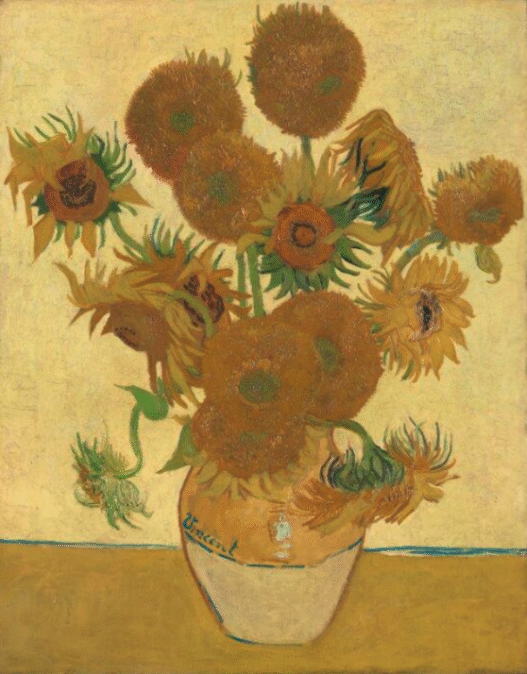
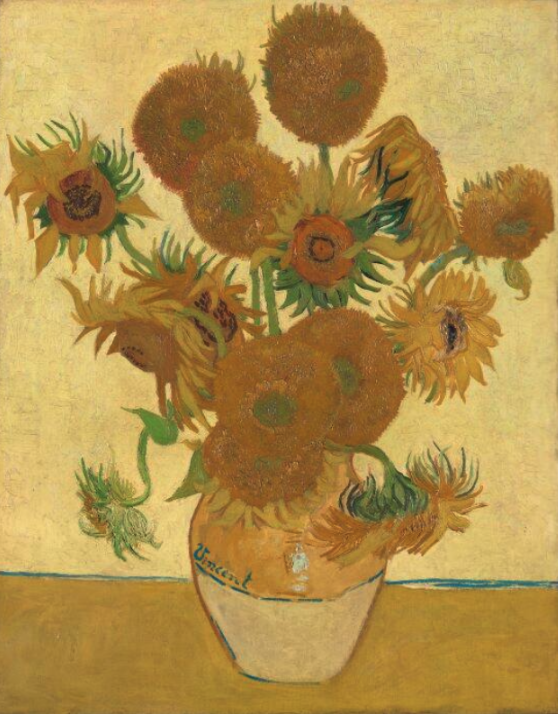
Behind the golden glow of Van Gogh’s Sunflowers lies a story of loneliness and heartbreak. Van Gogh painted the entire series in a burst of excitement, decorating his house in Arles ahead of his friend Paul Gauguin’s arrival, convinced they were about to build something extraordinary together
Burst of Light in a Lonely Life
When Van Gogh moved to Arles, it’s not obvious why. The truth is he longed to create a community of artists, a “Studio of the South.”
For Van Gogh, the sunflower was a symbol of devotion and hope. Its habit of turning toward the sun mirrored his own yearning for light amid darkness. In his letters, he often described the flower as “almost a religious symbol,” embodying faith and gratitude.
Van Gogh and the Unconscious Pull Toward Light
There is something in Van Gogh’s sunflowers that triggers a deeper part of the human mind. Whenever I find this angle, I think of Carl Jung. Jung believed every human being carries within them an unconscious drive toward wholeness, toward light, the same way a sunflower turns its face to follow the sun across the sky.
He called this process individuation, the lifelong journey of becoming fully yourself.
Van Gogh never read Jung. Jung was barely a teenager when Van Gogh died, but the symbolism speaks the same language. In painting the sunflower again and again, Van Gogh was doing what Jung would later describe in words, reaching toward something he could feel but never quite hold. The light was always there. The darkness kept following him anyway.
Why do you choose the subjects you keep returning to when you create? Does the same object reach out to you again and again, waiting to be explored?
It’s something I return to often, and explore more in my writing on Jungian symbolism in art.
The sad story behind Van Gogh Sunflowers
Have you ever witness the breakdown of a friendship right before your eyes? That’s the truth behind this painting. Within weeks of being in each other company, tensions between the two artists exploded, leading to Van Gogh’s infamous mental breakdown and the tragic episode in which he cut off part of his ear.
This is noted in the book The Yellow House: Van Gogh, Gauguin, and Nine Turbulent Weeks in Arles
“This experiment would surely have failed sooner had it not been for a devoted cleaning-lady who came in every day to clear up their mess … But it could not last.”
The bright yellows that once radiated friendship became, in hindsight, something more fragile. Sunflowers is a bittersweet painting, a record of Van Gogh’s longing for connection, for peace, and for a beauty that would never last.
Two Unknown Van Gogh Sunflowers
When I first learned that there were not just one or two, but two “lost” Van Gogh Sunflowers, I felt an odd mix of wonder and sadness. These lesser-known versions, Three Sunflowers and Six Sunflowers, carry stories as fragile as the blooms themselves.
Three Sunflowers disappeared into private hands decades ago, quietly fading from public memory, while Six Sunflowers met a tragic end in 1945, destroyed in a wartime fire in Japan.
What moves me most is the thought that Van Gogh painted these with the same love and intensity as his famous works, yet they now exist only in photographs and fragments of history. It’s a reminder that art, like the flowers he adored, can be both brilliant and fleeting, and that even in their absence, these lost Sunflowers continue to radiate a kind of invisible light.
How Many Sunflowers Did Vincent van Gogh Paint?
Art lovers often wonder: how many Sunflowers did Vincent van Gogh paint? The answer reveals just how deeply this subject mattered to him. Between 1887 and 1889, Van Gogh painted a total of seven versions of his famous Sunflowers.
Two of them were created in Paris in 1887, showing the flowers lying on a flat surface. The other five were painted later in Arles, southern France, as vibrant still lifes of sunflowers arranged in vases.
If you’ve ever painted something over and over again, you’ll find a deeper understanding of what that form truly represents. How it shifts with the seasons, how light transforms each hue, how the same subject can carry an entirely different feeling depending on the day you pick up the brush.
These Arles paintings, with their blazing yellows and thick, textured brushwork, were meant to adorn the guest room for his friend Paul Gauguin, a symbol of friendship, warmth, and artistic hope. Though similar at first glance, each version differs slightly in composition, number of blooms, and emotional tone, revealing Van Gogh’s evolving state of mind.
Together, these seven canvases form one of the most iconic series in art history, proof of how one simple flower became a lifelong source of inspiration and meaning for Vincent van Gogh.
Paris Sunflowers by Vincent van Gogh (1887)
The Paris sunflowers were born out of something unexpected. In late 1887, Van Gogh hung his work at a small Parisian restaurant alongside Toulouse-Lautrec and other avant-garde artists.
The show received little attention and Van Gogh reportedly quarrelled with the owner and carted the paintings away himself.
But one person noticed. Gauguin’s eye went straight to the sunflower studies, their seed-cores velvety in texture, petals like dancing flames. It was the beginning of an obsession that would follow Van Gogh all the way to Arles.
Something else worth knowing: the blazing yellows we admire today are not quite what Van Gogh originally painted. Some of the pigments he used were chemically unstable, and over time they have shifted, browning and fading in ways he never intended. The sunflowers we see in galleries are a quieter version of his original vision.
Van Gogh’s Two Cut Sunflowers
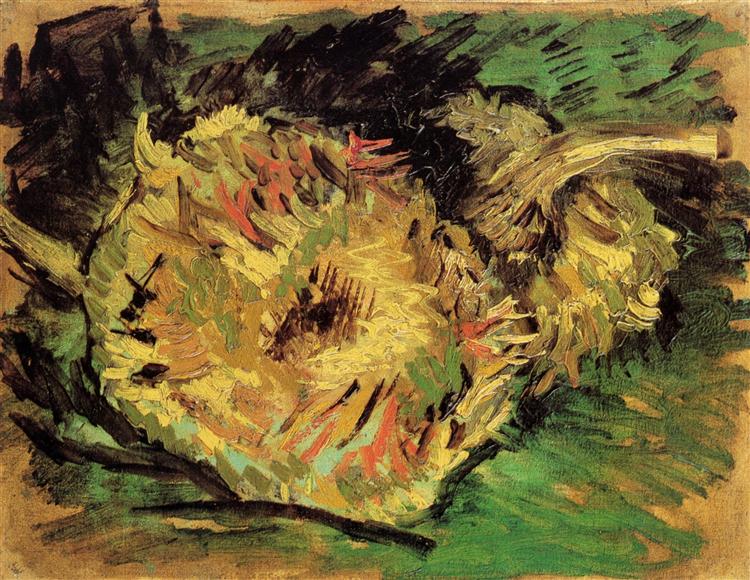
Two Cut Sunflowers (1887) is one of Van Gogh’s lesser-known works from his Paris period, and one of his most honest. You can feel the impression captured in the frenzy of it, the sunflower dissolving into a swirl of brushwork, part sun, part damp soil, caught somewhere between blooming and decay.
The painting now lives at the Van Gogh Museum in Amsterdam. It is quieter than his famous Arles series, but in many ways more revealing, a glimpse into the moment he was still figuring out what the sunflower meant to him.